
- Key insight: Banks are taking advantage of a pullback in the private-credit market, but banks are not as exposed to that pullback as they were in 2008.
- Key number: JPMorganChase has about $50 billion worth of exposure to private credit, a small fraction of its $4.9 trillion balance sheet.
- Forward look: Private credit may have a painful shakeout, but it won’t pull in banks, observers say.
Private credits problems are problems for who exactly?
An interesting trend has emerged out of first-quarter earnings, our Allissa Kline reports. A number of banks have posted strong growth in commercial and industrial (C&I, in the parlance) loans. But the growth may not be necessarily because of a stronger overall market; rather it is because of a pullback in the very troubled private-credit market.
Processing Content
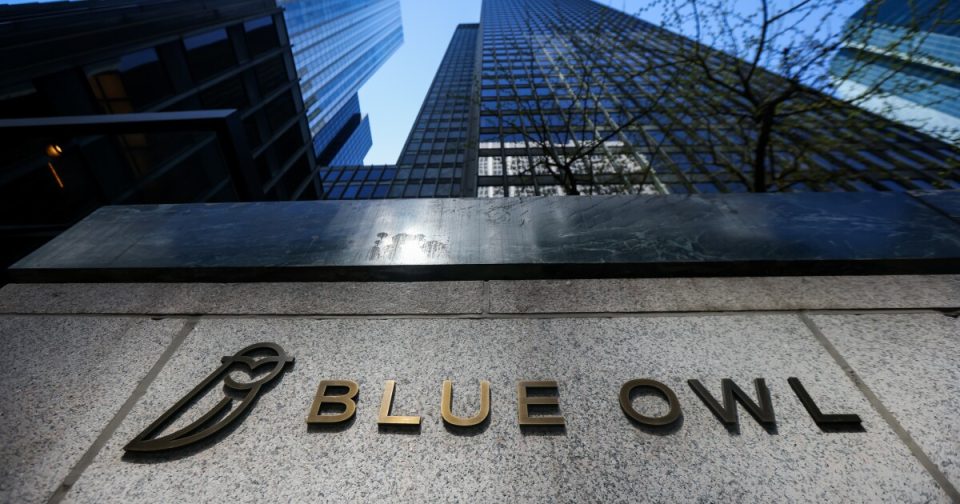
It would be only the latest sign of trouble for private credit, which more and more is feeling like it could be the unstable thing that sparks another financial crisis. The anxiety is most prominently reflected in the shares of alternative-asset manager Blue Owl Capital, shares of which
Blue Owl has come under intense scrutiny because a lot of its business is exposed to the data-center boom that’s resulting from the related boom in artificial intelligence. That’s led to a boom in private credit, which became a $1.8 trillion market.
Private credit – like mortgage-backed securities, collateralized debt obligations and even collateralized debt obligations of collateralized debt obligations (CDOs squared; yes, that was a thing) before it – is an opaque market that deals heavily in leverage. The questions of course, now as then, are exactly how much leverage, and on which balance sheets does the leverage reside? The answers, now as then, are that nobody is quite sure.
Blue Owl dodged the bullet on Wednesday; its earnings beat Street estimates and its batter stock rose sharply. That on its own is not the all-clear signal. The whole sector is getting a “painful but probably necessary shakeout,” analysts at JPMorganChase wrote on Tuesday. How much longer and deeper that goes really will depend upon how the loans on all those private-credit firms’ books perform. And nobody can answer that question quite yet.
Some banks, such as
So private credit may be the canary in the coal mine. But what’s important about that sentence, for this audience at least, is a word that is not in that sentence: banks. The banks’ role as creditors this time around is limited by the very nature of the market. Private credit firms, after all, are not banks. There may be some overlap of risks – I’d mentioned BofA and M&T, and there are others invested in the market as well. But the exposure of the banks is seemingly limited. “Private credit works to shift risk, not amplify it,” a New York banker writing under the pen name D. Ricardo recently argued in the Institutional Risk Analyst newsletter. Private credit may indeed be an unstable market hiding a lot of bad debts that are going to go unpaid and cause a lot of grief and pain.
But the important point for the banking industry is where the exposure lies. JPMorganChase, for instance, has about $50 billion worth of exposure to private credit; that’s tiny compared to its $4.9 trillion balance sheet. “We’re reasonably comfortable with our exposure here,” CFO Jeremy Barnum
This was not the case in 2008. In 2008 you could argue quite persuasively
Of course, there were plenty of people