

Key Takeaways
- Samson Mow argues that Bitcoin treasury firms and spot ETFs are absorbing more BTC than miners can produce.
- Mow says much of the Bitcoin held on exchanges is not truly available for sale.
- The Bitcoin bull believes BTC remains undervalued.
Samson Mow, the outspoken Bitcoin bull and CEO of JAN3, has claimed that a $1 million Bitcoin price is “just around the corner.”
Speaking on The Bitcoin Historian podcast, Mow listed several reasons why he believes Bitcoin could reach seven figures sooner than most people expect.
Here are three reasons Mow believes Bitcoin is not far from reaching the famed $1 million mark.
Relentless Institutional Buying Is Absorbing Supply
Mow’s first major argument centers on structurally committed buyers accumulating Bitcoin regardless of price.
He pointed to Strategy, alongside newer treasury firms and spot Bitcoin ETFs, as entities acting as continuous buyers of Bitcoin.
“These are buyers of last resort. They will always buy Bitcoin. They’re price-insensitive. They will always buy, even if it’s 500,000 a coin or 700,000 a coin,” Mow said.
According to Mow, institutional inflows are already outpacing newly mined supply by a wide margin.
“Even the ETFs are a net buyer over time… they’re already buying a multiple of the mined supply on average,” he said.
He also highlighted Strategy’s preferred-share products, such as STRC.
“STRC is kind of a brilliant product, because it’s stripping away volatility from Bitcoin and sharing upside,” Mow said.
Mow argued there is effectively no limit to how many firms could replicate that model.
Bitcoin’s Tradable Supply Is Much Smaller Than Investors Think
A second pillar of Mow’s thesis is that Bitcoin’s true liquid supply is far lower than headline exchange balances suggest.
He argued that investors wrongly assume millions of coins are readily available for sale, when much of that inventory is already tied up.
“People think there’s 2–3 million coins on exchanges ready for sale,” Mow said.
“That is liquidity, and it is not meant to be just sold and never bought back.”
Mow said the continued rise of ETFs, corporate treasury strategies, and prospective Bitcoin bond issuers will increasingly remove coins from circulation.
“There are only 21 million, and the supply to be mined is less than a million,” he said.
Mow Says Bitcoin Price Is Still Deeply Undervalued
Mow also argued Bitcoin remains materially undervalued despite trading above six figures earlier this cycle.
“Anything under 120,000, 110,000 I think is below fair market value,” he said.
“This is a deep, deep discount right now, and it’s because people don’t really understand Bitcoin.”
He tied that view to inflation-adjusted valuations and stock-to-flow scarcity models, which he believes already imply significantly higher prices.
“Bitcoin needs to be at 111,000, I think, to keep track with inflation over the past four to five years,” Mow said.
Beyond valuation metrics, Mow argued that investors continue to underestimate Bitcoin’s political neutrality in an increasingly unstable geopolitical environment.
“War is when you need neutral money,” he said.
Adding: “You want something that has no counterparty risk, which means nobody can seize it or prevent you from spending it.”
Other $1 Million Bitcoin Price Predictions Continue to Emerge
Mow’s comments come amid a broader wave of seven-figure Bitcoin forecasts from investors, analysts, and researchers.
A recent peer-reviewed academic paper published in the Journal of Risk and Financial Management projected Bitcoin could reach $1 million by early 2027 under high-demand scenarios driven by institutional accumulation.
The study, titled “A Supply and Demand Framework for Bitcoin Price Forecasting,” modeled Bitcoin’s fixed supply against increasing withdrawals into ETFs and sovereign reserves.
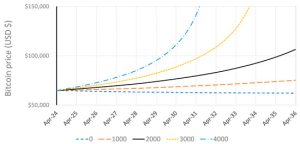
Under its most aggressive demand scenarios, the model forecast Bitcoin reaching $1 million by early 2027, $2 million later that year and potentially $5 million by 2031.
The researchers concluded that Bitcoin’s capped supply fundamentally differentiates it from traditional assets.
Mow Says Nation-State Competition Could Accelerate The Move
Mow also suggested sovereign accumulation could become the next catalyst in Bitcoin’s rise.
“Time is really limited,” he said. “The timeframe at which you can accumulate, especially at these prices, is dropping very rapidly.”
He compared the current environment to a competitive race among corporations seeking to acquire larger Bitcoin reserves.
“Every company that’s accumulating Bitcoin is kind of trying to outdo each other and race up the leaderboards for who has the most bitcoin,” Mow said.
For Mow, that competition ultimately points toward a rapid repricing once available supply dries up.
“There are multiple big entities scooping up Bitcoin like you wouldn’t believe, with no intention to stop and no sensitivity to the price,” he said. “So, if you don’t believe in $1 million bitcoin, good luck, but it’s coming.”

Kurt Robson is a London-based reporter at CCN, specialising in the fast-moving worlds of crypto and emerging technology. He began his career covering local news in Cornwall after graduating from Falmouth University with First Class Honours in Journalism. There, he cut his teeth on everything from council meetings to missing swans.
He quickly rose through the ranks to become a frontline journalist at several of the UK’s leading national newspapers. Over the years, he has interviewed musicians and celebrities, reported from courtrooms and crime scenes, and secured multiple front-page exclusives.
Following the upheaval of the COVID-19 pandemic, Kurt shifted his focus to technology journalism—just ahead of the AI boom. With a natural curiosity and a trained eye for emerging trends, he has found a new rhythm in reporting on innovation.
At CCN, Kurt’s work focuses on the cutting edge of crypto, blockchain, AI, and the evolving digital world. Drawing on his background in people-first reporting and his deep interest in disruptive tech, Kurt delivers stories that are insightful, entertaining, and human-centric.