
What is the GSE battery swapping market forecast to be worth by 2036?
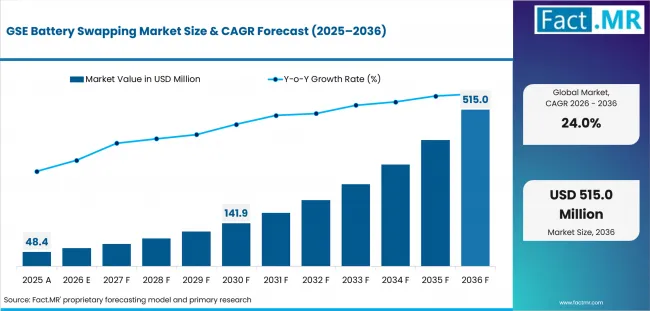
USD 60 million in 2026 to USD 515 million by 2036, at 24.0% CAGR.
- The GSE battery swapping market reached USD 48.4 million in 2025.
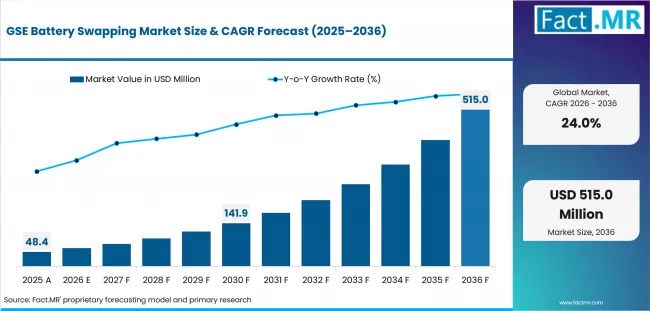
- Market value is projected to increase to USD 60 million in 2026 before reaching USD 515 million by 2036.
- The market is forecast to expand at a 24.0% CAGR during the forecast period as airports accelerate fleet electrification and seek faster charging alternatives for daily operations.
What are the defining numbers behind GSE battery swapping market growth?
USD 455 million absolute opportunity by 2036, supported by airport electrification and higher electric GSE deployment.
- Demand Drivers in the Market
- Airports continue replacing diesel-powered support vehicles with electric fleets.
- Ground handlers seek faster battery replacement to reduce equipment downtime.
- Airline sustainability programs encourage investment in electric ground operations.
- Higher airport traffic increases demand for continuous fleet availability.
- Key Segments Analyzed
- By Swap System: Automated cabinets are expected to account for 38.0% share in 2026 because they reduce battery replacement time and improve operational efficiency.
- By Battery Type: Lithium-ion packs are projected to hold 41.0% share in 2026 as they deliver higher energy density and longer operating life.
- By GSE Application: Baggage tractors are forecast to represent 32.0% share in 2026 because they operate continuously across airport terminals.
- By Buyer Type: Ground handlers are expected to capture 35.0% share in 2026 as they manage large electric GSE fleets across daily airport operations.
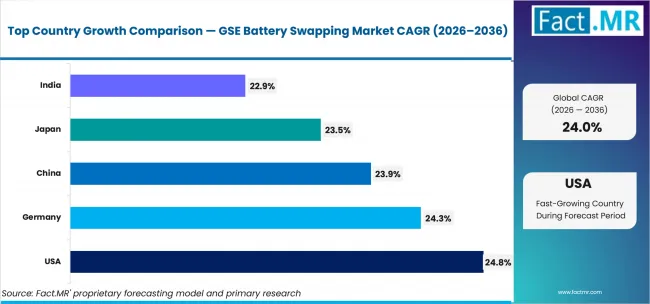
- By Geography: The United States is projected to record 24.8% CAGR through 2036 as airport fleet electrification continues expanding.
- Analyst Opinion at Fact.MR
- Shambhu Nath Jha, Senior Analyst at Fact.MR, states, “Battery swapping offers airports a practical way to improve electric fleet productivity without extending vehicle downtime. Suppliers that deliver dependable battery systems with standardized designs are expected to strengthen their market position as airport electrification accelerates.”
- Strategic Implications
- GSE manufacturers should develop standardized battery modules across multiple vehicle platforms.
- Airport operators should include battery swapping within long term electrification plans.
- Fleet operators should optimize battery inventory to improve equipment availability.
- Technology providers should strengthen battery monitoring software to improve lifecycle management.
Battery swapping systems allow depleted batteries to be replaced within minutes instead of waiting for charging. The approach improves equipment utilization and reduces operational delays across baggage handling, aircraft servicing and cargo movement. Swappable batteries also support better fleet scheduling during peak airport activity.
Demand continues rising because airports are replacing diesel powered support vehicles with electric alternatives. Higher aircraft traffic creates greater pressure to keep ground fleets available throughout the day. Battery swapping provides a practical solution where charging time may interrupt operations. Advances in lithium battery technology also improve system reliability and battery life.
The United States is projected to record 24.8% CAGR through 2036 because airports continue expanding electric GSE fleets. Germany is expected to achieve 24.3% CAGR through airport decarbonization programs. China is likely to register 23.9% CAGR through large scale airport infrastructure investment. Japan is forecast to grow at 23.5% CAGR through airport modernization projects. India is anticipated to record 22.9% CAGR as electric ground support equipment adoption increases.
How does the GSE battery swapping market break down by segment?
Automated cabinets lead at 38.0%. Lithium ion packs lead at 41.0%.
Which swap system dominates?
Automated cabinets hold 38.0% share in 2026.
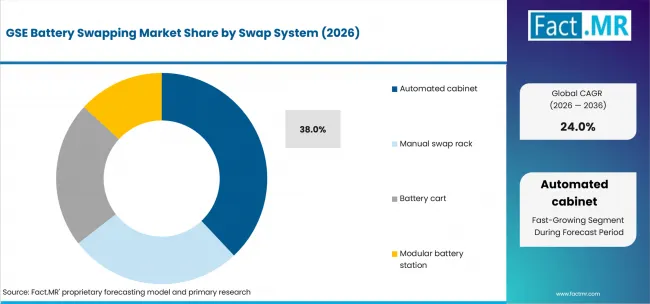
Automated cabinets are expected to account for 38.0% share in 2026 because they replace batteries quickly with minimal manual effort. Fast exchange improves equipment availability during busy airport operations. Manual swap racks remain suitable for smaller fleets. Battery carts improve flexibility across terminals. Modular battery stations support future fleet expansion. The International Air Transport Association (IATA) launched its Enhanced GSE Recognition Program to accelerate deployment of electric and advanced GSE. The initiative promotes electrically powered GSE and encourages adoption of technologies that simplify fleet electrification, including modern battery-powered equipment that can support modular battery operations.
Which battery type dominates?
Lithium ion packs lead with 41.0% share in 2026.
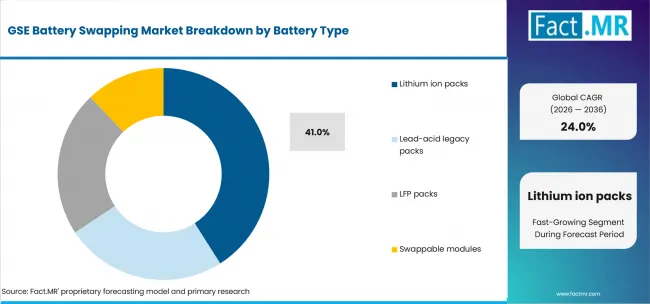
Lithium ion packs are projected to capture 41.0% share in 2026 because they provide longer operating time and faster charging than legacy technologies. Lower maintenance also improves fleet efficiency. LFP packs gain demand through improved safety and cycle life. Swappable modules simplify battery replacement. Lead acid legacy packs continue serving older airport fleets. Swissport announced a new procurement policy requiring electric-powered versions for many new GSE purchases beginning in 2025. The large-scale transition increases demand for battery-powered airport GSE, creating opportunities for fast battery replacement and battery-swapping solutions to maximize equipment uptime.
Which GSE application dominates?
Baggage tractors hold 32.0% share in 2026.
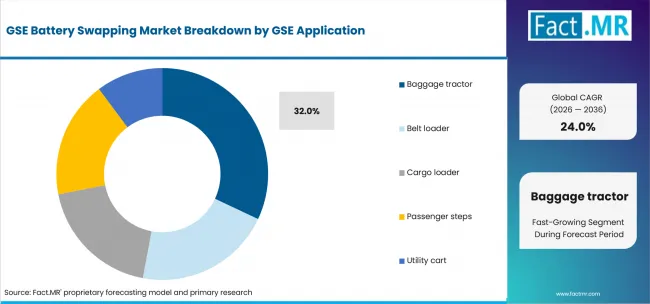
Baggage tractors remain the largest application because they operate throughout the day across airport aprons and terminal areas. The segment is expected to account for 32.0% share in 2026. Belt loaders require dependable battery availability. Cargo loaders support freight operations. Passenger steps continue shifting toward electric models. Utility carts strengthen demand across airport support services. Oshkosh AeroTech introduced the Battery-Powered AmpCart™, a battery-powered mobile ground power solution for airports. The launch demonstrates continued industry movement toward battery-operated GSE where modular battery replacement and future battery-swapping concepts can reduce downtime.
Which deployment dominates?
GSE depots lead with 37.0% share in 2026.
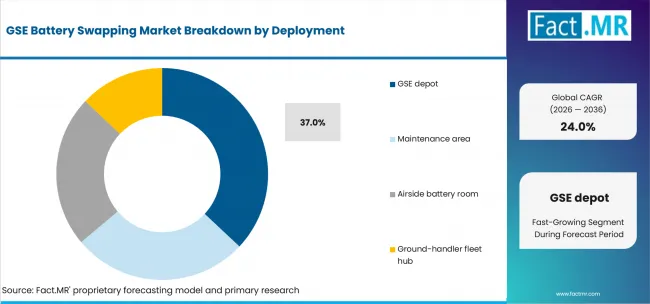
GSE depots are expected to account for 37.0% share in 2026 because centralized fleet management improves battery replacement efficiency. Depot based systems also simplify maintenance and battery storage. Maintenance areas support servicing operations. Airside battery rooms improve access near operating zones. Ground handler fleet hubs strengthen daily battery logistics. Green Cubes Technology launched a new Lithium Iron Phosphate (LFP) battery specifically engineered for airport Ground Support Equipment (GSE), including baggage tractors, belt loaders, aircraft tugs, and cargo handling vehicles.
Which buyer type dominates?
Ground handlers lead with 35.0% share in 2026.
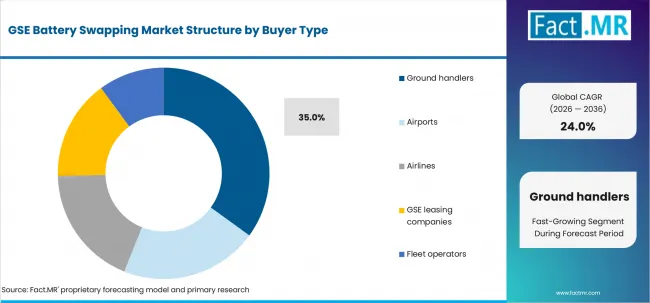
Ground handlers remain the largest customer group because they operate extensive fleets across multiple airport functions. The segment is expected to account for 35.0% share in 2026. Airports continue investing in cleaner operations. Airlines electrify support equipment. GSE leasing companies expand electric fleet offerings. Fleet operators improve battery utilization across airport sites. Electrovaya announced the launch of multiple lithium-ion battery system products designed specifically for airport GSE applications, including airplane tuggers, baggage tractors, belt loaders, and cargo loaders.
What is accelerating GSE battery swapping adoption, and what is holding it back?
Airport electrification supports market growth while battery standardization remains a challenge.
Drivers Impact Analysis
| DRIVER | (~) % IMPACT ON CAGR | GEOGRAPHIC RELEVANCE | IMPACT TIMELINE |
|---|---|---|---|
| Airport fleet electrification | +1.4% | Global | Medium term (2-4 years) |
| Higher demand for rapid battery exchange | +1.1% | North America, Europe | Medium term (2-4 years) |
| Growth of lithium battery adoption | +0.9% | Global | Long term (≥4 years) |
| Airport sustainability programs | +0.7% | Europe, Asia Pacific | Medium term (2-4 years) |
| Expansion of automated fleet management | +0.5% | Global | Short term (≤2 years) |
- Airport fleet electrification
- Airports continue replacing diesel powered equipment with electric alternatives. Battery swapping supports uninterrupted daily fleet operation.
- Rapid battery exchange
- Ground handling companies require equipment that returns to service within minutes. Fast battery replacement improves operational efficiency.
- Lithium battery adoption
- Lithium batteries provide longer service life and better energy performance than older technologies. Fleet operators continue increasing adoption.
- Airport sustainability programs
- Airport operators continue reducing emissions through electric vehicle deployment. Battery swapping strengthens the value of electric GSE fleets.
- Automated fleet management
- Digital fleet platforms improve battery tracking and equipment scheduling. Better visibility increases fleet utilization.
Opportunity Impact Analysis
| OPPORTUNITY | (~) % IMPACT ON CAGR | GEOGRAPHIC RELEVANCE | IMPACT TIMELINE |
|---|---|---|---|
| Standardized battery platforms | +0.9% | Global | Long term (≥4 years) |
| Airport expansion projects | +0.8% | Asia Pacific, Middle East | Medium term (2-4 years) |
| Battery as a service models | +0.6% | North America, Europe | Medium term (2-4 years) |
| AI based fleet optimization | +0.5% | Global | Short term (≤2 years) |
- Standardized battery platforms
- Common battery formats simplify fleet management across multiple equipment types. Operators also reduce inventory complexity.
- Airport expansion projects
- New airport terminals increasingly include electric ground equipment from the planning stage. Battery swapping stations benefit from these projects.
- Battery as a service models
- Subscription based battery supply reduces capital investment for fleet operators. Flexible contracts also improve battery availability.
- AI based fleet optimization
- Intelligent software predicts battery demand and schedules replacement efficiently. Better planning improves equipment readiness.
Restraints Impact Analysis
| RESTRAINT | (~) % IMPACT ON CAGR | GEOGRAPHIC RELEVANCE | IMPACT TIMELINE |
|---|---|---|---|
| Lack of battery standardization | -0.8% | Global | Medium term (2-4 years) |
| High infrastructure investment | -0.6% | Emerging airports | Medium term (2-4 years) |
| Battery inventory management | -0.4% | Global | Short term (≤2 years) |
| Limited retrofit compatibility | -0.3% | Older airport fleets | Long term (≥4 years) |
- Lack of battery standardization
- Different vehicle manufacturers often use different battery formats. This limits compatibility across mixed airport fleets.
- High infrastructure investment
- Battery swapping stations require dedicated equipment and storage facilities. Initial deployment costs remain significant.
- Battery inventory management
- Operators must maintain sufficient charged batteries to support daily operations. Inventory planning adds operational complexity.
- Limited retrofit compatibility
- Older electric GSE models may require modification before supporting battery swapping technology. Fleet upgrades can increase implementation costs.
Which countries are scaling GSE battery swapping infrastructure fastest?
United States 24.8%; Germany 24.3%; China 23.9%; Japan 23.5%; India 22.9%.
Based on regional analysis, the GSE battery swapping market is segmented into North America, Europe, East Asia, South Asia, Middle East and Africa and Latin America.
| Country | CAGR |
|---|---|
| United States | 24.8% |
| Germany | 24.3% |
| China | 23.9% |
| Japan | 23.5% |
| India | 22.9% |
What is driving demand in the United States?
24.8% CAGR, supported by airport electrification and fleet modernization.
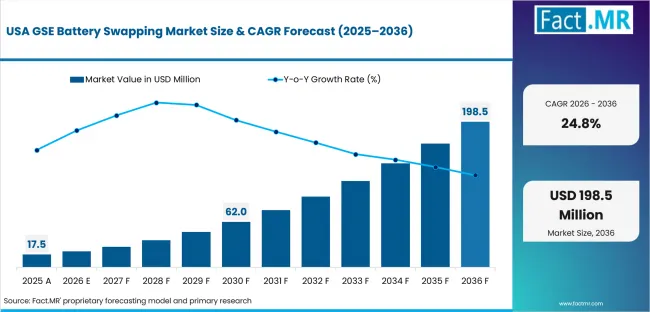
The United States is projected to record 24.8% CAGR from 2026 to 2036 as airports continue replacing diesel powered ground support equipment with electric fleets. Ground handling companies are investing in battery swapping systems that reduce vehicle downtime. Airport expansion and sustainability programs also strengthen long term demand.
Why is Germany building strong market momentum?
24.3% CAGR, backed by airport decarbonization projects.
Germany is expected to achieve 24.3% CAGR through 2036 because airport operators continue expanding low emission ground operations. Electric baggage tractors and service vehicles create greater demand for efficient battery replacement systems. Standardized fleet management also supports wider deployment.
What supports China’s market expansion?
23.9% CAGR, driven by airport infrastructure growth.
China is forecast to expand at 23.9% CAGR as large airports continue increasing electric GSE deployment. Battery swapping improves equipment availability during periods of heavy aircraft movement. Continued investment in airport modernization also creates additional opportunities.
Why is Japan strengthening market demand?
23.5% CAGR, backed by operational efficiency.
Japan is likely to register 23.5% CAGR by 2036 because airport operators continue improving fleet efficiency through electrification. Automated battery exchange systems reduce service interruptions while supporting reliable ground operations. Technology driven airport upgrades also strengthen equipment demand.
How is India creating future opportunities?
22.9% CAGR, supported by airport capacity expansion.
India is expected to record 22.9% CAGR as commercial airports continue expanding infrastructure and adopting electric support vehicles. Ground handlers are improving fleet productivity through faster battery replacement. Continued aviation investment is expected to strengthen long term market growth.
Who leads the GSE battery swapping market?
TLD; Charlatte; Textron GSE; Oshkosh AeroTech; Goldhofer shape competitive positioning.
The market includes airport ground support equipment manufacturers, battery technology companies and airport electrification specialists. TLD continues strengthening its position through electric ground support equipment designed for high utilization airport fleets. Charlatte expands its presence with electric baggage tractors and utility vehicles that support battery powered airport operations.
Goldhofer continues expanding its electric tow tractor portfolio for modern airport fleets. Flux Power strengthens competition through lithium battery systems developed for industrial vehicle applications including airport equipment.
Competition increasingly depends on battery compatibility and service support. Airport operators seek suppliers that reduce operating delays while simplifying battery management. Companies offering standardized battery platforms and dependable technical support are expected to strengthen their market position.
Which companies are the key providers?
TLD and Charlatte are leading providers. Oshkosh AeroTech remains established participant. Goldhofer and Flux Power complete the competitive landscape.
- TLD
- Charlatte
- Oshkosh AeroTech
- Goldhofer
- Flux Power
Bibliography
- International Air Transport Association. (2024, May 8). IATA initiative to accelerate transition to Enhanced GSE. International Air Transport Association.
- Swissport International. (2024, September 13). Swissport accelerates shift to electric vehicles. Swissport International.
- Oshkosh AeroTech. (2025, September 30). Oshkosh AeroTech debuts battery-powered AmpCart™ solution. Oshkosh AeroTech.
- Green Cubes Technology. (2024, September 12). Green Cubes Technology unveils new Li-ion battery for ground support equipment. Green Cubes Technology.
- Electrovaya Inc. (2025, July 29). Electrovaya launches battery system products for airport ground support equipment (GSE) with first delivery in August to a major OEM supplier. Electrovaya Inc.
This Report Addresses
- Strategic assessment of battery swapping infrastructure for electric airport ground support equipment.
- Segment evaluation covering Automated Cabinets and Lithium-ion Packs.
- Country outlook for the United States, Germany, China, Japan and India.
- Competitive review of TLD, Charlatte, Textron GSE, Oshkosh AeroTech, Goldhofer and Flux Power.
- Technology assessment covering automated swap systems, modular battery stations, lithium battery platforms and fleet management software.
- Operational assessment covering baggage tractors, belt loaders, cargo loaders, passenger steps and utility carts.
- Market estimates supported by airport electrification trends, fleet replacement analysis and primary industry interviews.
What does the GSE battery swapping market cover?
Battery exchange systems developed for airport ground support equipment.
The market includes manual swap racks, automated cabinets, battery carts and modular battery stations designed for electric airport vehicles. These systems reduce charging downtime while supporting continuous fleet operation.
The assessment focuses on battery swapping infrastructure used with airport ground support equipment. Conventional plug in charging systems without battery exchange capability remain outside the market scope.
What is included in the scope?
Battery replacement infrastructure supporting electric airport operations.
The study covers lead acid legacy packs, lithium ion packs, LFP packs and swappable battery modules. It also includes deployment across GSE depots, maintenance areas, airside battery rooms and ground handler fleet hubs.
Applications include baggage tractors, belt loaders, cargo loaders, passenger steps and utility carts. The study evaluates products supplied to ground handlers, airports, airlines, GSE leasing companies and fleet operators.
What is excluded from the scope?
Airport charging equipment without battery swapping capability is excluded.
The assessment excludes conventional EV charging stations, onboard battery management systems, stationary energy storage and airport power infrastructure supplied without battery exchange systems. Aircraft propulsion batteries are also outside the study scope.
How was the analysis built?
111+ sources, 42+ company portfolios, 30+ countries, 25+ interviews.
- Primary Research:
- Airport operators, ground handling companies, GSE manufacturers and battery technology specialists contributed operational and technical insights. Fleet managers also supported market validation.
- Desk Research:
- The study reviewed airport electrification projects, company product portfolios, aviation sustainability programs and fleet modernization initiatives. Public investment announcements strengthened market assessment.
- Market Sizing and Forecasting:
- Forecasts were prepared using airport electrification spending, electric GSE deployment, battery replacement demand and fleet expansion across major aviation markets.
- Data Validation and Update Cycle:
- Forecasts were verified through supplier interviews, airport project tracking and expert review. Procurement activity and fleet conversion trends supported the final market estimates.