

Africa produces approximately 60% of the world’s raw cashews, yet much of the value created through processing, branding, packaging, and distribution is captured elsewhere in the global supply chain.
For Lloyd Ward and the team at Ward Holdings International, that imbalance became the starting point for building a different model.
Starting With the Market Instead of the Commodity
Ward Holdings International, a U.S.-based global enterprise founded in 2018 and operating through subsidiary entities in Tanzania and across Africa, developed what it calls Sustainable Market-Driven Industrialization, or SMDI.
The model begins with a full mapping of the global cashew supply chain from farm to consumer, identifying where value is created and where it is captured.
“The first thing we did was map the global cashew industry from farm to consumer and lay out every step,” Ward said. “What we discovered wasn’t unique to cashews. We saw the same pattern across cocoa, vanilla, avocados, cassava, and many other crops.”
What Ward Holdings found mirrors what plays out across agricultural commodities globally: the farm creates enormous value, but the processing, branding, and distribution infrastructure that converts that value into margin often sits elsewhere.
The insight behind SMDI is that producers consistently monetize at the lowest point of the value chain because supply chains are organized around pushing product to the next step rather than engineering backward from what the market will actually pay for.
“For maximum benefit, the market should pull production forward, not the other way around,” Ward said. “They only see the next step in the supply chain. They don’t understand the markets that they serve.”
Ward Holdings reversed that sequence. The company starts with the consumer market, reverse engineers the value chain from there, and then builds the operational infrastructure required to supply it.
The Africa 20|20 Vision
The company’s long-term vision is expressed through what Ward calls Africa 20|20 — the belief that Africa can contribute 20 percent of global GDP within the next 20 years through greater industrialization, value creation, and direct participation in global markets.
For Ward, SMDI is the mechanism through which that vision becomes practical. The model is designed to move African producers beyond commodity exports and into processing, branding, and direct participation in global consumer markets.
“We want to be remembered as the first successful activation of a new trade corridor connecting African producers directly to consumers around the world,” Ward said. “This corridor is designed to help Africa capture more of the value created from its own resources, talent, and entrepreneurship.”
The vision behind Ward Holdings was shaped by careers spent outside agriculture.
Before founding the company, Lloyd D. Ward held leadership roles at Procter & Gamble, PepsiCo, and Frito-Lay before later serving as CEO of Maytag Corporation. His co-founder, Martin W. Johnson, spent two decades in banking, most recently as President of Regions Bank’s Central Louisiana market.
Neither came from agriculture.
“We didn’t choose agriculture,” Ward said. “Agriculture chose us.”
What They Built
The company built infrastructure inside Africa, starting in Tanzania, and structured it so that every participant in the supply chain has an economic stake in its performance.
The model extends beyond processing. It is designed to identify sources of value that have historically remained outside African markets and reconnect them to participants within the supply chain.
One example is cashew nutshell liquid. When a raw cashew nut is processed, the shell can be mechanically pressed to extract an industrial oil representing roughly 20 percent of the shell’s weight. According to Ward, India and Vietnam have monetized this byproduct for decades while many processors in Tanzania have not participated in that value stream.
Ward believes opportunities like this exist throughout the agricultural value chain.
“We leapfrog all that,” he said. “We don’t go to the next step in the supply chain. We go to the market.”
Ward Holdings intends to capture this secondary stream and route a share of it back to the processors who provide the shells, creating an additional revenue opportunity within the supply chain.
Uncommon Delights and the U.S. Market Entry
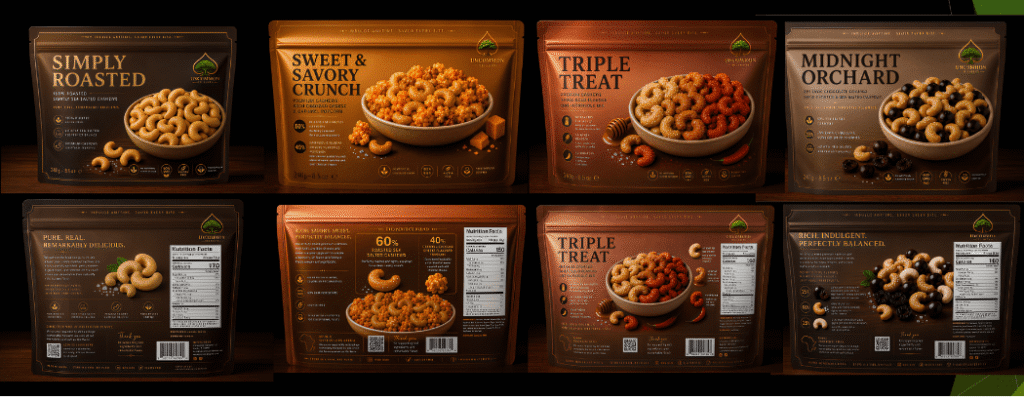
The first commercial vehicle for the SMDI model entering the U.S. market is Uncommon Delights, a premium cashew brand built around four distinct product lines.
Ward believes there is an opportunity to build a dominant global cashew brand, a gap he says exists within the category.
Rather than compete as another commodity snack product, the company built Uncommon Delights around distinct consumption experiences designed to establish a recognizable category position.
“Our vision is not simply to sell cashews,” Ward said. “Our vision is to create amazing consumption experiences built around cashews, one of the world’s most versatile and nutritious foods.”
Along with Simply Roasted, a premium roasted and lightly salted offering designed for cashew purists, Uncommon Delights includes Midnight Orchard, which combines cashews, dark chocolate, and dried cherries. Triple Treat brings together traditional, honey-roasted, and Sriracha-seasoned cashews in a single package, while Sweet & Savory Crunch pairs cashews with cheddar cheese and caramel-coated popcorn.
According to Ward, each product was designed around a distinct consumption experience rather than competing on commodity pricing.
The Trade Corridor
Uncommon Delights is entering the U.S. market through a trade corridor Ward Holdings has been building as the logistics infrastructure connecting African producers directly to global consumers.
The company is approaching the inaugural activation of the corridor, with the first shipment of Uncommon Delights serving as the operational proof of the model.
For Ward Holdings, the corridor is not simply a logistics route.
“It’s not simply exporting cashews but delivering finished consumer products from Africa directly to global consumers,” Ward said.
Products often pass through multiple intermediaries before reaching the end customer. Ward Holdings’ objective is to reduce that distance between producer and consumer while retaining more value within the ecosystem creating the product.
“The first shipment of Uncommon Delights isn’t just a product launch,” Ward said. “It’s the opening of a new trade corridor.”
Ward Holdings has financed development primarily through private sources while building the underlying supply chain and trade infrastructure. The company is now pursuing additional capital to expand the model beyond its initial launch markets.
What Comes Next
Ward emphasized that while the company’s mission is ambitious, success ultimately depends on consumers.
“We are mission-driven, but we understand a simple truth: missions do not win markets. Consumers do,” Ward said. “We earn success by creating products consumers love, brands they trust, and experiences they want to enjoy again and again.”
Uncommon Delights is the first commercial product moving through the corridor.
Ward Holdings views the launch as a proof point for a broader model that can be applied across additional crops, brands, and markets.
“The future of Africa is not commodity extraction,” Ward said. “The future of Africa is value creation.”
For Ward, success will not be measured solely by sales of Uncommon Delights. It will be measured by whether African producers, processors, entrepreneurs, and brands capture a greater share of the value they create.
The launch of Uncommon Delights is intended to demonstrate that model in action.