
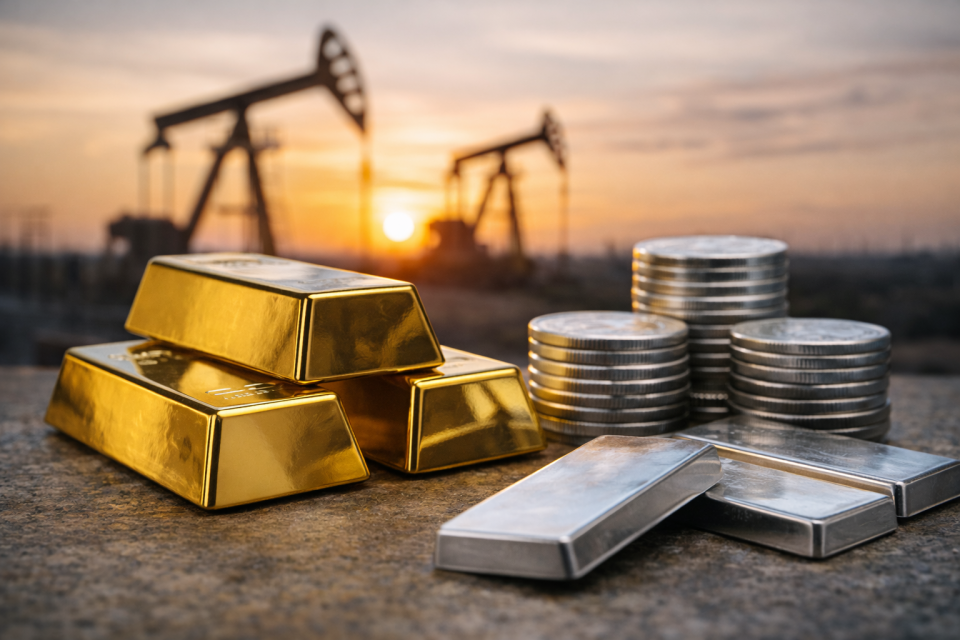
Oil prices tumbled more than 8% on Wednesday, while gold jumped above $4,700 per ounce as hopes of an end to the US-Iran war influenced the markets.
Gold on COMEX breached the $4,700 per ounce level for the first time since April 24 as energy prices tumbled, easing concerns about higher inflation and interest rates.
Silver prices on COMEX also surged more than 6% to above $78 per ounce.
Global economic sentiment improved following signs of the US attempting to de-escalate the conflict in Iran, driving copper prices higher for the third consecutive session.
Meanwhile, aluminium slipped more than 1.5% as supply concerns eased.
Gold jumps to over 1-week high
Following reports of a potential peace agreement between the US and Iran, gold prices rose to a more than one-week high on Wednesday.
This news alleviated concerns about persistent high inflation and a prolonged era of elevated interest rates.
At the time of writing, the COMEX gold contract was at $4,709.30 per ounce, up 3.1%, and had risen to $4,733.86 earlier in the day, its highest level since April 24.
Silver was up 5.9% at $77.895 per ounce.
“The move was closely correlated to the downside move in the US dollar,” said David Morrison, senior market analyst at Trade Nation.
“Investors began to cut their long side dollar positions as it became apparent that the Trump administration was winding down its operations to escort shipping through the Strait of Hormuz.”
The 0.5% drop in the US dollar index resulted in a lower cost for greenback-priced metals for holders of other currencies.
Risk appetite saw a resurgence as oil prices dropped by approximately 9%.
This shift was prompted by reports that the US and Iran were nearing an agreement on a one-page memo to end their conflict, leading to the dollar selling off further while gold received an additional boost.
“It’s unclear what may be in the agreement, especially concerning the reopening of the Strait of Hormuz. But investors seem confident that, ten weeks into the war, an end to hostilities may be in sight,” Morrison said.
Rising energy costs, upward inflationary pressure, and a strengthening US dollar had collectively exerted sustained downside pressure on silver prices during the conflict.
Today’s sharp pullback in oil prices has provided some relief, though the outlook remains sensitive to both central bank policy and geopolitical developments.
Oil tumbles over 8%
Oil prices hit a two-week low on Wednesday, following a report from a Pakistani source that the United States and Iran were close to an initial peace agreement.
According to a source in Pakistan, which is acting as a mediator, the United States and Iran are nearing a consensus on a one-page memorandum of understanding.
Iran is currently reviewing a new proposal from the US and will communicate its response shortly via Pakistan, an Iranian foreign ministry spokesperson told the country’s ISNA news agency on Wednesday.
This development follows Iran’s previous statement that it would only accept a “fair and comprehensive agreement.”
US media outlet Axios, citing sources, reported that America expects Iran’s feedback on several key points within 48 hours.
This was described as the closest the two parties have come to an agreement since the war began.
However, a senior Iranian MP later stated that the US proposal was “more of a wish list than a reality.”
At the time of writing, Brent crude oil was at $101.59 per barrel, down 7.5%. West Texas Intermediate crude fell below $90 a barrel briefly, but was last at $94.92 a barrel, down 7.19%.
Both crude contracts hit a two-week low, with Brent touching an intra-session low of $96.77, before recovering losses after US President Donald Trump remarked that it was “too soon” to consider face-to-face talks with Tehran.
Copper rises
Global economic sentiment improved, bolstering copper prices for a third consecutive session, due to indications that the US is seeking to de-escalate the conflict in Iran.
The White House’s changing rhetoric has sparked hope that the nine-week-long conflict, which has raised the specter of a devastating energy crisis, may soon conclude.
“Copper is likely to stay headline-driven, with stronger physical demand or inventory drawdowns needed for a more sustained move higher,” Ewa Manthey, commodities strategist at ING Economics, said in a note.
A prolonged closure of the Strait of Hormuz poses the primary risk to metals.
Such an event would increase energy costs and inflation, ultimately weighing on manufacturing demand.
This pressure would, in turn, limit the potential upside for industrial metals.
The three-month copper contract on the London Metal Exchange was at $13,361.85 per ton, up 2.0% from the previous close.