
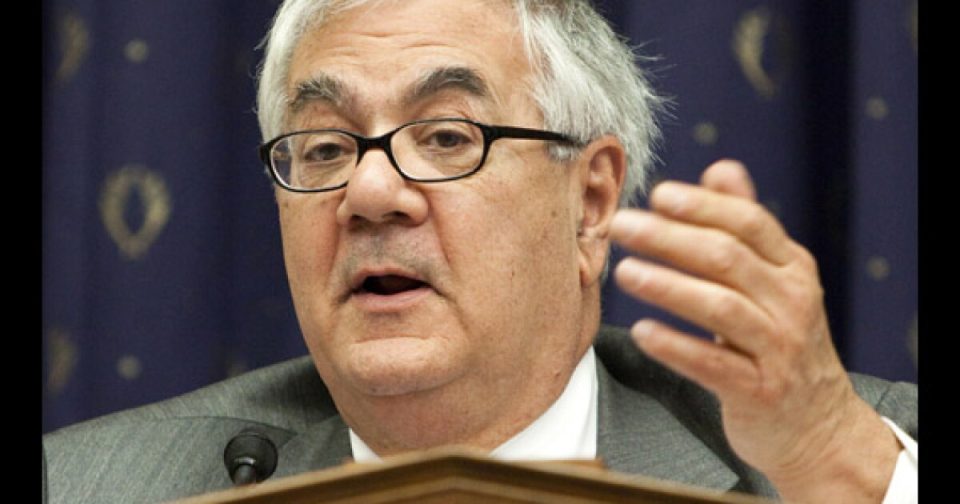

Barney Frank, a former congressman who died at age 86 on May 19, is being remembered as an architect of sweeping U.S. financial reform legislation that reshaped the municipal securities market’s regulatory framework and for being a muni market ‘champion.’
Processing Content
“Congressman Frank had a profound influence on the municipal market through his signature legislation – the Dodd-Frank Act,” Lynnette Kelly, a former president and CEO of the Municipal Securities Rulemaking Board, said Wednesday. “Notably, the act brought municipal advisors under regulation for the first time imposing on them a federal fiduciary duty to their state and local government clients.”
Kelly was serving as the MSRB’s executive director when what’s known more formally as the Dodd-Frank Wall Street Reform and Consumer Protection Act was signed into law by then President Barack Obama on July 21, 2010. Dodd-Frank was enacted to promote the financial stability of the United States in the wake of the 2008 financial crisis, the worst financial crisis since the Great Depression.
The legislation is named after former U.S. Senator Christopher Dodd, who at the time of its enactment was chairman of the Senate Banking Committee, and Frank. A member of the U.S. House of Representatives from Massachusetts who served from 1981 to 2013, Frank, a Democrat, was chairman of the House Financial Services Committee from 2007 to 2011.
“The act also established the Office of Municipal Securities at the [Securities and Exchange Commission] for more focused attention to our market,” Kelly said. “Additionally, and somewhat controversially, Dodd-Frank expanded the MSRB’s mandate to protect municipal issuers and obligated persons, in addition to investors, which influences the rulemaking and other activities of the MSRB.”
While the office had existed previously as part of the SEC’s Division of Trading and Markets, Dodd-Frank called for the creation of a stand-alone Office of Municipal Securities headed by a director who reports to the SEC’s chairman.
Emily Brock, director of the Government Finance Officers Association’s Federal Liaison Center, said that in his “long and impactful tenure” as a congressman and as chair of the House Financial Services Committee, Frank “worked to craft [a] pivotal legislative framework for the municipal securities market and the protection of issuers.”
“The chairman worked to ensure that municipal advisors have a federal fiduciary duty to issuers of municipal securities and strengthened swap regulations, in addition to numerous other provisions in the act and in other laws that impact many aspects of public finance today, all while noting his fondness for, and investments in, municipal bonds,” Brock said of Frank in comments Wednesday.
The former Massachusetts congressman “was a true champion for the municipal bond market – and all things built by bonds – a legacy of which he will be long remembered,” she said.
Susan Gaffney, executive director of the National Association of Municipal Advisors, also noted Frank’s impact on the muni industry in comments Wednesday.
“Chairman Frank led many muni aspects of the [Dodd-Frank Act] negotiations not only as a legislator, but also from the point of view of his experience working at the state and local government levels earlier in his career,” Gaffney said.
In addition, as he frequently stated during hearings, Frank “was a big proponent of munis as an investor,” she said.
“His efforts leading the regulatory framework around many muni areas, especially with MAs and establishing the federal fiduciary duty, is a long lasting legacy that has made the MA profession and the market better,” Gaffney said.
The provision to regulate previously unregulated MAs “was certainly one of the most impactful aspects of Dodd-Frank,” said Martin J. Luby, an associate professor and faculty director of the Center on Municipal Capital Markets at the Lyndon B. Johnson School of Public Affairs at the University of Texas at Austin.
“The new duty of care required under this regulatory framework has enhanced the professionalization and competencies of the financial firms and their professionals that provide advice to municipal issuers,” Luby said Wednesday. “The duty of loyalty imposed on municipal advisors has mitigated conflicts of interest problems.”
Some research has shown that those developments have yielded benefits for municipal issuers in the form of lower borrowing costs, he said.
“At the same time, it has also led to significant firm consolidation in the municipal advisory industry as well as a reduction in municipal advisor professionals participating in the market,” Luby said.
Frank’s influence on the muni market “is considerable, and perhaps a bit underappreciated,” said Justin Marlowe, a research professor in the University of Chicago Harris School of Public Policy, where he also serves as director of the school’s Center for Municipal Finance.
“Dodd-Frank’s municipal advisor rule was structural change for the municipal market,” said Marlowe, who added that “several academic research papers have shown that the fiduciary duty on municipal advisors” reduced borrowing costs for many issuers.
“The robustness of today’s independent municipal advisor sector is further testament to how Dodd-Frank shifted the incentives in that part of the industry,” Marlowe said in comments provided Thursday.
However, the legacy of other parts of the act “is more mixed,” he said. “The prop trading rules, advisor registration requirements and bank liquidity rules remain something of a work in progress even today.”
That’s Rep. Frank’s real legacy in the muni market, Marlowe believes.
“Dodd-Frank pulled the municipal market into the larger federal regulatory structure for banking and financial services. Some parts of that shift have worked well. Others less so,” he said. “But there’s no question that since Dodd-Frank, the municipal market is no longer seen as outside the scope of direct federal regulation.”
Former Senator Dodd, a Democrat who represented Connecticut, said he was “deeply saddened,” by Frank’s passing, according to a statement provided to The Bond Buyer on Wednesday.
“Barney came to Congress in 1981, the same year I came to the Senate, but it was during the financial crisis of 2007-2010 – through three years of long days and nights working together as chairs of the Senate Banking and House Financial Services Committees – that he became a dear friend and a trusted partner,” Dodd’s statement said. “He was one of the smartest, funniest, and most effective legislators I ever had the privilege to work alongside.”