
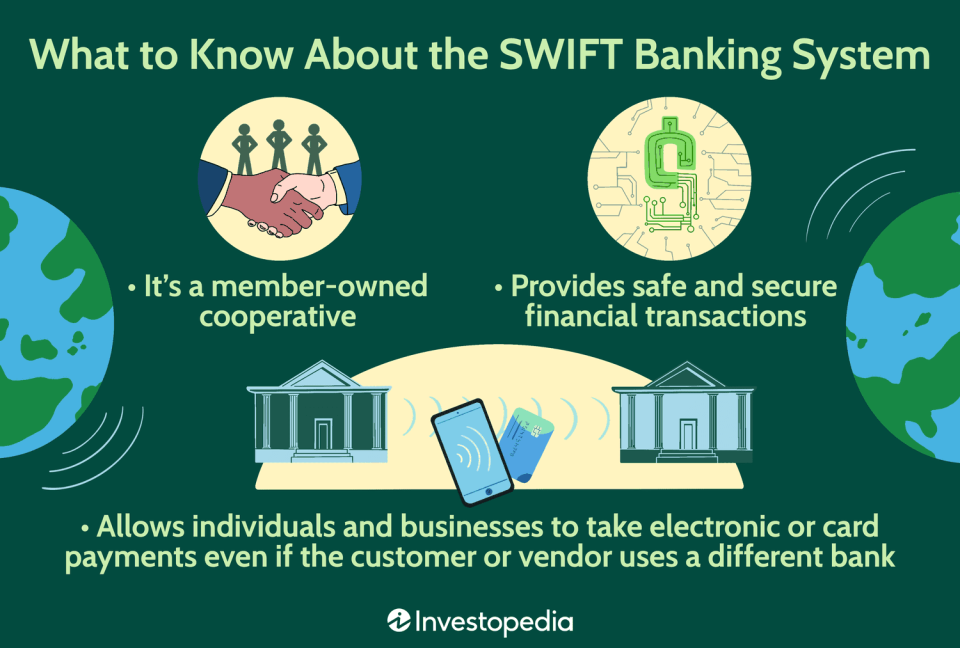
What Is the SWIFT Banking System?
The Society for Worldwide Interbank Financial Telecommunications (SWIFT) system is a global messaging network that enables secure and efficient international money and securities transfers. Founded in 1973 as a faster and more reliable alternative to the telex system, SWIFT now connects more than 11,000 financial institutions worldwide.
It assigns each institution a unique identification code, allowing for seamless and secure exchange of payment and transaction information. Beyond banking, SWIFT plays a key role in securities and trade transactions and has become a critical tool in enforcing economic sanctions against countries such as Iran and Russia.
Key Takeaways
- SWIFT is a vast messaging network that enables secure international financial transactions for over 11,000 institutions.
- Each financial institution on the SWIFT network is assigned a unique code called a BIC or SWIFT code.
- SWIFT does not transfer funds but provides a secure method for sending transaction instructions globally.
- Formed in 1973, SWIFT addresses the limitations of the older Telex system in global financial transfers.
- SWIFT’s services extend beyond payments to include treasury, trade, and compliance solutions.
Get personalized, AI-powered answers built on 27+ years of trusted expertise.
Understanding a SWIFT Transaction Flow
Financial institutions use SWIFT to securely transmit information and instructions through a standardized code system. Although SWIFT is crucial to global financial infrastructure, it’s not a financial institution. SWIFT does not hold or transfer assets but facilitates secure, efficient communication between member institutions.
SWIFT assigns each financial organization a unique code with either eight or 11 characters, known as a bank identifier code or BIC. The BIC may also use the terms SWIFT code, SWIFT ID, or ISO 9362 code. To understand how the code is assigned, let’s look at the Italian bank UniCredit Banca, headquartered in Milan. It has the eight-character SWIFT code UNCRITMM.
- First four characters: the institute code (UNCR for UniCredit Banca)
- Next two characters: the country code (IT for the country Italy)
- Next two characters: the location/city code (MM for Milan)
- Last three characters: optional, but organizations use them to assign codes to individual branches.
Here’s an example. A customer wants to send money to his friend in Venice, Italy, so he visits a local Bank of America branch. He brings his Italian friend’s account number and Venice-based branch information for UniCredit Banca. This information includes the unique SWIFT code.
Bank of America sends a payment transfer message to the UniCredit Banca branch over the secure SWIFT network. When Unicredit Banca receives the SWIFT message about the incoming payment, it will clear and credit the money to the Italian friend’s account.
As powerful as SWIFT is, remember that it is only a messaging system. SWIFT does not hold any funds or securities, or manage client accounts.
Tip
When making an international money transfer, the SWIFT/BIC code is used to identify your particular bank.
Steps to Transfer Money Internationally via SWIFT
You may need to send money with SWIFT to family and friends abroad or to secure a vacation rental, pay tuition, or get other services or merchandise. In general, sending money with SWIFT is the same process as sending a wire transfer. Here are the steps.
First, gather these items:
- Recipient’s bank name, address and country, routing code
- Recipient’s full legal name, current address, and account number
- SWIFT Code of the bank account
- Your government-issued ID
- Purpose of sending funds
- Any other documentation or information required by your bank
- Go to your bank or log into your bank’s system to request an international wire.
- Make sure you understand all fees and limits associated with sending cash abroad.
- You may be asked for the country you’re sending to, the currency you wish to send in, and the above information.
- Send the money from your bank via SWIFT, and keep a record of the event.
If you’re receiving money, you’ll need to collect your bank’s SWIFT number for the person sending you money. These SWIFT numbers may differ based on whether you’re receiving funds in U.S. dollars or foreign currency.
Financial Communications Before SWIFT
Before SWIFT, Telex was the only available means of message confirmation for international funds transfer. Low speed, security concerns, and a free message format hampered Telex. In other words, Telex did not have a unified system of codes like SWIFT to name banks and describe transactions. Telex senders had to describe every transaction in sentences that the receiver interpreted and executed. This led to many human errors, as well as slower processing times.
According to the London School of Economics, “Support for a shared network … began to achieve institutional form … in the late 1960s, when the Société Financière Européenne (SFE, a consortium of six major banks based in Luxembourg and Paris) initiated a ‘message-switching project.'”
To circumvent these problems, the SWIFT system was formed in 1973 with 239 banks in 15 countries. The global network would transfer financial messages in a secure and timely manner as Worldwide Interbank Financial Telecommunication, with headquarters in Belgium. SWIFT’s messaging services went live in 1977.
Why SWIFT Leads Global Financial Messaging
Although other message services like Fedwire, Ripple, and Clearing House Interbank Payments System (CHIPS) exist, SWIFT remains dominant in the market. Success may be attributed to the platform’s security, and to the fact that it’s continually adding new message codes to transmit different financial transactions.
In addition, some countries use the International Bank Account Number (IBAN) to identify international bank accounts across national borders, but the U.S. does not participate in IBAN.
Though SWIFT primarily started for simple payment instructions, it now sends various messages, including security, treasury, trade, and system transactions.
Ownership and Oversight of SWIFT
Initially, SWIFT founders designed the network to facilitate communication about Treasury and correspondent transactions only. The robustness of the message format design allowed for the huge scalability through which SWIFT gradually expanded to provide services to the following:
- Banks
- Brokerage institutes and trading houses
- Securities dealers
- Asset management companies
- Clearinghouses
- Depositories
- Exchanges
- Corporate business houses
- Treasury market participants and service providers
- Individuals or businesses making international wires or money transfers
- Foreign exchange and money brokers
Ownership and Oversight of SWIFT
SWIFT is a member-owned cooperative controlled by its shareholders (certain member financial institutions), representing some firms worldwide. SWIFT is overseen by the Group of Ten countries’ G-10 central banks. These countries are Belgium, Canada, France, Germany, Italy, Japan, Netherlands, Sweden, Switzerland, the United Kingdom, and the United States. The European country of Belgium acts as the lead overseer alongside other members such as the U.S. Federal Reserve.
Because all countries rely on SWIFT to conduct fast, seamless, secure communication, they are incentivized to remain in good standing with the organization. Central banks oversee SWIFT from Group of Ten (G10) countries, but it is a neutral organization operating for all its members’ benefit.
Investopedia / Dennis Madamba
Core Services Provided by SWIFT
The SWIFT system offers many services that help businesses and individuals to complete seamless and accurate business transactions. Some of the services offered are listed below.
Applications
SWIFT connections enable access to various applications, including real-time instruction matching for treasury and forex transactions, banking market infrastructure for processing payment instructions between banks, and securities market infrastructure for processing clearing and settlement instructions for payments, securities, forex, and derivatives transactions.
Business Intelligence
SWIFT has recently introduced dashboards and reporting utilities that enable its clients to get a dynamic, real-time view of monitoring the messages, activity, trade flow, and reporting. The reports enable filtering based on region, country, message types, and related parameters.
Compliance Services
Aimed at services around financial crime compliance, SWIFT offers reporting and utilities for Know Your Customer (KYC), sanctions, and anti-money laundering (AML).
Messaging, Connectivity, and Software Solutions
The core of the SWIFT business resides in providing a secure, reliable, and scalable network for the smooth movement of messages. Through its various messaging hubs, software, and network connections, SWIFT offers multiple products and services that enable its end clients to send and receive transactional messages.
SWIFT’s Revenue Model Explained
SWIFT Members are categorized into classes based on share ownership. All members pay a one-time joining fee plus annual support charges that vary by member classes.
SWIFT also charges users for each message based on message type and length. These charges vary depending on the bank’s usage volume. Different charge tiers exist for banks generating different message volumes.
SWIFT has also launched additional services as described above, backed by SWIFT’s long history of data. These services include business intelligence, reference data, and compliance services and offer SWIFT other income streams.
Navigating Challenges in the SWIFT Network
Most SWIFT clients process huge transactional volumes where manual instruction entry is not practical. The need to automate SWIFT message creation, processing, and transmission is growing. However, this comes at a cost and increased operational overhead.
Although SWIFT successfully provides software for automation, that also comes at a cost. SWIFT may need to tap into these problem areas for most of its client base. Automated solutions within this space may bring new income streams for SWIFT and keep clients engaged in the long run.
SWIFT’s Role in Economic Sanctions
In recent years, the possible use of SWIFT membership as a potential economic sanction against members has emerged multiple times. In 2012, for example, the European Union passed a sanction against Iran that compelled SWIFT to disconnect sanctioned Iranian banks.
In 2022, EU Council Regulation (EU) 833/2014 prohibited SWIFT and other financial messaging providers from providing services to designated Russian entities and subsidiaries. Based in Belgium, SWIFT must comply with EU regulations. EU Council Regulation (EU) 765/2006 prohibited SWIFT from working with designated Belarusian entities and subsidiaries. As a result, both Russian and Belarusian entities were disconnected from SWIFT.
Important
SWIFT does not provide services for EU-sanctioned banks from Iran, Russia, and Belarus.
What is SWIFT in Simple Terms?
Behind most international money and security transfers is the Society for Worldwide Interbank Financial Telecommunications, known as the SWIFT system. SWIFT is a vast messaging network banks and other financial institutions use to quickly, accurately, and securely send and receive information, such as money transfer instructions.
How Important Is SWIFT to Global Finance?
SWIFT has become a crucial part of the global financial infrastructure, with more than 11,000 global SWIFT member institutions sending messages daily through the system.
Do All Banks Use SWIFT?
No. In fact, many smaller banks in the U.S. and most credit unions are not members of the SWIFT network.
Can Banks Transfer Money Without SWIFT?
Yes, but doing so relies on slower, legacy systems to process the payments (often relying, in part, on manual settlement). This makes international payments more difficult, slower, costlier, and uncertain.
The Bottom Line
SWIFT remains a cornerstone of global finance, facilitating secure communication among more than 11,000 financial institutions worldwide. Its expansion into areas like reporting tools and business intelligence reflects its commitment to innovation and efficiency. These advancements reinforce SWIFT’s vital role in maintaining stability and connectivity across the international financial system.