

McKinsey projects that global data center capacity demand could nearly triple by 2030, with roughly 70% driven by AI workloads. Even in the constrained scenario, the investment required is measured in trillions. Projections are based on current assumptions and may not be realized.
That spending is expected to flow across multiple parts of the ecosystem, including technology developers, power providers, builders, operators and AI infrastructure platforms.
Data Centers Are Becoming Infrastructure, Not Just Facilities
One of the most important shifts underway is that data centers are no longer simply buildings that house servers. They are becoming essential infrastructure for the digital economy.
The supply chain includes several key layers:
- Semiconductors and memory: chips, GPUs, accelerators, DRAM and high-bandwidth memory that enable AI training and inference.
- Networking and servers: the equipment needed to connect AI rack clusters and move data efficiently across facilities.
- Power and cooling: electrical systems, liquid cooling, power management and thermal technologies required for higher-density compute.
- Grid and energy infrastructure: transmission equipment, transformers, substations, off-grid generation and reliable baseload power sources.
- Data center operations: companies that own, operate, connect or support data center facilities and cloud infrastructure.
Taken together, these areas point to a broader reality: the data center supply chain is not a narrow technology theme. It is a multi-sector infrastructure theme.
Power Is Becoming a Key Bottleneck
Among the biggest constraints is power. AI workloads require significant electricity, and higher-density data centers need reliable, scalable energy sources.
This is pulling new parts of the market into the AI infrastructure discussion, including utilities, nuclear energy, grid equipment, transformers, substations, energy storage and cooling technologies.
US Data Center Power Demand (GW)
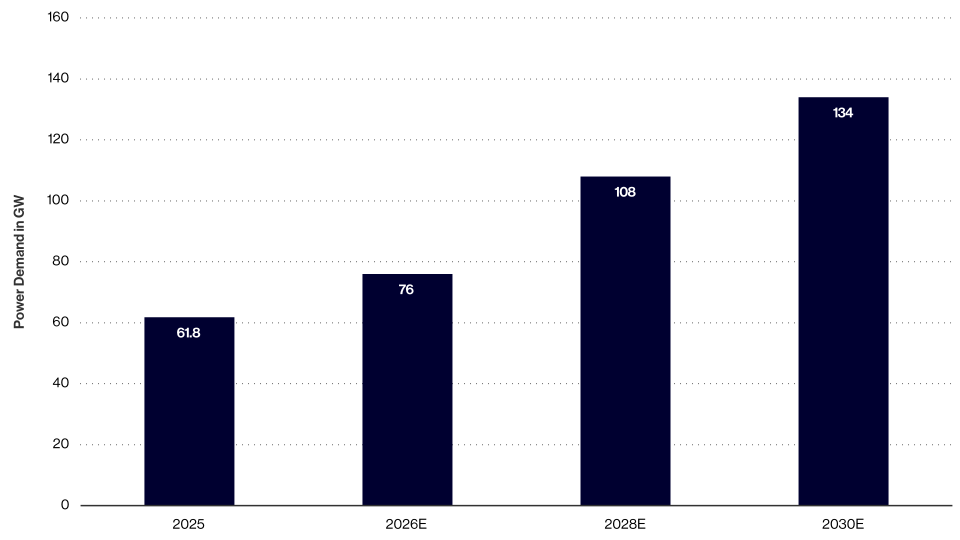
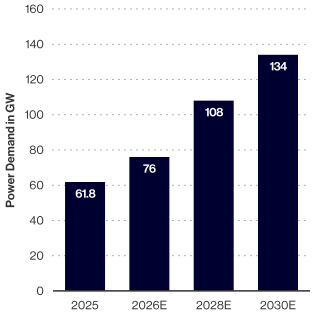
Source: S&P Global Commodity Insights / 451 Research, Oct. 14, 2025. Not intended as a forecast or prediction of future results. For illustrative purposes only.
The implication is straightforward: more compute capacity requires more power capacity. As data center demand grows, the companies helping deliver, manage and cool that power may become increasingly important to the broader AI investment case.
Why RACK?
The VanEck Data Center Supply Chain ETF (RACK) seeks to track the MarketVector Data Center Supply Chain Index, a rules-based, modified float-adjusted market capitalization weighted index designed to track U.S.-listed companies contributing to the buildout and ongoing operation of data centers across the supply chain.
Rather than focusing only on the hyperscalers spending on AI infrastructure, RACK focuses on the companies they may be spending with.
The index targets companies across four key areas:
- Fabless Semiconductors and Quantum Computing
- Nuclear Energy Producers
- Data Center Solutions
- Power Bridge
For initial inclusion, companies generally must generate at least 50% of revenues from eligible data center supply chain activities. The index also applies a 4.5% single-security cap and reconstitutes and rebalances quarterly.
That structure is designed to provide focused exposure to the companies supporting the physical buildout behind AI, while avoiding overconcentration in a small number of individual names.
What This Means for Investors
At VanEck, we have long believed that structural change can create demand for new infrastructure, new markets and new business models — though there is no guarantee that any investment theme will result in positive outcomes for investors.
The data center supply chain fits that framework.
This is not only a story about AI applications. It is a story about the infrastructure required to support growing compute demand: chips, servers, memory, networking, power, cooling, real estate and grid equipment.
For investors looking beyond the most visible AI companies, RACK offers a targeted way to access the businesses helping build and operate the infrastructure behind the theme.