

Along the banks of the Huangpu River, crowds throng with vibrant energy.
The annual World Artificial Intelligence Conference (WAIC) has arrived as scheduled, and this year’s event is nothing short of spectacular — the total exhibition area has exceeded 100,000 square meters for the first time, with over 1,100 enterprises showcasing more than 3,000 exhibits, including over 300 products making their global debut. The venue is packed to the brim, buzzing with unprecedented enthusiasm.
“It’s absolutely electric. Without advance planning, you can’t even book a nearby hotel,” remarked an AI investor who traveled from Beijing, having locked in his itinerary as early as last month. On the high-speed train to Shanghai, he was surprised to find dozens of his peers on the same journey.
The ticket situation is even more staggering. Standard tickets originally priced at 168 yuan have been scalped for as high as 2,000 yuan. “Money doesn’t guarantee you a spot,” lamented an investor who only secured a ticket through his portfolio company. “This is easily the most popular WAIC in history.”
“If you don’t show up, you can’t call yourself a qualified AI investor” — this FOMO sentiment hangs thick in the air.
The Hottest Conference of the Year
1,100 AI Companies Gather Under One Roof
Now in its ninth edition, WAIC has become a condensed chronicle of AI’s evolution.
Stepping into the venue, the electric atmosphere is immediately palpable. Looking back two or three years ago, exhibition boards were dominated by model parameter counts, context window lengths, and Benchmark rankings. By 2025, embodied prototypes and Agent demonstrations began to appear on booths. This year, every exhibitor has brought products that can operate seamlessly in real-world scenarios, with mass production and delivery figures openly displayed. From “competing on parameters” to “competing on real-world deployment,” AI has finally stepped out of the screen.
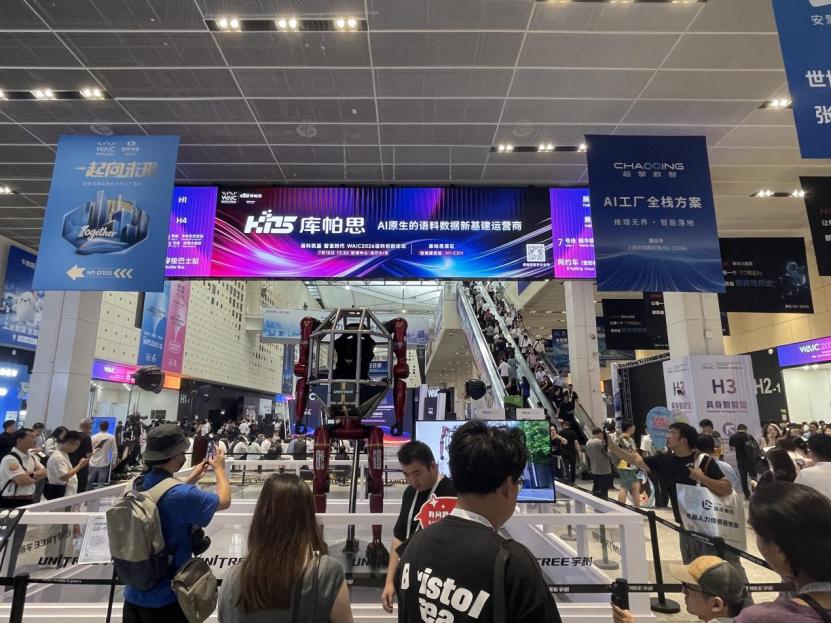
This WAIC adopts for the first time a “three locations, four pavilions” collaborative layout spanning Zhangjiang, the World Expo Center, and Xuhui. Among them, the Shanghai World Expo Exhibition & Convention Center boasts the largest area and the most comprehensive industrial chain coverage, serving as the core hub for global new product premieres — H1 showcases industrial implementation, H2 highlights underlying computing power, H3 focuses on robotics, and H4 features startup projects.
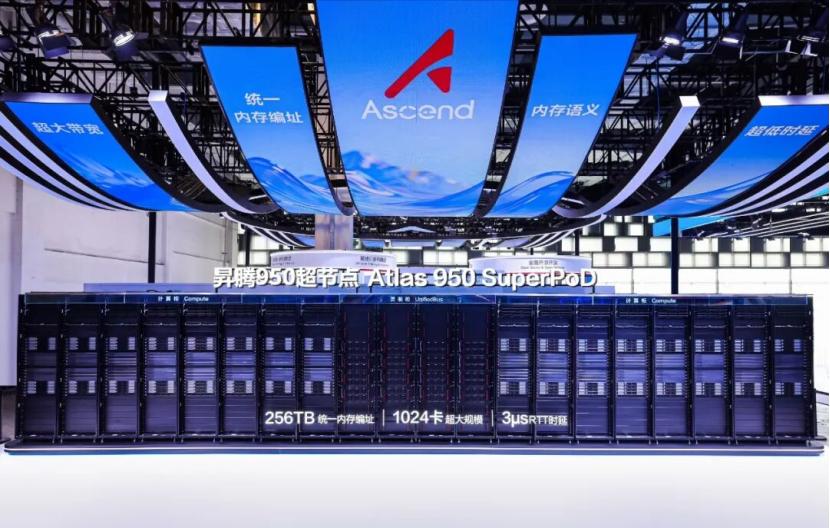
Hall H1 features demonstrations of large model and agent deployment progress, including MiniMax M3, the InfiniClawBox secure de-identification agent from Infinicore, and Kimi, which launched its most powerful K3 model on the opening day. Hall H2 reads like a computing power “military parade,” with Huawei unveiling the industry’s largest supernode Atlas 950 SuperPoD, displaying 1,024 Ascend cards on site — a scale 56.8 times that of NVIDIA’s NVL144 solution.
Hall H3 is undoubtedly the most popular spot, a paradise for robotics enthusiasts. More than 200 leading robotics enterprises, 208 embodied intelligent terminals, and over 300 physical robots are simultaneously performing dynamic demonstrations, leaving the venue packed shoulder to shoulder.
Unitree Technology presents the world’s first manned transformable mecha GD01; Fourier Intelligence showcases its “working team” by bringing a real production line directly into the conference; itstone Robotics’ A1 robot demonstrates operational capabilities on an actual industrial production line. In addition, UBTECH, Galaxy Universal, Dimensional Intelligence, Fourier Intelligence, Qixin Intelligence, Geekplus, and Traction Motion have all unveiled new generation embodied products, with capabilities evolving from “being able to move” to “being able to perform useful work” — the gap between players is clearly widening.
The Xuhui West Bund venue is equally bustling. BioMap, Bilibili, and Tencent cluster in the digital perception exhibition area; Honor, NetEase Youdao, and iFlytek have launched their latest daily-use AI devices, alongside lightweight products like the Rokid Leji AI glasses, LLVision Hey2 AR translation glasses, and HeartMona AI glasses, which are so light they are barely noticeable. The Zhangjiang exhibition area gathers over 100 computing power chip enterprises, with almost all major domestic GPU manufacturers in attendance, presenting 67 products making their domestic debut.
Many familiar names have also brought new achievements: Xiaohongshu showcases its RED Skill and Vibe Coding content ecosystem, Boton Intelligent launches its new OntoZ robot body, Qiyuan Robotics unveils T1 — the world’s first deformable personal robot, and Wall Intelligence collaborates with the Institute for AI Industry Research (AIR) to release its latest report.
The list goes on and on.
Investors Are Swamped With Activities
“Available during WAIC” — AI investors have collectively updated their WeChat profiles.
AI-focused investors would never miss this annual AI gala. “Post a message on your social feed, and you can easily fill an entire train carriage heading to Shanghai,” shared an investor who helped organize a group trip to the city, brimming with excitement.
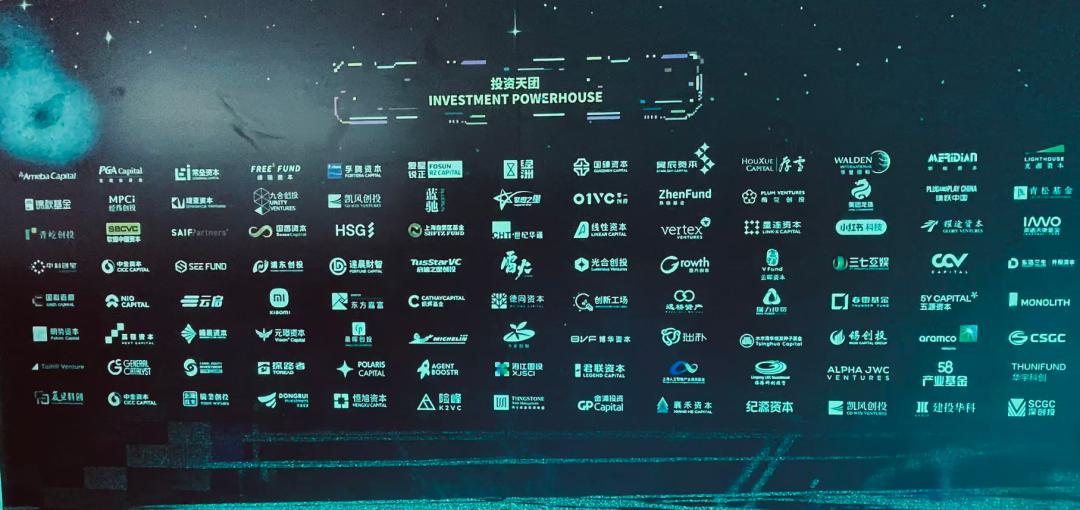
Investors can be seen everywhere. The WAIC Future-Tech Venture Capital Zone in Hall H4 hosts more than 160 outstanding startups, over 70% of which were founded less than three years ago, with post-1990s founders accounting for more than 50%. Over 80 leading investment institutions, including HSG, GL Ventures, and ZhenFund, have set up dedicated capital docking areas. The next unicorn could very well emerge from here.
“You absolutely must see the ‘Six Dragons of World Models’ share the stage together.” During the conference, founders of the six leading world model enterprises gathered for an exclusive roundtable: TAO Dacheng (Founder of Daxiao Robotics), SHEN Yujun (Chief Scientist of Ant Group Lingbo), ZHU Zheng (President of Super Vision), XIA Zhongpu (CTO of Boundless Power), REN Guanghui (Technical Lead of Fourier Intelligence), and WANG Hao (CTO of Variable Robotics). This is a moment no physical AI investor wants to miss.
SDIC Shanghai also left a strong impression, hosting the “POWER Open Mic” which brought together for the first time key players from computing power, algorithms, data, embodied intelligence, and AI application sectors. In addition, ZHOU Zhifeng, Managing Partner of Qiming Venture Partners, will release the “2026 Qiming Venture Partners Top 10 AI Outlook” at the forum.
This year’s institution-led Side Events are also in full swing. BlueRun Ventures hosted the “Booming Night,” Source Code Capital launched “WAIC After Hours,” Linear Capital organized the “AI Industry Gossip Championship” by the Huangpu River, and Huaying Capital held the “Tsinghua Tech Innovation Night,” while Jinqiu Fund hosted “Founders Back Founders.”
Numerous other venture capital and FA institutions, including 5Y Capital, Yunqi Partners, Unity Ventures, Matrix Partners China, Starlight Capital, Changshi Capital, MiraclePlus, GaoHu Capital, and Lighthouse Capital, have all launched their own exclusive events.
All this keeps investors extremely busy, with 20,000 steps a day being no exaggeration.
Their schedules are split into half-hour fragments: checking out new computing power chip launches in the morning, holding closed-door in-depth discussions with embodied intelligence founders at noon, rushing to three vertical track roundtables in the afternoon, and attending consecutive closed-door roadshows and after-parties in the evening. If you invest in AI but skip WAIC, you are likely missing out on the most authentic and exciting transformations happening in China’s AI industry.
The Youth-Driven Storm
AI Is Spawning a New Wave of Trillion-Dollar Companies
The unprecedented hype around WAIC vividly reflects this year’s AI investment boom.
Public data shows that in the first half of 2026, total financing in China’s embodied intelligence sector has exceeded 900 billion yuan, more than five times the figure of the same period last year. Expanding to the entire AI sector, there were 1,203 financing events in the first half of the year, with total funding surpassing 3 trillion yuan — far exceeding the full-year total of 2025.
In other words, the AI sector alone has absorbed more than half of the capital allocated by VC firms in the first half of the year.
Unicorns valued at over 10 billion yuan are emerging one after another. DeepMotion, Variable Intelligence, Zhifang, StarMap, Qixin Intelligence, Zhongqing Intelligence, Starry Era, Traction Motion, and Dimensional Intelligence have all crossed this valuation threshold.
The heat on the financing side has quickly spread to the IPO market. According to incomplete statistics, at least 20 embodied intelligence companies have clarified their listing plans since the start of this year. Unbeknownst to many, IPO has become a make-or-break competition — the first to land on the capital market will have a far greater chance of staying in the game.
Unitree is about to list on the STAR Market, opening a new window for the entire industry. Everyone is wondering: will a Chinese embodied company eventually stand at the center of the global stage? This is the most imaginative part of China’s embodied intelligence narrative.
Outside the conference venue, discussions about the next 100-billion and trillion-yuan valuations are happening everywhere. “The internet eventually gave birth to trillion-dollar companies, and artificial intelligence will certainly do the same — and it will happen faster than the internet,” a managing partner from a Shanghai-based dual-currency fund predicted.
This is no mere fantasy. Zhipu AI’s market value once exceeded 1 trillion yuan, DeepSeek’s latest valuation is over 350 billion yuan, and it is reportedly preparing for a STAR Market IPO. Kimi, valued at over 200 billion yuan, is expected to complete its Hong Kong IPO as soon as within six months. Looking overseas, as Anthropic and OpenAI anchor their valuations at the trillion-dollar level, the ceiling of China’s AI sector is far from being reached.
The flow of capital always has far-reaching implications.
Right now, those investors weaving between booths, holding ample “ammunition,” are gradually mapping out the technology landscape of the next decade. Perhaps the next trillion-dollar company is hidden in a certain booth, a closed-door meeting, or an accidental casual conversation. No one wants to miss it.
This article is from the WeChat official account “Investment (ID: pedaily2012)”, written by ZHOU Jiali, and published with authorization from 36Kr.