
India’s tobacco industry came under intense pressure this
week after the government announced a sharp increase in excise duties on
cigarettes, triggering a swift and broad selloff across tobacco stocks. The
policy move forced investors to reassess earnings visibility for
cigarette manufacturers, with ITC Ltd., the country’s largest cigarette maker,
bearing the brunt of the market reaction.
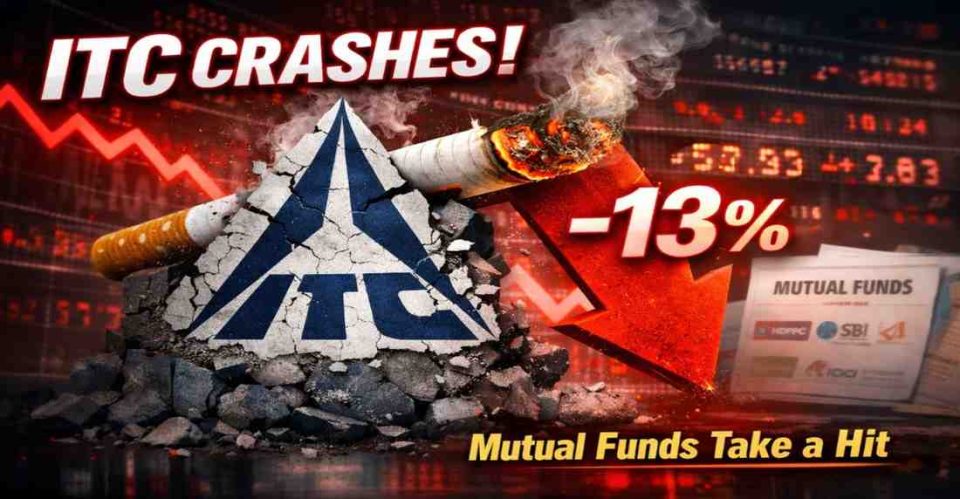
ITC shares fell nearly 13 per cent over two trading
sessions, touching an intraday low of Rs 345.25 on the BSE after hitting a high
of Rs 404.80 earlier in the week. The stock dropped to its lowest level since
February 2023, wiping out nearly USD 7 billion in market capitalisation. The
sharp correction marked one of the most severe short-term reactions ITC has
seen in recent years and reflected growing uncertainty over near-term
profitability.
Tax Shock Triggers Market Volatility
The selloff followed a late-Wednesday notification by the
Finance Ministry announcing a significant increase in excise duty on
cigarettes, effective February 1. Under the revised structure, excise duties
will range from Rs 2,050 to Rs 8,500 per 1,000 sticks, depending on cigarette
length. These levies will be imposed over and above GST, while the existing GST
compensation cess on tobacco products will be withdrawn.
Cigarettes, pan masala, and related tobacco products will
now attract a GST rate of 40 per cent, while biris will be taxed at 18 per cent.
In addition, a Health and National Security Cess will be levied on pan masala,
and tobacco products will face an additional excise duty. The magnitude of the
increase was higher than what markets had anticipated, amplifying concerns over
the immediate impact on cigarette manufacturers’ cost structures.
Brokerages Cut Ratings, Flag Demand Risks
Following the announcement global and domestic brokerages
downgraded ITC’s stocks. It is cautioned that the higher tax burden could
compress margins in the short term until price hikes are implemented and
absorbed by consumers.
Highlights were saying that cigarette prices may need to
rise by as much as 40 per cent to fully pass on the increased levies. In a
price-sensitive market such as India, such sharp increases could hurt volumes
before demand stabilises. Experts warned that higher legal prices could
encourage the growth of illicit cigarette trade, a trend that has historically
accelerated whenever taxes rise sharply.
Sector-Wide Impact Extends Beyond ITC
The impact of the policy shift was not limited to ITC alone.
Shares of Godfrey Phillips India declined more than 20 per cent over two
sessions, underscoring broader concerns about earnings visibility across the
tobacco sector. Heavy trading volumes and elevated volatility reflected
investors’ efforts to reassess exposure to cigarette manufacturers amid
heightened regulatory risk.
The episode once again highlighted how quickly fiscal
changes can alter sentiment toward tobacco stocks, which remain highly
sensitive to taxation policies despite strong cash flows and pricing power over
the long term.
Mutual Funds Hold Nearly 195 Crore ITC Shares
Despite the sharp correction, ITC remains one of the most
widely held stocks in India’s mutual fund ecosystem. As per AMFI MF data,
mutual funds collectively held around 195.07 crore shares of ITC as of November
2025, with a market value of approximately Rs 78,952 crore. Around 48 asset
management companies had exposure to ITC, making it one of the most common
holdings across large-cap, value, flexi-cap, and hybrid schemes.
ITC has no promoter or promoter-group holding, with 100 per
cent of its equity owned by public shareholders. The company’s deep
institutional ownership meant that the sudden fall had a pronounced impact on
portfolio values across the mutual fund industry, especially within
FMCG-focused and diversified equity schemes.
Top 12 Mutual Funds With the Highest Exposure to ITC
Among mutual funds, the Parag Parikh Flexi Cap Fund held the
largest exposure to ITC, owning over 14.47 crore shares as of November 2025.
The stock accounted for 4.51 per cent of the fund’s assets under management,
reflecting strong long-term conviction in ITC’s cash-generating ability despite
regulatory risks.
The ICICI Prudential Value Fund was the second-largest
holder, with approximately 5.59 crore shares and an allocation of 3.75 per cent
of its AUM. Mirae Asset Large Cap Fund followed closely, holding about 4.37
crore shares, where ITC formed over 4 per cent of the portfolio.
HDFC Balanced Advantage Fund also featured among the largest
institutional holders, owning nearly 4.15 crore shares, though the stock
accounted for a relatively lower proportion of its diversified portfolio.
Nippon India Large Cap Fund and Kotak Arbitrage Fund held around 3.53 crore and
3.15 crore shares respectively, reflecting ITC’s presence across both
equity-oriented and arbitrage strategies.
SBI Contra Fund, known for its value-driven approach, held
over 3.10 crore shares, while Mirae Asset Large & Midcap Fund and ICICI
Prudential Multi-Asset Fund each owned close to 3 crore shares. Kotak Multicap
Fund stood out for its relatively high portfolio exposure, with ITC accounting
for nearly 4.81 per cent of its assets.
ICICI Prudential Large Cap Fund and Mirae Asset ELSS Tax
Saver Fund completed the list of the top twelve, each holding close to 2.5
crore shares of ITC as of November 2025.
What Investors Are Watching Going Forward
In the coming months, investor focus will remain firmly on
ITC’s pricing strategy and how quickly higher taxes are passed on to consumers.
Market participants will closely monitor cigarette volume trends after February
1 to assess whether demand stabilises or weakens further.
While ITC’s diversified presence in FMCG, hotels, and
agri-business provides some earnings cushion, cigarettes continue to contribute
a disproportionate share of profits. As a result, taxation changes remain a
critical risk factor for the stock.
Conclusion
The sharp fall in ITC shares serves as a reminder that
regulatory and policy risks remain central to the investment case for tobacco
companies in India. With mutual funds holding nearly 200 crore shares, even
modest shifts in sentiment can trigger large market moves. As earnings
expectations adjust to the new tax regime, volatility in ITC and other tobacco
stocks is likely to persist until clarity emerges on pricing power and demand
resilience.
Disclaimer: The article is for informational purposes
only and not investment advice.
Empowering Investors Since 1986, A SEBI-Registered Authority
Dalal Street Investment Journal
Contact Us