
What Is a Currency Option?
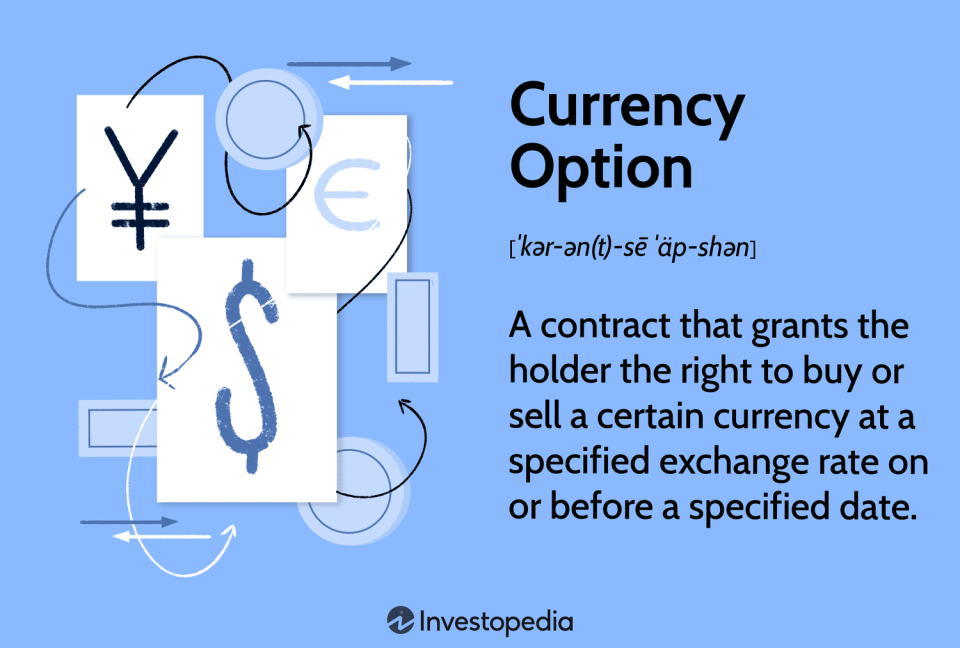
A currency option (also known as a forex option) is a contract that gives the buyer the right, but not the obligation, to buy or sell a certain currency at a specified exchange rate on or before a specified date. For this right, a premium is paid to the seller. There are two main types: vanilla and spot options.
Currency options are commonly used by corporations, individuals, and financial institutions to hedge against unfavorable exchange rate changes.
Key Takeaways
- Currency options offer the right, but not the obligation, to trade currencies at a specific exchange rate before expiry.
- Investors use currency options to hedge against exchange rate risks or speculate on currency movements.
- There are two primary types of currency options: vanilla options and SPOT options.
- Trading FX options limits downside risk to the premium paid, with potential for unlimited gains.
- Premiums for currency options vary based on strike price, expiration date, and market volatility.
Get personalized, AI-powered answers built on 27+ years of trusted expertise.
Investopedia / Michela Buttignol
Understanding Currency Options in the Forex Market
Investors can hedge against foreign currency risk by purchasing a currency put or call. Currency options are derivatives based on underlying currency pairs. Trading currency options involves a wide variety of strategies available for use in forex markets. A trader’s strategy depends on the type of option chosen and the broker or platform used. The characteristics of options in decentralized forex markets vary much more widely than options in the more centralized exchanges of stock and futures markets.
Traders use currency options for several reasons. Traders have limited downside risk, losing only the paid premium, but enjoy unlimited upside potential. Some traders will use FX options trading to hedge open positions they may hold in the forex cash market. In contrast to a futures market, the cash market, also called the physical and spot market, has the immediate settlement of transactions involving commodities and securities. Traders also like forex options trading because it gives them a chance to trade and profit on the prediction of the market’s direction based on economic, political, or other news.
However, premiums on currency options contracts can be high. The premium depends on the strike price and expiration date. Also, once you buy an option contract, it cannot be re-traded or sold. Forex options trading is a complex process, with numerous factors that make valuation challenging. Risks include interest rate differentials (IRD), market volatility, the time horizon for expiration, and the current price of the currency pair.
Exploring Vanilla Options: Calls and Puts
There are two main types of options, calls and puts.
- Call options provide the holder the right (but not the obligation) to purchase an underlying asset at a specified price (the strike price), for a certain period of time. If the stock fails to meet the strike price before the expiration date, the option expires and becomes worthless. Investors buy calls when they expect the share price of the underlying security to rise, or sell a call if they anticipate it will fall. Selling an option is also referred to as ”writing” an option.
- Put options give the holder the right to sell an underlying asset at a specified price (the strike price). The seller (or writer) of the put option is obligated to buy the stock at the strike price. Put options can be exercised at any time before the option expires. Investors buy puts if they think the share price of the underlying stock will fall, or sell one if they believe it will rise. Put buyers, or those who hold a “long” put, are either speculative buyers seeking leverage or “insurance” buyers who want to protect their long positions in a stock for the period covered by the option. Put sellers hold a “short” expecting the market to move upward (or at least stay stable). A worst-case scenario for a put seller is a downward market turn. The maximum profit is limited to the put premium received and is achieved when the price of the underlying is at or above the option’s strike price at expiration. The maximum loss is unlimited for an uncovered put writer.
The trade involves being long one currency and short another. In essence, the buyer specifies the amount, price, and expiration date. A seller will then respond with a quoted premium for the trade. Traditional options can have American or European expirations. Both the put and call options give traders a right, but there is no obligation. If the current exchange rate puts the options out of the money (OTM), then they will expire as worthless.
Understanding SPOT Options: Higher Premiums and Flexibility
SPOT contracts, a type of exotic option, are used for trading currencies. Spot options cost more than traditional ones but are easier to set and execute. A currency trader buys a SPOT option by inputting a desired scenario (e.g., “I think EUR/USD will have an exchange rate above 1.5205 15 days from now”) and is quoted a premium. If the buyer purchases this option, the SPOT will automatically pay out if the scenario occurs. Essentially, the option is automatically converted to cash.
The SPOT is a financial product that features a more flexible contract structure compared to traditional options. This all-or-nothing strategy is also called binary or digital options. The buyer will offer a scenario, such as that EUR/USD will break 1.3000 in 12 days. They will receive premium quotes representing a payout based on the probability of the event taking place. If this event takes place, the buyer gets a profit. If the situation does not occur, the buyer will lose the premium they paid. SPOT contracts require a higher premium than traditional options contracts do. Also, SPOT contracts may be written to pay out if they reach a specific point, several specific points, or if it does not reach a particular point at all. Of course, premium requirements will be higher with specialized options structures.
Other exotic options may tie the payoff to more than the underlying value at maturity, such as Asian, barrier, binary, digital, or lookback options.
Practical Example: Profiting with Currency Call Options
Let’s say an investor is bullish on the euro and believes it will increase against the U.S. dollar. The investor purchases a currency call option on the euro with a strike price of $115, since currency prices are quoted as 100 times the exchange rate. When the investor purchases the contract, the spot rate of the euro is equivalent to $110. Assume the euro’s spot price at the expiration date is $118. Consequently, the currency option is said to have expired in the money. Therefore, the investor’s profit is $300, or (100 * ($118 – $115)), less the premium paid for the currency call option.
The Bottom Line
Currency options are contracts that give the buyer the option, but not the obligation, to buy or sell a currency at a specific time, date, and price. Forex traders can buy or sell vanilla or spot options, which have different features and costs.
If you’re considering using currency options, it’s essential to understand premiums, strike prices, market volatility, interest rate differentials, and the non-retradability of options contracts to become successful. It’s also best to consult a financial advisor or seek currency trading education from professional courses if you’re new to currency trading.