
AUD/USD Range Hides a More Complex Backdrop
AUD/USD remains caught in a tight range, but the calm tone on the chart hides a more complicated backdrop. With both Australian inflation data and the next Federal Reserve rate decision approaching, traders are weighing whether this week’s events will leave the pair drifting sideways or finally push it out of its recent band. The way the market reacts to a pause in Middle East tensions, shifting rate expectations and upcoming economic releases makes the current setup more interesting than a simple consolidation pattern.
Why This Week’s Data And Fed Decision Matter For AUD/USD

The Aussie dollar started the week with a gap higher after news that U.S. strikes in Iran had halted, briefly lifting risk appetite and raising hopes of a possible de‑escalation in the Middle East. That early enthusiasm faded as attention turned back to Wednesday’s key Australian consumer price index release and the Federal Reserve’s closely watched July rate decision. Economists expect core inflation to rise 0.9% in the second quarter, pushing the annual pace to 3.7%, and traders are ready to reassess the chances of an RBA hike in August if the data surprises. At the same time, markets largely expect the Fed to leave its benchmark range at 3.5% to 3.75%, making the language of the accompanying statement especially important for understanding whether policymakers are leaning more hawkish or willing to tolerate easier conditions. Together, these factors explain why the pair’s seemingly modest moves carry more weight than the chart alone suggests.
What The AUD/USD 1‑Hour Chart Currently Shows
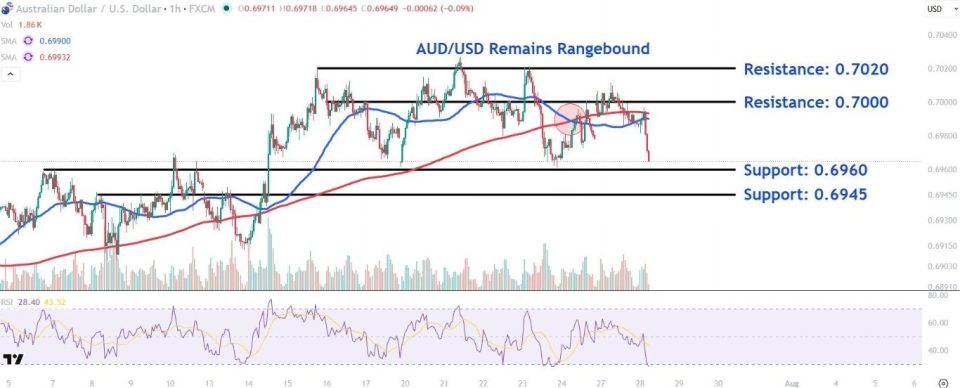
On the 1‑hour chart, AUD/USD continues to oscillate mostly sideways, even as a potential triple top formation emerges near recent highs. The 50‑period moving average has crossed below the 200‑period moving average, creating a so‑called death cross that many traders interpret as a signal of waning upside momentum rather than a guarantee of downside follow‑through. Despite these developments, price has yet to break decisively out of its band, reflecting the market’s wait‑and‑see stance ahead of this week’s data and policy events. A stronger push higher from current levels would put the crucial 0.7000 area back in focus, where a round number and a horizontal line connecting price action since mid‑July combine to create a notable resistance zone. A convincing close above that region could open a path toward 0.7020, where recent peaks and the implied triple top align as a natural area for traders who bought near last week’s lows to consider taking profits.
How Key Resistance Levels Could Shape The Next Move
If the pair does manage to build on its recent recovery, the structure of resistance above current levels will matter for how sustainable any move becomes. The 0.7000 handle stands out as a psychological barrier as well as a technical one, drawing attention from those who watch round numbers and past reaction points closely. Price action that repeatedly stalls near this band without attracting stronger follow‑through can reinforce the sense that the market remains more comfortable fading rallies than chasing breakouts. Beyond 0.7000, the 0.7020 region marks an area where several intraday peaks have formed, effectively sketching the outlines of a possible triple top. Traders who are long from lower levels may treat this zone as a logical place to reassess exposure, particularly if momentum indicators fail to show improvement as price approaches the upper edge of the recent range.
Support Bands And What To Watch Next In AUD/USD
On the downside, the first area that many traders will be watching sits near last week’s trough around 0.6960. This level lines up with multiple earlier peaks on the chart, making it a natural candidate for support within the current range. Participants who expect AUD/USD to remain trapped between nearby highs and lows may look for buying opportunities around this band, viewing it as a place where demand has previously emerged. A sustained move below 0.6960 could open the door to a deeper decline toward 0.6945, an area associated with a prior period of consolidation just below the early July peaks. Some traders may see that region as a potential accumulation zone, particularly if broader conditions still favour the Aussie in relative terms, while others will interpret a break toward it as evidence that the range is loosening rather than firmly intact.
For now, the pair’s cautious drift higher at the start of the week reflects a mix of improved risk appetite from paused hostilities and ongoing uncertainty about the path of interest rates in Australia and the United States. The next few sessions should reveal whether this combination leads to a genuine breakout from the recent range or simply extends the existing pattern of sideways trade. Traders will likely focus less on the first reaction to Australian CPI and the Fed decision and more on how AUD/USD behaves around key bands near 0.7000, 0.6960 and 0.6945. That behaviour will offer clearer clues about whether the market is ready to reprice the pair’s outlook or content to keep treating rallies and dips as opportunities within a familiar corridor.
Ready to trade our analysis of the AUD/USD? Here is our list of the best Forex brokers worth checking out.