
A breakthrough in AI-driven crop disease detection is set to reduce harvest losses and chemical-related health risks thanks to a first-of-its-kind tomato leaf dataset comprising almost 9000 images of tomato images.
The Sri Lankan In-Field Tomato (SLIF-Tomato) dataset – built by academics from Charles Darwin University (CDU), the University of Peradeniya (UoP), and more – is the first complete in-field dataset comprising class labels and bounding box annotations collected under diverse real-world conditions.
The dataset includes 890 raw photos of tomato leaves featuring eight classes, healthy and seven diseases – bacterial spot, early blight, mosaic, powdery mildew, septoria, wilt, and late blight – which were then augmented through two phases to produce a total of 8,934 images.
The images are then assessed using an AI algorithm called Inverted Residual Convolutional Block Attention Module (IR-CBAM) that tells the AI scanners what to focus on reducing the complexity of the image.
Research supervisor Dr Thuseethan Selvarajah, a CDU Lecturer in Information Technology, said the technology taught AI-based disease recognition models to focus like a trained eye, as opposed to scanning every part of an image equally.
“First, it figures out what kind of clues matter most such as colour, texture, and edges, and turns up the focus on those,” Dr Selvarajah said.
“Then, it figures out where in the photo to look, zooming in on the actual diseased spot and ignoring soil, shadows, and background leaves. It does this in a lightweight, efficient way so it can still run fast on things like phones.
“This matters because field photos are messy. Unlike clean lab images, they’re full of background clutter. Teaching the model to filter out the noise and focus on the disease itself is exactly why accuracy improved significantly.”
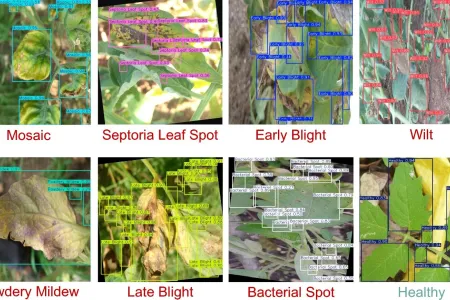
The dataset allows farmers to detect diseases in their crops early and with more than 99 per cent accuracy. Previous studies indicated this was only achieveable in controlled settings.
Sri Lanka’s tomato yield averaged 18.9 tons per hectare as of 2018, contributing to national income and export revenue. It also generates employment, boosts household income, and supports national nutrition.
UoP PhD candidate and study lead author Romiyal George said undetected or misdiagnosed tomato leaf diseases cause substantial yield losses, while excessive chemical use posed risks to human health and the environment.
Mr Romiyal said traditional disease detection often depended on manual inspection from farmers or agricultural experts, a time-consuming process that could delay treatment decisions and result in profit losses.
“The lightweight AI models developed in this research can enable rapid disease identification using resource-constrained devices such as mobile phones or embedded systems,” he said.
“This can reduce dependency on continuous expert support, minimize crop losses through early detection, and help farmers apply treatments more efficiently.
“In the long term, this technology can contribute to precision agriculture by enabling data-driven decision-making and more sustainable use of agricultural resources.”
Mr Romiyal said the next step was taking their findings from a research setting to the real world for deployment and expanding the available datasets to include a broader range of crops and diseases.
He said AI had a major role to play in the future of agriculture.
“This research is a step towards bridging the gap between advanced AI technologies and practical agricultural applications,” Mr Romiyal said.
“By combining lightweight deep learning models with realistic field data, we can move closer to creating affordable and sustainable solutions that benefit farming communities, particularly in regions where access to agricultural expertise is limited.”
Published in Neural Computing and Applications journal, this research supports Australia’s agricultural innovation priorities through AI-based crop disease detection, improved productivity, and enhanced biosecurity.