
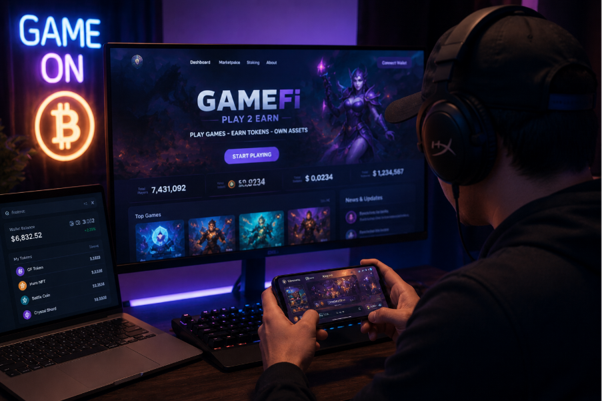

So, crypto gaming’s dead, huh? It is according to Lily Liu.
Early this year, Solana’s president officially rang the death knell for GameFi, taking to X to announce that “gaming on blockchain’s not coming back.” For anybody who’s been following the space for more than five minutes, that’s a strange thing to read. After all, Solana isn’t some radical new chain, hoping to make its mark in a saturated market. Nor is it a distant and uninterested observer of the crypto gaming phenomenon. This has been one of the core networks most closely associated with gaming’s blockchain ambitions.
Crypto enthusiasts will already know that Solana was one of the most robust chains for GameFi, powering mammoth hits like Star Atlas. What, then, has prompted such a response from a network leader that has previously been a champion for blockchain gaming? And is Liu right and 2026 is the end for crypto gaming? Let’s dig in.
Did it Fail? Or Have We Gotten Better at Spotting Bad Games?
Cast your mind back a few years. Remember when pretty much every crypto gaming announcement heralded itself as being the “future” of player-centric economies? Publishers were experimenting, mainstream gaming manufacturers were investing, and suddenly, everything from RPGs to pet simulators was being rebuilt around tokens, digital marketplaces, and player-owned assets. At the time, the loudest voices didn’t necessarily declare blockchain to be gaming’s biggest influence… it seemed all set to completely redefine it.
But! The more games and native tokens that came into the market, the more we noticed something: not all of these experiences were actually hitting the mark. Progression was basic at best, if present at all, and the only thing that kept us interested in P2E titles was the earning aspect, not the playing. See, here in 2026, there hasn’t been a better time to be a gamer. There’s simply so much variety and depth within our reach now that it takes something pretty special to keep us playing once the novelty has worn off. Layering a bit of tokenomics onto a standard collectibles game just isn’t enough to warrant lasting attention.
So, maybe it’s not so much that gaming on blockchain itself has failed. More that we’ve gotten better at spotting those bad games and are logging out in favor of something more rewarding. After all, there are still plenty of spaces where gaming with crypto is being done right…
From iGaming to Mobile-First Soccer, Crypto Gaming’s Success Stories
You might be fully clued up about the sector, or you might only pay attention to GameFi when it makes gaming headlines. Either way, have you noticed that the projects and spaces that are doing crypto gaming right don’t make it the central focus anymore? Look at iGaming, for instance. It’s gone all-in on crypto gambling! This mammoth digital entertainment sector was one of the first to fully embrace cryptocurrencies, integrating decentralized currencies into online casino platforms, gambling apps, and digital sportsbooks alike.
So, how has this early adopter stayed the course? That’s easy to answer—rarely has online gambling ever positioned blockchain as the experience itself. Instead, crypto gambling games, be that Big Bass Splash or Gates of Olympus, are positioning both decentralized currencies and the blockchain itself as new technologies to provide a better infrastructure for tried-and-true variants—think slots, table games like blackjack, video poker, etc.
Payment systems supporting both fiat and crypto access, live gaming formats, enhanced security and transparency – all of these inherent benefits of blockchain expand what players can do within the platform without changing the nature of the gameplay itself.
Mythical Games is another great example of a blockchain-driven gaming company that’s pivoted into the next-generation space. Blockchain isn’t the star of the show here: rather, it’s one of a number of advanced technologies being woven together to provide cutting-edge gaming experiences. Paired with instantly recognizable IP—FIFA, Pudgy Penguins—decentralized tech becomes essential to the wider Web3 experience, yes, but doesn’t pull focus. The strategy? Less “come and see our blockchain” and more “come and play something you’ll enjoy.” It’s minor, sure, but still cause for a big shift in crypto gaming culture.
Meanwhile, the poster child for crypto gaming and P2E, Axie Infinity, isn’t about to retire anytime soon. According to Jeffery Zirlin (JiHo), 2026 is the year where the game will be taking “much larger risks”—no doubt accelerated by Ronin’s recent upgrade to a true Ethereum layer-2 scaling network.
Is 2026 The End?
If the sectors and games we’ve mentioned above are doing so well, why was Liu prompted to make such a drastic statement about decentralized gaming? Momentum—rather, a drop-off in momentum—was undoubtedly a trigger. As a sector, GameFi has lost a lot of steam, especially when we consider where Web3 gaming as a whole is headed right now. Studios want faster iteration, channeling resources into procedural systems and machine-assisted production workflows over token interoperability.
Does this mean it’s the end for crypto gaming? No. Okay, it’s time to retire the era of GameFi built around tokens and speculative economies, but a sector that enhances AAA-quality gaming with ownership tools and frictionless bleeding-edge infrastructure? There’s definitely room for that in the decades to come!