

Original by Odaily Planet Daily (@OdailyChina)
Author: Azuma (@azuma_eth)

On August 26, Hyperliquid’s Aligned Quote Assets v2 (AQAv2) mechanism officially began accruing yields.
This means that, in addition to trading fees, Hyperliquid will add a new revenue stream tied to stablecoin reserve yields, which will ultimately be used to repurchase HYPE.
According to the mechanism design, AQAv2 yields will be settled on a 30-day cycle and automatically enter the Assistance Fund on the 8th day after the cycle ends (the first payment is expected to arrive on October 3), which will then be fully used for HYPE buybacks — in other words, while AQAv2 won’t immediately generate a massive buyback fund today, starting now, the relevant stablecoin reserves on Hyperliquid will officially begin “filling the reservoir” for HYPE buybacks — the market currently estimates that AQAv2 could potentially bring Hyperliquid approximately $150 million to $200 million in additional buyback funds annually.
For Hyperliquid, which already possesses strong revenue and buyback capabilities, the value of AQAv2 lies not only in revenue scale growth but more importantly in the expansion of its revenue structure — it gives Hyperliquid its first revenue and buyback source that is weakly correlated with trading activity and can grow alongside the expansion of stablecoin scale.
To summarize in one sentence: AQAv2 is HYPE’s second buyback engine.
What exactly is AQAv2?
Simply put, AQAv2 is a “revenue sharing” mechanism introduced by Hyperliquid for stablecoins.
The core logic of this mechanism is not complicated — stablecoin issuers can share reserve yields with Hyperliquid in exchange for liquidity and distribution channels within the Hyperliquid ecosystem.
To understand AQAv2, we first need to look back at its predecessor AQA (or the v1 version).
Previously, Hyperliquid launched the Aligned Quote Assets (AQA) mechanism, which allowed eligible stablecoins to become quote assets in Hyperliquid’s spot and perpetual contract markets, enjoying lower trading fees, higher market maker rebates, and greater trading volume contributions. However, AQAv1 had a clear limitation: only stablecoins “exclusive” to Hyperliquid could become Aligned Quote Assets. This meant that stablecoins like USDC, which are distributed across other ecosystems such as Ethereum and Solana, did not qualify for AQA’s requirements.
Hyperliquid’s initial idea was to use trading-level concessions to secure deep binding from stablecoin issuers to its own ecosystem. However, as AQAv1 was implemented, Hyperliquid gradually discovered that the “exclusivity” requirement actually constrained the protocol’s development, preventing it from leveraging the global liquidity and brand effects already established by mature stablecoins like USDC, while its native stablecoin (USDH) also struggled to compete head-on with these established giants.
This led to the creation of AQAv2, designed to break those restrictions. According to Hyperliquid’s official definition, AQAv2 extends “Aligned” eligibility to stablecoins that are not exclusive to Hyperliquid, on the condition that the stablecoin deployer shares approximately 90% of the cost-adjusted reserve yields generated by the stablecoins circulating on Hyperliquid with the platform.
If AQAv1 was “give me exclusive rights to your stablecoin, and I’ll give you trading incentives,” AQAv2 has become “you can continue serving other ecosystems, but if you want deep access to Hyperliquid, you must share reserve yields with me.”
In May of this year, in order to secure Hyperliquid’s highly promising on-chain distribution channel, Circle and Coinbase announced cooperation agreements with Hyperliquid, making USDC the official “aligned” stablecoin on Hyperliquid, while the native stablecoin USDH gradually phased out.
Under the cooperation terms, Circle, as the technical deployer, is responsible for ensuring the stable operation of stablecoin minting, redemption, and cross-chain transfer infrastructure; Coinbase, as the Treasury deployer, handles treasury management and yield distribution. To ensure long-term commitment and performance capability from participants, both parties must each stake 500,000 HYPE and must provide 6 months’ notice before exiting. If the treasury address balance is insufficient and causes yield deduction failures, the staked funds will be penalized at a rate of 2% per day.
To briefly summarize this three-party cooperation: Hyperliquid provides users, liquidity, and financial markets; Circle provides the stablecoin product USDC; Coinbase provides reserve asset management services — ultimately, the three parties will jointly share the new value generated by USDC’s scale expansion.
This is also the most interesting aspect of AQAv2. Hyperliquid doesn’t need to issue its own USDC, nor does it need to personally manage billions of dollars in Treasury bonds and cash reserves, yet it can participate in sharing the yields generated by these dollar-denominated assets by leveraging its own users and financial infrastructure.
From this perspective, AQAv2 is not merely a stablecoin mechanism update; it signifies that Hyperliquid is transforming its liquidity and distribution capabilities into a new business model.
How much money can AQAv2 bring to HYPE in a year?
Having understood the logic of AQAv2, the next natural question is: how powerful can this new buyback engine really be? The answer primarily depends on two variables — the scale of stablecoins on Hyperliquid, and the actual yield rate of reserve assets.
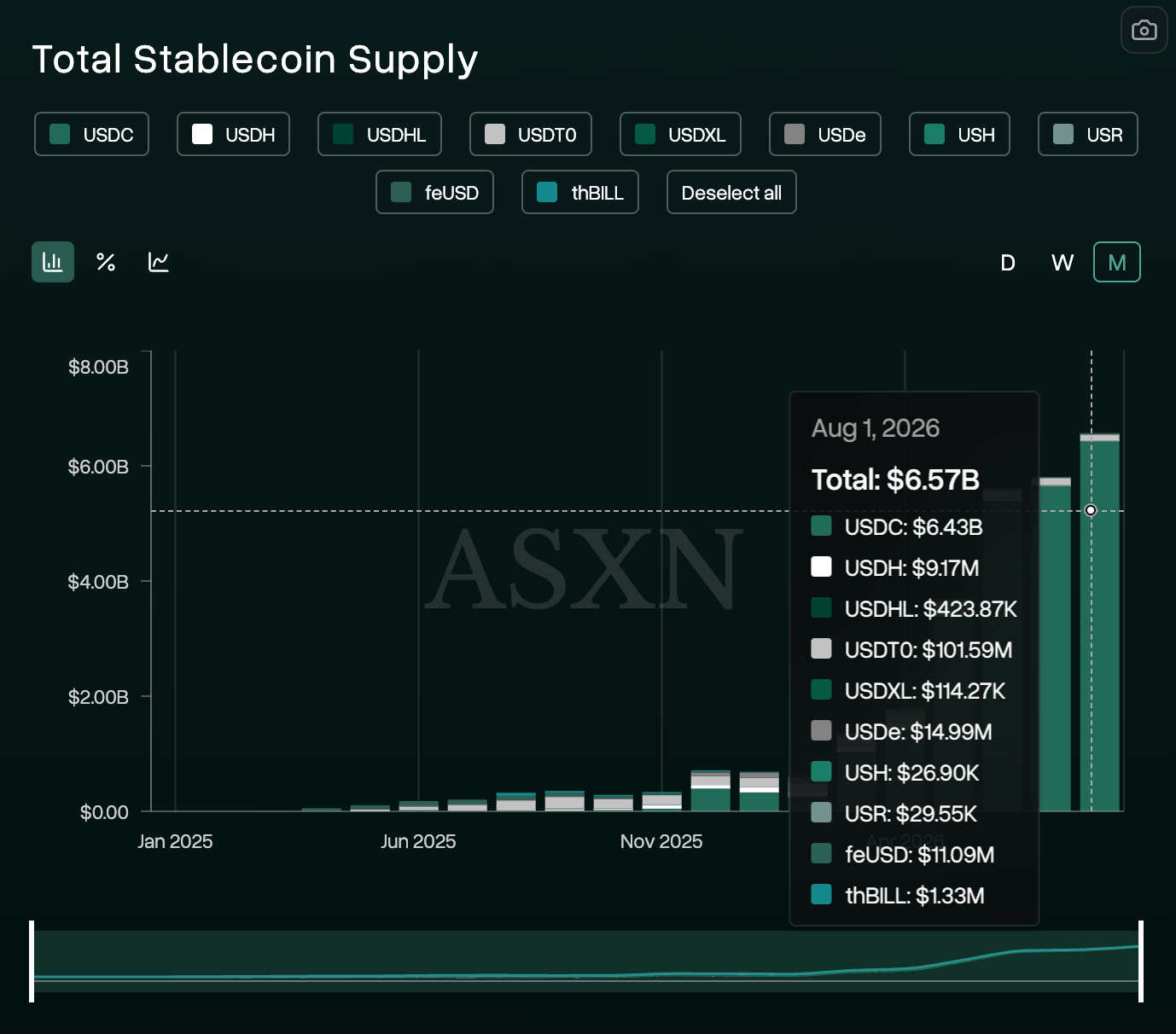
The latest data from Hyper Screener shows that the total circulating stablecoin supply on Hyperliquid has reached approximately $6.57 billion, with USDC dominating overwhelmingly at approximately $6.43 billion in circulation.
Since AQAv2’s revenue sharing ratio is approximately 90%, a very simple formula can be used for estimation:
- AQAv2 annualized revenue ≈ USDC supply on Hyperliquid × reserve yield rate × 90%
Using the current USDC circulation of approximately $6.43 billion as the baseline, the revenue AQAv2 could contribute under different yield scenarios is roughly as follows:
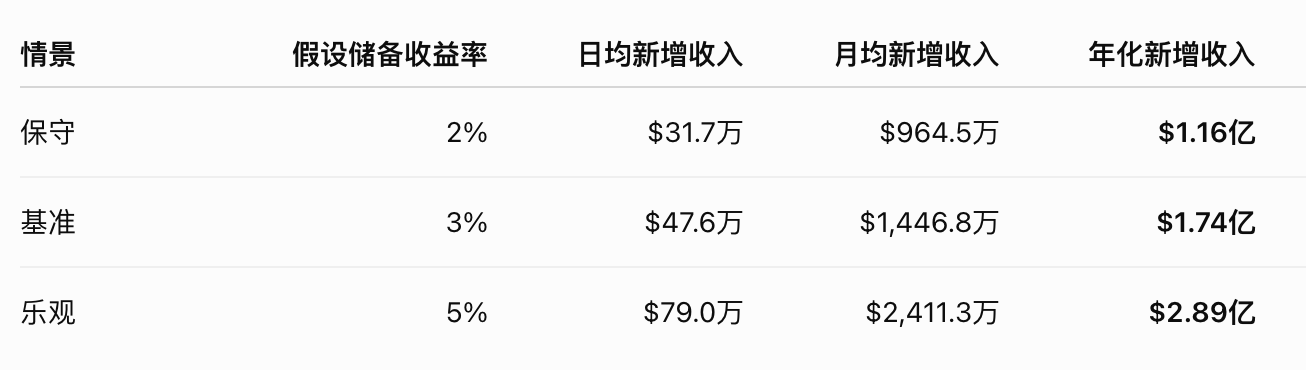
Even using a 3% yield rate, with approximately $6.43 billion in USDC circulation, AQAv2 is estimated to add approximately $476,000 in daily revenue for Hyperliquid, amounting to approximately $174 million on an annualized basis.

What does this number mean? The latest data from Hyper Screener shows that Hyperliquid’s cumulative revenue for August stands at $50.27 million, which, roughly calculated over 26 days, translates to approximately $1.933 million per day. In other words, if AQAv2 operates at a 3% yield rate, the additional revenue would be equivalent to approximately 24.6% of the current daily average revenue.
Even when evaluated based on this static data, AQAv2 already represents a revenue source that cannot be ignored at the margin, and the more critical point is that the USDC circulation on Hyperliquid is still growing at a rapid pace — the more USDC, the more reserve yields generated; the more reserve yields, the more funds entering the Assistance Fund; and ultimately, the more capital available for HYPE buybacks.
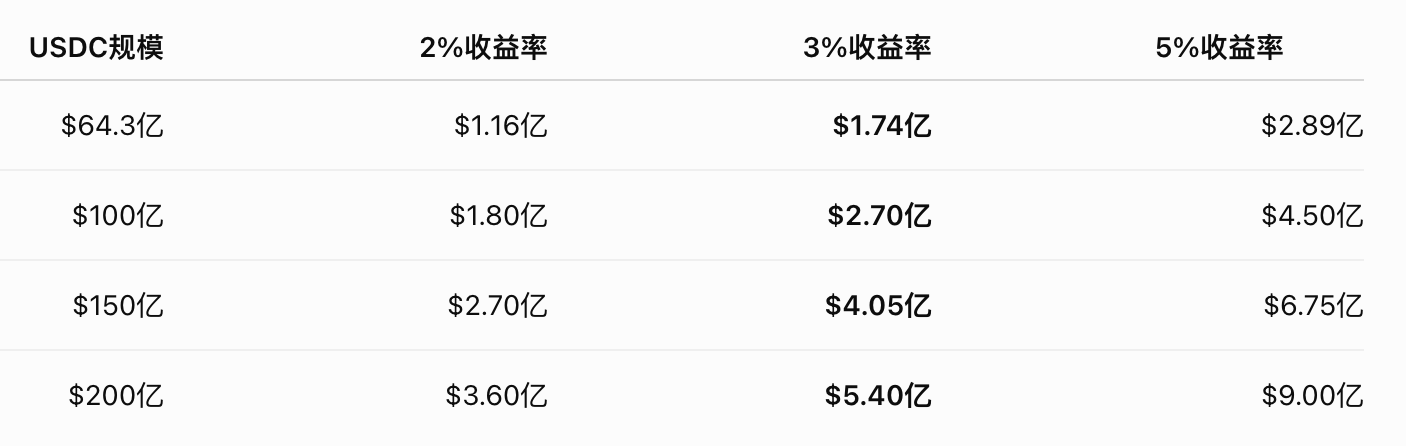
Therefore, $150–200 million in revenue is by no means the ceiling for AQAv2 — rather, it looks more like a starting point for baseline revenue.
The bull market is here, and the positive catalysts keep coming
If the market’s core pricing logic for HYPE was previously highly dependent on Hyperliquid’s trading volume conditions and fee revenue, the launch of AQAv2 means this logic is now expanding further — HYPE’s buyback capability is no longer tied solely to trading activity but is also becoming linked to stablecoin scale.
This coincides with HYPE’s recent strong price action. With improving macro liquidity and rising overall market sentiment, HYPE has broken through $80 and hit an all-time high. The market is reflecting Hyperliquid’s growth expectations through price, and AQAv2 further provides HYPE with new fundamental support — the larger the USDC scale, the higher the reserve yields, and the more capital ultimately available for HYPE buybacks.
Of course, after the short-term rally, HYPE’s valuation is no longer cheap. Whether it can continue to rise ultimately depends on whether revenue, stablecoin scale, and buyback volume can keep growing. But at least for now, Hyperliquid is evolving from an on-chain trading platform that “earns money from trading fees” into a protocol capable of continuously capturing value from trading, stablecoins, and the entire on-chain financial ecosystem.
AQAv2 may not be the sole reason for HYPE’s next leg up, but it is very likely to be an important component of its long-term value capture logic.