
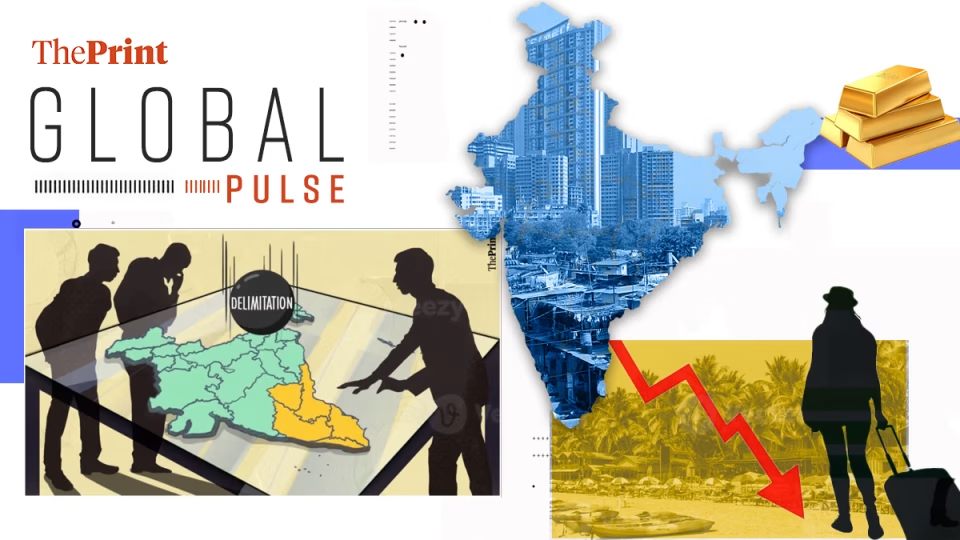
New Delhi: The noise around the delimitation bill may be eclipsing a bigger problem, a column in The Economist said, analysing what lies at the heart of the debate and whether southern states had a point in opposing it.
“Mr Modi’s Bharatiya Janata Party (BJP) introduced a package of reforms that aimed to boost the number of seats in India’s lower house from 543 to 850, to redistribute them between states to reflect demographic changes, and to reserve a third of them for women,” the column noted.
Opposition leaders, particularly from the South, called it “a power grab dressed up as an effort to empower women”, it said.
Had the bill passed, the Opposition alleged, it would have given the poorer northern states greater representation than the prosperous southern ones. “The North is poor, procreates prodigiously, and reliably votes for Narendra Modi. The South is prosperous and less fecund and does not,” the column read.
But, it added, the North has facts and democratic fairness on its side. “MPs in northern Uttar Pradesh on average represent a fifth more voters than those in southern Tamil Nadu. Eventually this imbalance will have to be fixed, probably after a fresh census is held next year,” it argued.
In the larger picture though, the column pointed to the urban-rural divide as a cause for carrying out delimitation. “On average, metropolitan MPs represent a tenth more voters than those in the countryside, and in many places the disparity is much worse,” it said.
It also gave the example of Bengaluru, where the four Lok Sabha seats hold as many voters as six average rural ones. “India’s industrialised southern states complain that they are often treated shoddily despite the chunky contributions they make to national coffers. Cities can make the same claim, but better,” it said.
About 40 percent of India’s population lives in urban areas and produces close to 60 percent of the country’s GDP. Yet, they are greeted with broken footpaths, potholed roads, poor public transport, unbreathable air, and sewage-clogged waterways.
According to The Economist’s analysis, “a fair redistricting” would boost the number of seats by a sixth in India’s six biggest cities alone. “Suburban and semi-urban bits of the country are fast-growing, but often belong to large rural constituencies. A bigger house with smaller districts would see these broken into more sensible divisions. Together, redistricting and expansion would raise urban India’s share of MPs to something like its share of the population. Governments might finally start taking seriously the omnishambles of city life,” the column said.
Veena Venugopal, in the India edition of the Financial Times newsletter, wrote about the concerns over India’s foreign reserves following Prime Minister Narendra Modi’s austerity appeal.
“How dire is the situation if Indians have to tighten their belts and avoid foreign travel and gold purchases,” she asked.
From 748 billion dollars in February 2026 to 690 billion dollars, India’s foreign exchange reserves are clearing out rapidly. “While India has one of the largest reserves in the world — often ranked fifth—the tension this week emerged from a perfect storm of factors,” Venugopal wrote.
Three factors are contributing to India’s foreign exchange crunch. India is the third biggest energy importer and depends on other countries for 90 percent of its oil and 60 percent of its gas. “In the year to March 31, the country had spent $174 billion on energy imports.
Gold imports totalled $72 billion for the same period, up almost a quarter in value on the previous year, while silver imports surged by nearly 150 percent to $12 billion. Fertiliser imports rose 77 percent to $14.6 billion in the last financial year,” the report noted.
Over these four commodities, India’s import bill has more than doubled in the last four years.
The country’s investment portfolio is weakening too, it said, adding that investors were looking elsewhere and withdrawing from the country. “On international trade, India continues to import more than it exports. The country’s trade deficit swelled to nearly $120 billion in the year to March 31, up from $95 billion the previous year.”
The only bright spot, as Venugopal called it, was remittances coming from Indians living abroad, which have largely remained unchanged despite the conflict. “With outflows high and inflows trickling, it is understandable why the government has now hit the panic button. Curtailing gold imports is the least painful way to preserve foreign exchange reserves,” she wrote.
Nikhil Inamdar of the BBC wrote about Goa’s dwindling foreign tourists. According to data released by the state’s tourism department, nearly 9 lakh foreigners visited the state in 2017. By 2025, the number had fallen to 5 lakh.
“The number of domestic tourists, on the other hand, grew from 6.8 million in 2016 to more than 10 million last year,” the report said.
While officials say that the war has affected foreign tourists’ numbers, Inamder pointed out that the decline predates the West Asia conflict. “Why are foreign visitors, who’ve patronised the relaxed budget getaway since the hippie heyday of the 1960s and 1970s, now turning away,” Inamdar questioned.
Budget has become Goa tourism’s biggest problem. People are finding Vietnam and Sri Lanka cheaper. Europeans are also choosing Egypt and Turkey due to proximity and cheaper flights amidst the war, the report pointed out.
Another priority for tourists right now was going to places that are accessible, which preferably give visas on arrival, rather than a long, winding process.
The local government, according to the report, has taken stock of the situation and has started promoting Goa and its culture through roadshows abroad while also trying to draw tourists from Africa and the rest of Asia.
“But with the rise of cheaper, cleaner and more fiercely tourist-driven alternatives emerging across the continent, this land of whitewashed churches, colourful Portuguese homes and charming Susegad people (the quintessential Goan trait of living a slow life) will be forced to sweat much harder to win them back,” the report said.
Also Read: Caution over optimism: Global media looks at reasons behind private equity ‘cooling’ on India