

Strategies from Ninety One, Baillie Gifford and more attracted investor flows in the first half of the year.
After years of playing second fiddle to the US, regions like Japan, Asia Pacific and emerging markets roared back into favour in 2025, as investors sought to diversify their portfolios. Momentum has so far continued into 2026, particularly in markets benefiting from the AI build-out.
But not all funds have equally benefited from the new wave of interest. In fact there were numerous funds that saw outflows – perhaps as people trimmed their winners.
To find out which funds have attracted or lost the most money, we used FE Analytics data across IA Global Emerging Markets, IA Asia Pacific Excluding Japan and IA Japan to highlight those that recorded more than £200m in inflows or more than £200m in outflows over the first six months of the year.
IA Global Emerging Markets
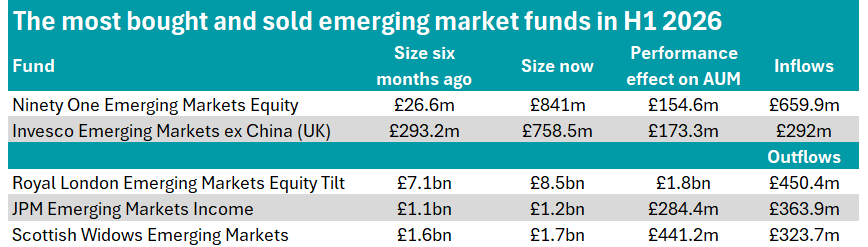
The two funds that have attracted over £200m in inflows over the first half of the year have possibly drawn people in thanks to their exposure to South Korea and Taiwan – two high-flying regions that house companies integral to the AI value chain.
Source: FE Analytics
In particular, Ninety One Emerging Markets Equity was the standout beneficiary of inflows, with the strategy attracting just shy of £660m in net new money and a further £155m from performance. As such, assets under management (AUM) surged from £26m to £841m by the end of June 2026. Much of this increase occurred within a very sudden timeframe, which usually suggests a large investment by an institutional investor or a merging of share classes.
The fund, co-managed by Archie Hart and Varun Laijawalla, carries an FE fundinfo five-Crown Rating and sits on the more expensive end, with an ongoing charges figure (OCF) of 1.18%.
The 87-stock portfolio has leaned into the AI-driven resurgence in Asian technology, with South Korea’s Samsung and SK Hynix accounting for 10.4% and 9.8% of the portfolio respectively. Taiwan’s TSMC is a 9.6% portfolio position.
RSMR analysts said this is a well-established investment philosophy, noting that “its emphasis on behavioural inefficiencies and improving fundamentals is logical in markets like emerging economies”.
Invesco Emerging Markets ex China (UK) also attracted meaningful inflows, pulling in £292m and gaining £173m from performance, bringing total assets to £759m.
Co-managed by FE fundinfo Alpha Manager Charles Bond and James McDermottroe, the fund invests at least 80% of assets in emerging markets outside of China and maintains a 55-stock portfolio.
Like Ninety One Emerging Markets Equity, its top 10 holdings include Samsung and TSMC.
Part of the Invesco strategy’s appeal is also price, as it is one of the cheapest actively managed funds in the sector, with an OCF of 0.75%.
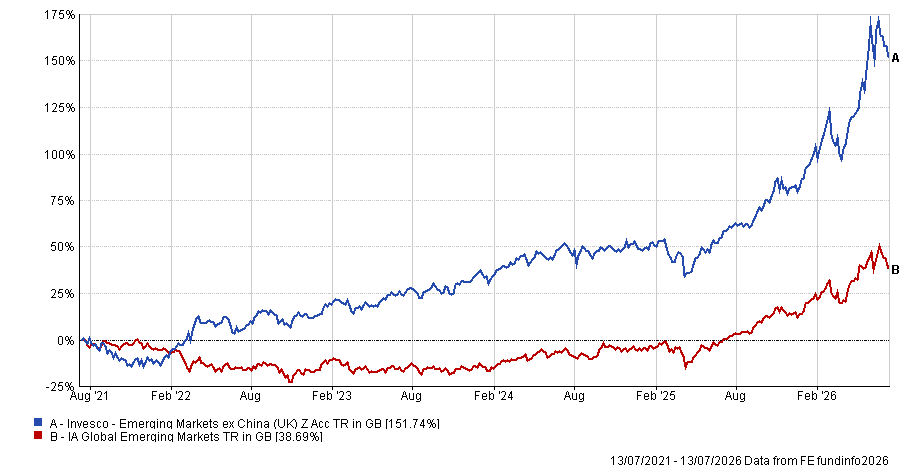
In addition, it proved resilient during downturns, logging top-decile downside capture ratios against the MSCI Emerging Markets index.
Performance of the fund vs sector over 5yrs
Source: FE Analytics
In contrast, Royal London Emerging Markets Equity Tilt had the largest withdrawals in the sector, with investors removing £450m. Despite this, strong performance added £1.8bn, lifting total AUM to £8.5bn.
Co-managed JoJo Chen and Michael Sprot, the fund aims to match the MSCI Emerging Markets ex China A GBP Net 10/40 index over rolling three-year periods while maintaining a carbon footprint at least 10% below the benchmark, although the financial objective takes priority.
Other funds that recorded outflows included JPM Emerging Markets Income and Scottish Widows Emerging Markets, which lost £363.9m and £323.7m respectively.
IA Asia Pacific Excluding Japan
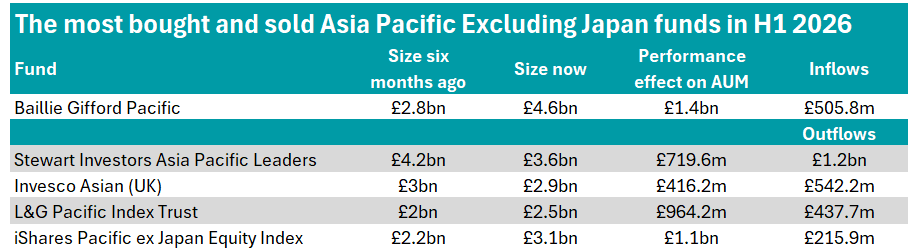
Turning to the IA Asia Pacific Excluding Japan sector, only one strategy attracting more than £200m in net new money.
Source: FE Analytics
Baillie Gifford Pacific was the clear winner, pulling in £506m from investors and gaining £1.4bn from performance. Assets rose from £2.8bn at the start of the year to £4.6bn by the end of June.
The strategy is positioned as a long-term growth strategy with a strong preference for companies capable of compounding earnings. Managed by Roderick Snell and Ben Durrant, it is both index- and sector-agnostic.
However, technology remains a dominant theme, with half of the fund’s assets invested in the sector. Alongside the familiar AI-linked holdings, the fund also has a 2.2% position in CATL, the Chinese battery manufacturer specialising in lithium-ion systems for electric vehicles and energy storage.
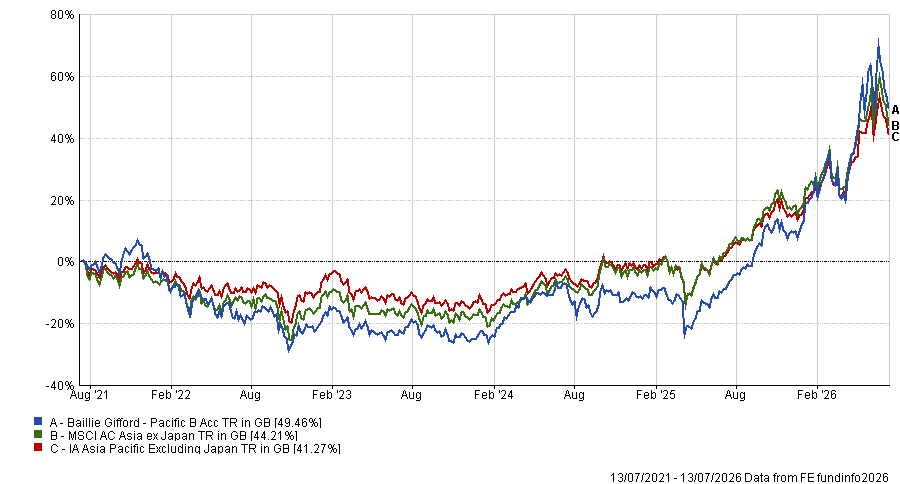
Earlier this year, Darius McDermott, managing director at Chelsea Financial Services, said he would pick Baillie Gifford Pacific in the event of a sell-off in Asia, noting that it tends to benefit significantly once markets recover and investors refocus on structural performance.
Performance of the fund vs sector over 5yrs
Source: FE Analytics
In contrast, Stewart Investors Asia Pacific Leaders recorded the largest outflows in the sector by a wide margin, losing £1.2bn over the six-month period. Although performance added back £720m, total assets still fell by around £700m.
Managed by Alpha Manager Martain Lau and supported by George Pickard and Rizi Mohanty, the fund invests in large- and mid-cap companies across the region and applies a sustainability-focused philosophy.
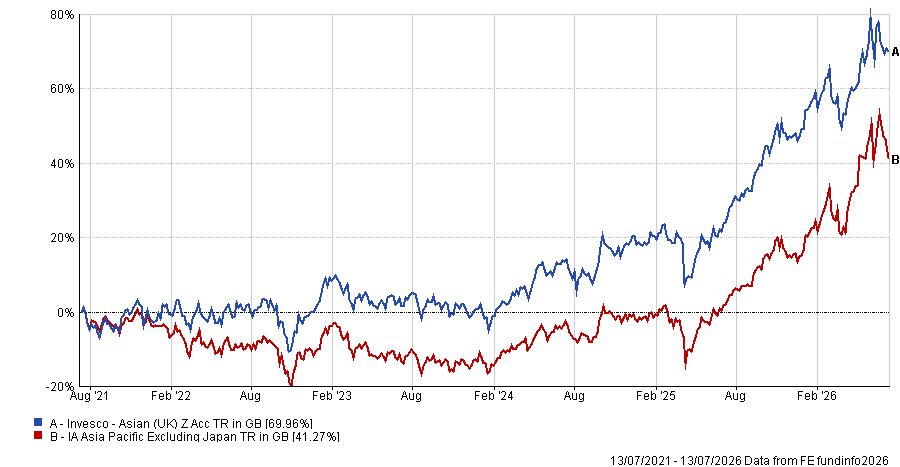
Invesco Asian (UK), which is co-managed by Bond (also in charge of the Invesco Emerging Markets ex China mentioned above), William Lam and Marc Ye, logged withdrawals amounting to £542m, although performance added back £416m.
The fund is benchmark-unconstrained and includes Australia within its remit, focusing on companies the managers believe are trading at a discount to fair value while expected to generate 10% or more in annual shareholder returns while awaiting a re-rating.
RSMR analysts said: “Strong momentum in a small number of names would see the fund lag but this would present opportunities to invest in names which meet the investment criteria of the fund.
“The managers are disciplined in adhering to the process and actively seek out contrarian positions.”
Despite short-term outflows and underperformance, Invesco Asian (UK) has a strong long-term track record, gaining 246.6% over the decade to June 2026.
Performance of the fund vs sector over 5yrs
Source: FE Analytics
IA Japan
Finally, the IA Japan sector logged limited movement at the top end of fund flows, with no strategy attracting more than £200m, while two funds lost above £200m: iShares Japan Equity Index (UK) and L&G Japan Index Trust.

Source: FE Analytics
iShares Japan Equity Index (UK), which is managed by Dharma Laloobhau, logged £657.5m in outflows. The fund tracks the FTSE Japan index, investing in equity securities of leading Japanese companies.
Meanwhile, L&G Japan Index Trust had £208m of outflows. Managed by Konstantins Golonovs and supported by Hailey Choi, the fund also tracks the FTSE Japan index on a net total return basis before fees and expenses.