
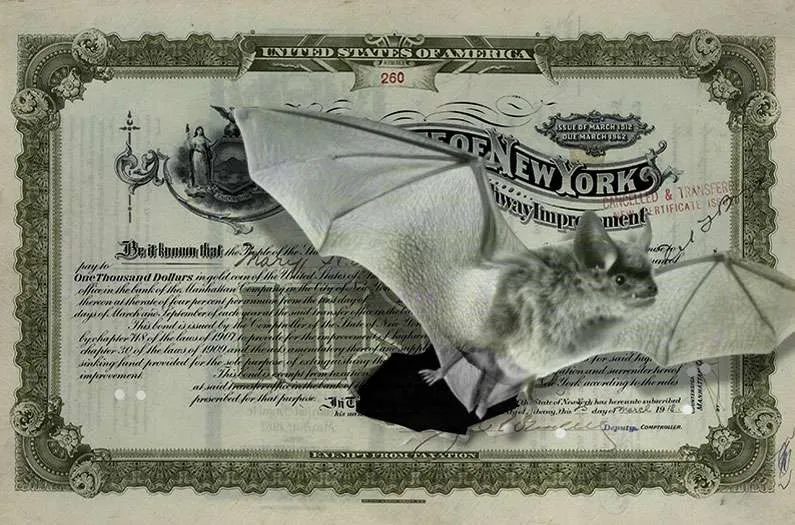
What does a bat-killing fungus have to do with the municipal bond market?
More than you might think. And the link points to the possibility of harnessing investors’ pursuit of profits to help biodiversity.
“This isn’t about conserving bats for bats’ sake,” said Yale University economist Eli Fenichel. “It’s about conserving bats to help communities reduce the cost of borrowing money for all manner of things.”
Conservationists are constantly looking for ways to entice people to invest in protecting wildlife. While “it’s good for the planet” is a common argument, appeals to altruism often fail to unlock the money researchers say is needed. Proponents of biodiversity instead appeal to people’s self-interest, whether it’s touting the role biodiversity protections can play in preventing human diseases, capturing carbon, controlling pests or various other human-centered benefits.
But what if wildlife conservation efforts could tap directly into financial markets, without needing to create a novel investment tool like biodiversity credits? Bats’ appetite for crop-eating insects and the connection between local farm income and government bond prices illustrates how that might work, Fenichel and colleagues at Yale and the University of Tennessee argue in a recent paper in Science.
“This approach reframes biodiversity protection not just as the ‘right thing to do’ from the perspective of conserving nature, but as a strategic risk-management strategy with a positive return for local government and investors alike,” said lead author Anya Nakhmurina, a professor of accounting at Yale.
To understand how this might work, we need to take a brief (I promise) journey into the arcane world of municipal bonds. Buckle up. We’ll get back to saving bats in a few paragraphs.
When local governments in the U.S. need to pay for big projects such as new roads or a sewage treatment plant, they usually borrow money and promise to pay back the loans, with interest. Those loans come in the form of bonds, which governments such as counties sell to investors.
The government uses future tax revenues to repay the bonds along with whatever interest rate they promised in order to lure investors. The lower the interest rate, the cheaper it is for the government to take on debt. The higher it is, the more attractive it can be to investors.
A key variable driving the interest rate is how much risk investors see that the government might not have the money to pay off the bond and instead default on the loan. Think of it like the mortgage market for home buyers. If someone has shaky finances, a bank might only provide a loan with a higher interest rate.
So how does this come back to nocturnal flying mammals? Because it turns out that the fate of bats in the U.S. is linked to the financial fortunes of farms, which in turn affects local property tax revenues collected from those farms, which can influence interest rates for municipal bonds. It’s like the kid’s song about the old woman who swallowed a fly, then swallows a spider to catch the fly, in a cascading set of interlinked actions that eventually lead to her swallowing a horse. Only in this case, it’s a story of bats swallowing a whole lot of flies.
Insect-eating bats are remarkably effective pest-control machines. The paper’s authors calculated that a single colony of 150 big brown bats could eat 600,000 cucumber beetles in a single year, translating into demolishing as many as 33 million larvae the beetles might have produced. Those larvae, known as rootworms, are a major pest for corn growers.
More pests mean less productive crops or more spending on pesticides. That can dent local tax collections which, for farmland, are pegged to farm revenue.
“Not managing bat populations is like letting roads become full of potholes,” said co-author Dale Manning, an economist at the University of Tennessee. “They’re part of the agricultural infrastructure, and when that gets degraded, the effects are felt broadly.”
This isn’t just hypothetical. The spread of the devastating fungus that causes the lethal white-nose syndrome in U.S. bats provided a kind of gruesome experiment, enabling the researchers to see links between bat health and local government health as the infection spread across the country.
First discovered in 2006 among bats hibernating in caves in upstate New York, the illness, caused by the fungus Pseudogymnoascus destructans, has now been found in 47 states and has killed millions of bats. Depending on the species, it can virtually wipe out a colony.
The damage showed up not just in bat caves but in county government coffers. When researchers compared counties’ financial condition before and after white nose syndrome arrived, they found a clear sign that a county’s tax revenue fell the longer the disease was around. Property tax revenue in infected rural counties fell by 16% per capita, compared with the average performance among rural counties. The effect also turned up in the interest rates for bonds, with fungus-affected counties facing higher interest rates. The link was particularly evident in places with a bigger variety in species of bats, probably because that increased the likelihood that some bats would be vulnerable to the disease.
While the disease creates a headache for bats, farmers and government officials, it could also create an opportunity for investors. That’s because if the damaged caused by the disease is diminished by conservation measures, such as protecting bat habitat, a bond issued by the local government would become less risky.
A savvy investor could, in theory, buy municipal bonds, then announce plans to help boost the local bat population. If the market thinks those plans will help bats and local tax revenues, the bonds suddenly seem less risky and more valuable.
The investor should be able to resell those bonds at a higher price and pocket the difference. Based on a hypothetical scenario, an investor could potentially buy a $1 million bonds and resell it for $1,013,855, the researchers calculated based on how the disease has affected bond values in the past.
“No one is going to become a billionaire with this strategy,” said Fenichel. “But if we can build these broader portfolios in the bond market, we can empower local communities to do things like finance conservation and even adapt to climate change.”
A similar strategy could work for species besides bats as well, assuming there’s a strong link to investment tools such as bonds.
But this all hinges on investors being able to finance things that are proven to counter the damage of white-nose syndrome. So far, there is little good news in that regard. Scientists are working on a vaccine, and there is some evidence that modifying caves to make them colder can help ward off the disease. But all of these remain in the experimental phase. Until one of them goes mainstream, bond investors are unlikely to be aiding in the campaign to rescue bats.
Nakhmurina, et. al. “The fiscal impact of biodiversity loss and a pathway for conservation finance.” Science. March 12, 2026.
Image: ©Anthropocene Magazine