
Artificial intelligence has long been seen as a way to supercharge drug development. But a whole new frontier of computing is opening up at cutting-edge labs around the globe—and Big Pharmas are getting in on the action.
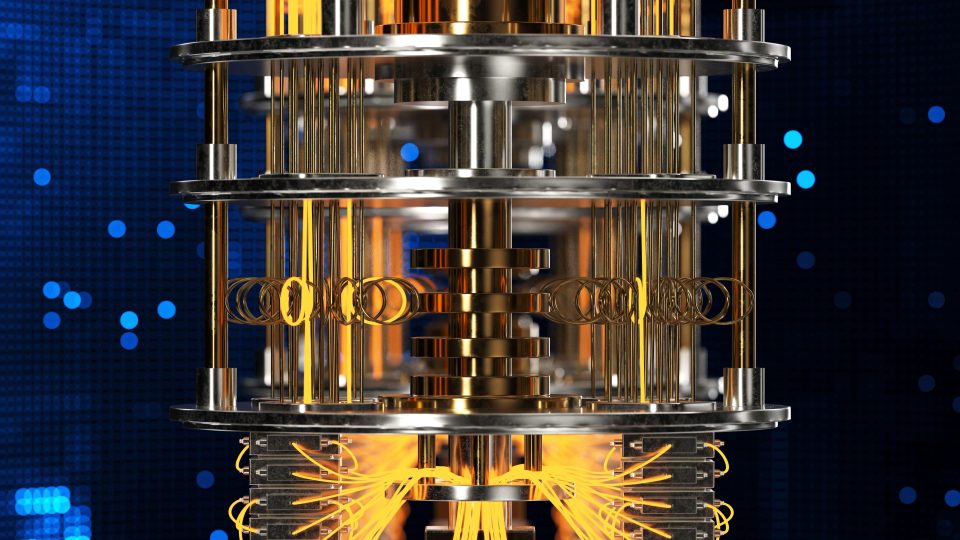
Quantum computing is based on the principles of quantum physics, which describes the behavior of atoms and particles. Unlike a traditional computer, whose CPU performs calculations using bits that have a value of 0 or 1, quantum computers store information in so-called quantum bits, or qubits, which can simultaneously be both 0 and 1 as well as an infinite number of states inbetween. In principle, this means they could solve problems far beyond the reach of today’s traditional supercomputers.
In fact, that’s something of an understatement—Google’s quantum computer is already considered to be 1.5 billion times faster than a classical computer. But household names like Google aren’t the only ones working on quantum computers. From the U.S. to the U.K., Japan and the Nordics, quantum startups and academic centers are pushing this science forward at rapid speed.
After steadily growing in recent years, venture capital investment in quantum-focused companies exploded in 2025. In fact, last year saw $3.8 billion of VC deal activity in the sector, according to Pitchbook data shared with Fierce, with another $581 million landing within the first two months of 2026 alone.

The end goal for the biggest tech giants like Google, IBM and Microsoft is to achieve “quantum supremacy”—where a quantum computer can demonstrate that it completed a mathematical calculation beyond the capability of even the most powerful supercomputers in existence today.
But a handful of drugmakers and pharma-related organizations haven’t been waiting around for this final proof to start adapting to the quantum future. Boehringer Ingelheim entered into a partnership with Google Quantum AI in 2021, while Pfizer has linked up with XtalPi, a U.S.-China pharmaceutical tech company whose work has been pioneered by a group of quantum physicists.
Amgen secured its first partnership in the quantum arena six years ago, according to Alan Russell, VP of R&D Technology and Innovation at the U.S. pharma.
That interest led to a collaboration—and eventual investment—in Quantinuum. The quantum tech firm was created in 2021 when industrial manufacturing juggernaut Honeywell spun off its quantum computing hardware business and merged it with a U.K.-based software firm. Quantinuum and Amgen have initially worked together on computational biology, before the pharma took part in Quantinuum’s $300 million equity investment round in 2023.
“We’re asking this question of: when is the moment that quantum value can be established for the kind of drug discovery work that we’re doing?” Russell told Fierce Biotech in an interview.
While the potential ways to create qubits stretch from using superconducting chips to ions and even a newly discovered state of quantum matter called topological insulators, Amgen is “agnostic” about which avenue of research will eventually pay off, Russell said.
“We don’t mind if the problem is solved by superconductors. We don’t mind if it’s solved by ion traps—that’s not our business,” he said. “What we’re interested in is when will stable, error-free quantum computing allow us to do things we can’t do today?”
For Amgen, those use cases fall into two main categories. The first, and more obvious, example is quantum-enabled drug discovery—where the tech is used to speed up or otherwise improve existing drug discovery processes.
“Separately, you could imagine that there are quantum-dependent drug discovery projects—things that you could only do once a quantum machine existed,” Russell added.
Quantum momentum
Darmstadt, Germany-based Merck KGaA has also been exploring the quantum realm for a few years now. This has included a 2019 collaboration with German startup HQS Quantum Simulations to evaluate the application of software to conduct precise quantum chemical calculations, as well as 2020 pact with London-based outfit Rahko focused on how quantum-based machine learning could be harnessed to develop new medicinal products and molecules.
Thomas Ehmer, Ph.D., who works within Merck KGaA’s Healthcare Digital Innovation and New Tech unit, told Fierce that he sees his role as “scouting the technology.”
The approach quantum-curious companies like Merck KGaA take to exploring the potential of quantum computing depends on “how much appetite you have, really, to drive the field yourself, or how mature you consider the field” to be, Ehmer told Fierce in an interview.
Among Merck KGaA’s fellow drug developers, interest in quantum computing has come “in waves,” he said.
“The more people get oversaturated with gen[erative] AI, the more they look for real alternatives—and then you just can’t ignore quantum,” Ehmer said.
Denmark’s capital of Copenhagen has developed a reputation as a quantum hub, thanks to research at the city’s top university. Back in 2022, the Novo Nordisk Foundation—of which Novo Nordisk itself is a subsidiary—pledged $200 million to a program at the University of Copenhagen designed to develop the world’s first full-scale quantum computer aimed at the development of new medicines.
Since then, Novo Holdings, which is the controlling shareholder of Novo Nordisk, has set up its own quantum team tasked with building a portfolio of up to 10 direct investments by 2030. The first commitment was to Quantonation II, a Paris-based deep tech fund focused on quantum.

Last October, Novo Holdings acted as a cornerstone investor in Copenhagen-based 55 North, which billed itself as the “world’s largest dedicated quantum fund.”
Søren Møller, Ph.D., who heads up Novo Holdings’ seeds investments team, told Fierce that while the firm has a “very strong view on the life sciences application” of quantum computing, for now a key goal is to understand its true potential beyond any one field.
“We need to understand the technology inside the quantum space,” Møller said in an interview. “Can it actually deliver what we think it can deliver, and what kind of risks are there?”
Among the various quantum plays Novo Holdings has made to date, Møller highlighted the firm’s participation in April 2025 in the €21.5 million ($24.8 million) series A round of Sparrow Quantum, a Danish manufacturer of photonic quantum chips.
While Sparrow “doesn’t have a specific life science application,” it was an opportunity for Novo Holdings to “get exposed to the technology and the hardware,” he explained.
Møller also drew attention to the firm’s involvement in last September’s $34 million series B for the U.K.-based quantum algorithms company Phasecraft.
“We are helping them think through: what are the first commercial applications, and could they be in the life science space?” he said.
The road ahead
Many hurdles remain before we truly enter the quantum realm. Scientists are grappling with error correction and how to scale qubit counts, while the debate about which hardware platforms to use has yet to produce a clear winner.

(Novo Nordisk Foundation)
But with so much money and Big Pharma interest, how close are we to using quantum computing in drug discovery?
Novo Holdings’ quantum team is “confident that tangible quantum advantage for defined applications will be achieved before 2030,” according to their annual review of investments (PDF).
“At the moment, you can’t go in and say, ‘Hey, we use quantum docking to improve this molecule,’ because the computer is not there yet,” Møller told Fierce.
“But I do think that if you come at it from the algorithm side and improve the efficiency of that piece of the calculation, and then you come from the hardware side—it’s not that far out that these two things will converge and be potentially useful for life sciences,” Møller added.
The “low-hanging fruit” will be using quantum computing to assist with “certain elements of docking of small molecules” for use in protein and peptide design, according to Møller. There’s also the opportunity to provide training sets for AI to then work off when optimizing drug design and biomarker discovery.
“If you have quantum model of a molecule, you can actually calculate the theoretical training set that you then use for the AI to build a model on,” he explained. “I think those kind of applications would be interesting, both for material science and drug discovery.”
Amgen’s Russell pointed out that quantum science “has been progressing at what seems to be a predictable timeline.”
“Let’s be really negative,” he said. “Let’s say it’s five years—plus or minus two years—before there’s a 1,000-error-free-qubit machine readily available for us to work with. That’s really soon.”
“If a company like Amgen was not deeply interested in this, and beginning to work on it and beginning to get ready—then you would have wasted three-to-five years,” he pointed out.
Reasons for caution
Merck KGaA’s Ehmer is more cautious about these timelines. “It’s always three years away,” he said, alluding to the bold predictions of quantum companies.
But Ehmer thinks “the expectations are growing from end users,” he continued, pointing out that we have come a long way from quantum-based systems that crashed as soon as they were opened.
As with the billions funneled into the AI explosion, there’s also the issue of cost.
“There comes this value discussion,” Ehmer said. “The challenge is that even if the hardware picks up and we have [workable] algorithms, is it justified that we identify problems that we can only use quantum computers [for]?”
“[Do] they really provide this niche [of] the killer app, so that it’s really added value to have people like me spending three years in advance, building competence, just to be ready at the moment—if this ever comes,” he continued.
While the jury is still out on just how transformational quantum computing will be to drug development, Amgen’s Russell described the strategy of Big Pharma getting involved now as “skating to where the puck is.”
“Given five-to-10-year interest in this space and actual work in this space, it’s not like we’ve been just watching,” he said. “We’ve been doing collaborations for quite some time.”
“Given that, I think we’re able to see where the puck is heading,” Russell added. “Now we are very actively skating towards the puck to make sure that we’re ready.”