
Pulse Alternative
Alternative Investments

The market is at the start of the next commodity supercycle, Carlyle’s Jeff Currie says


The market is at the start of the next commodity supercycle, according to energy strategist and investor Jeff Currie of the Carlyle Group.

In a thread posted to X on Friday morning, Currie laid out a multipronged argument for why the market is right at the beginning of the next years-long rally cycle for commodities that he called “the most asymmetric trade in modern financial history.”

First, the artificial intelligence trade faces major bottlenecks, even as four of the “Magnificent Seven” companies — Alphabet (GOOG, GOOG), Meta (META), Microsoft (MSFT), and Amazon (AMZN) — are expected to spend more than $700 billion on capital expenditures in 2026 alone.

One of those bottlenecks is in physical materials. The Iran conflict has triggered the largest energy supply shock in history as the oil market has lost more than 13.7 million barrels per day, according to Goldman Sachs. Traders argue that even after the war resolves, the playing field for the Persian Gulf — one of the most important supply markets in the world for everything from energy and metals to fertilizers — has changed.

At the same time, the metals complex has raced ahead, with demand for copper (HG=F), aluminum (ALI=F), and other metals booming, even as the world’s top 20 miners are spending 40% less than they were at the peak of the last supercycle in 2012, Currie said.

Another one of those bottlenecks is compute capacity. As leading AI labs, such as Anthropic (ANTH.PVT), OpenAI (OPAI.PVT), and Google’s DeepMind, have pushed the boundaries of their frontier models, computing has emerged as a key constraint.

The demand has reached such a fever pitch that the Chicago Mercantile Exchange is now working on constructing a futures market for compute, benchmarked to the rental prices of graphics processing units (GPUs). Shares in Cerebras (CBRS), a chip designer looking to rival Nvidia (NVDA), opened at a 90% premium to their IPO price when the company went public on Thursday.

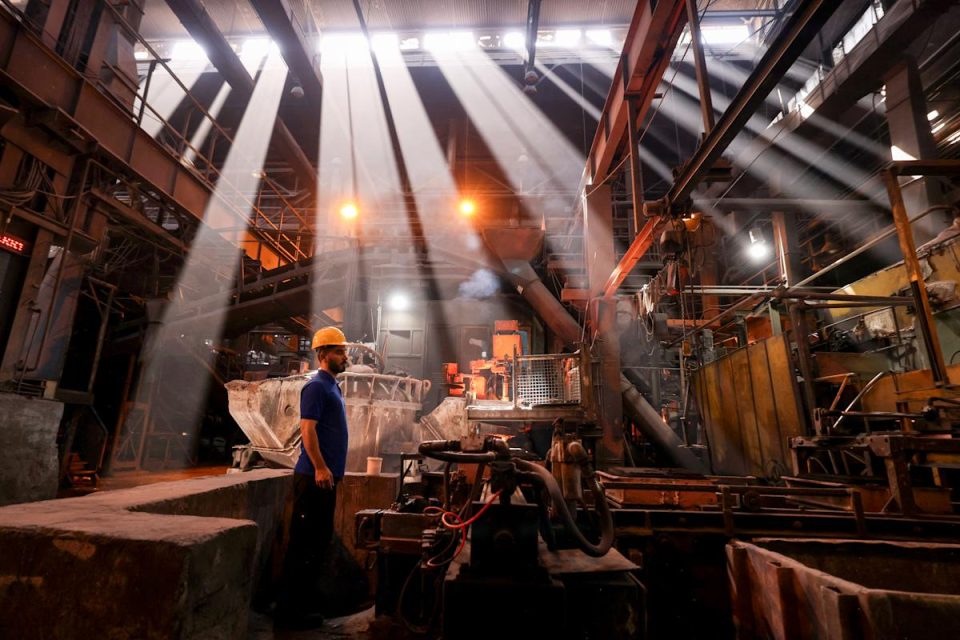
Iranian labourers work in the metal smelting plant, casting and molding of car engine parts, at the Tabriz Tractor Factory, on September 17, 2025, in Tabriz in northwestern Iran. (Photo by ATTA KENARE / AFP) (Photo by ATTA KENARE/AFP via Getty Images)
Iranian laborers cast and mold car engine parts at the Tabriz Tractor Factory’s metal smelting plant on Sept. 17, 2025, in Tabriz, in northwestern Iran. (Atta Kenare/AFP via Getty Images) · ATTA KENARE via Getty Images

All of that compute capacity relies on the physical infrastructure of semiconductor materials and manufacturing, from energy to metals.

“The opportunity exists because capital has chased the AI trade while ignoring the physical assets AI requires to run — assets that have quietly become the best-performing asset class of the decade,” Currie wrote.

Second, as physical resources get tighter, the market is swinging increasingly toward deglobalization, Currie argued, moving in the opposite direction of the last commodities supercycle that began in the early 2000s with China’s emergence on the world stage as a major economic power and the increasing interconnection of international markets.

U.S. President Donald Trump shakes hands with Chinese President Xi Jinping while leaving after a visit to the Zhongnanhai Garden in Beijing, China, May 15, 2026. REUTERS/Evan Vucci/Pool
President Trump shakes hands with Chinese President Xi Jinping after a visit to the Zhongnanhai Garden in Beijing, China, on May 15, 2026. (Reuters/Evan Vucci/Pool) · Reuters / REUTERS

In an environment of deglobalization, Currie argued, supply chains get tighter and competition for an increasingly small supply of resources increases, moving the market from a “HAGO” model — referring to “hard assets, global operations” — a to “HALO” model, which Currie defined as “hard assets, local operations,” rather than the term’s typical meaning of “heavy assets, low obsolescence.”

“The 2000s super cycle was HAGO — Hard Assets, Global Operations. China assembling, Russia piping, dollars recycling, everything moving across borders frictionlessly,” Currie wrote. “That regime is dead.”

His closing argument: “Get long. Buckle in. Hang on for the ride.”

Jake Conley is a breaking news reporter covering US equities for Yahoo Finance. Follow him on X at @byjakeconley or email him at jake.conley@yahooinc.com.

Click here for in-depth analysis of the latest stock market news and events moving stock prices

Read the latest financial and business news from Yahoo Finance


Source link

Related posts

FSB flags supervisory data gaps across $2 trillion private credit market

George

Is Manulife Expanding Global Alternative Asset Distribution Strategy? – Kalkine Media

George

UR and Ant Group’s TopNod Partner to Bring Onchain Assets to Everyday Spending

George

Leave a Comment