
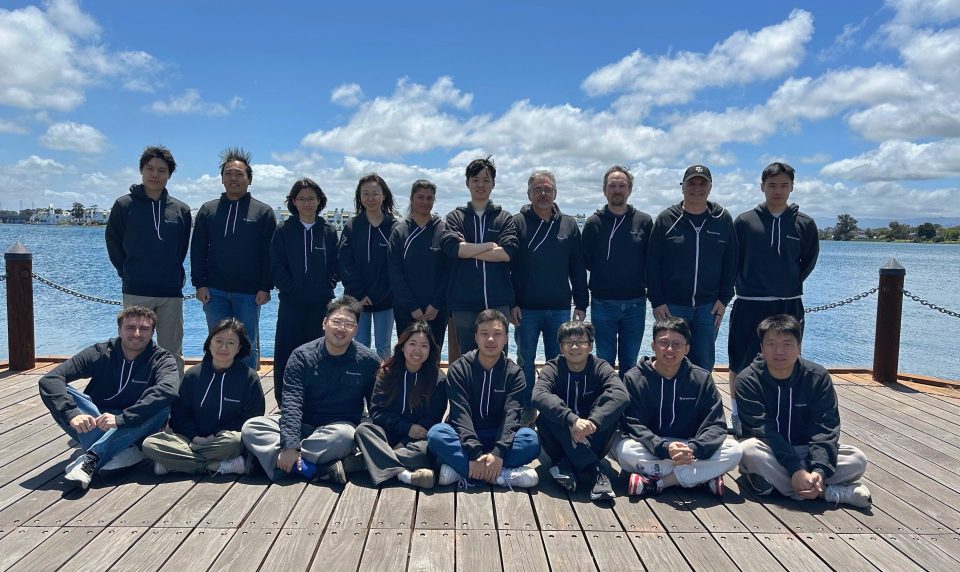

The Tensormesh team
Tensormesh has raised $20 million in new funding from investors including AMD Ventures, CoreWeave, NVentures, Valley Capital Partners, and Laude Ventures as the company launches its inference optimization platform aimed at reducing one of enterprise AI’s largest operational costs: redundant GPU computation.
The funding extends Tensormesh’s seed round and brings total capital raised to $24.5 million. The company also announced the general availability of Tensormesh Inference, a SaaS platform built around KV caching technology designed to reduce inference latency and GPU utilization costs.
The platform targets a growing infrastructure bottleneck across enterprise AI deployments, where large language model inference repeatedly recomputes identical prompt context — including conversation history, system prompts, and tool definitions — for every request.
That repeated processing consumes substantial GPU capacity and materially increases operating costs as AI workloads scale.
Tensormesh said its platform stores and reuses previously computed results through KV caching, allowing repeated prompt context to be served directly from cache rather than recomputed from scratch. The company claims the approach can reduce latency and GPU spend by as much as 10x.
Operationally, inference economics increasingly have become one of the most significant constraints on enterprise AI adoption, particularly for multi-step agentic workflows and production-scale deployments where token usage grows rapidly across repeated interactions.
While model training has historically received the majority of infrastructure attention, many enterprises now are discovering that inference execution — particularly repeated context recomputation — can become the dominant ongoing operational expense.
Tensormesh positions KV caching as foundational infrastructure for solving that problem.
The company’s strategic investor base highlights the growing importance of inference optimization across the broader AI infrastructure stack. Investors include GPU manufacturers, AI cloud operators, and infrastructure-focused venture firms.
AMD Corporate Vice President of AI Ramine Roane said software-layer optimizations like KV caching are becoming increasingly important complements to raw accelerator performance as enterprises attempt to maximize GPU utilization.
CoreWeave Co-founder Brannin McBee said inference scalability and economics increasingly represent critical infrastructure challenges for enterprise AI deployments.
Tensormesh said its platform emerged from LMCache, an open-source KV caching project that has gained adoption across AI infrastructure frameworks including vLLM, SGLang, TensorRT, AWS SageMaker, and Oracle OCI Data Science.
The company’s commercialization strategy centers on integrating caching directly into enterprise inference workflows without requiring customers to redesign application infrastructure.
Its serverless inference offering provides OpenAI-compatible APIs for immediate deployment, while reserved deployments support enterprises requiring dedicated inference capacity and customized SLAs.
One of the platform’s more aggressive commercial differentiators is its pricing model: cached input tokens served from KV cache are billed at zero cost.
The company also exposes operational metrics including cache hit rates, token-level cost breakdowns, throughput, latency, and GPU utilization in real time, allowing enterprise teams to tune deployments around measurable infrastructure efficiency rather than opaque backend optimizations.
That visibility addresses a broader frustration among enterprise AI operators, many of whom currently lack transparency into how inference providers manage caching, token reuse, and infrastructure optimization internally.
Tensormesh said optimized deployments regularly achieve cache hit rates above 70%, materially lowering inference costs as workloads scale.
The company plans to use the new funding to expand hardware-level integrations with AMD, NVIDIA, and CoreWeave infrastructure while continuing development of its open-source LMCache ecosystem.