
The US Securities and Exchange Commission (SEC) has elevated digital assets to a strategic priority, calling for regulatory clarity around blockchain technology, tokenization and crypto market infrastructure through 2030.
The shift was outlined in the agency’s draft Strategic Plan for fiscal years 2026–2030, published Tuesday. Alongside broader goals focused on capital formation, investor protection and agency modernization, the SEC dedicated an entire objective to digital assets and distributed ledger technology.
The agency said it aims to “provide a firm regulatory foundation for digital assets and distributed ledger technologies through a rational, coherent, and principled approach,” adding:
“Blockchain and crypto asset technologies have the potential to revolutionize America’s financial infrastructure.”
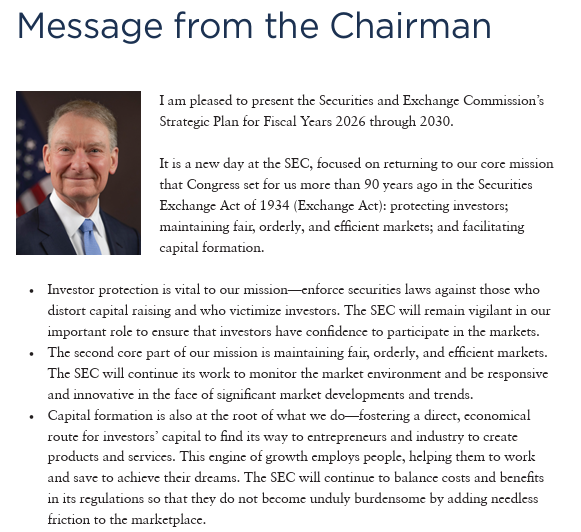
An excerpt from SEC Chair Paul Atkins’ message
in the agency’s draft Strategic Plan. Source: SEC
The strategic plan acknowledges that the growth of digital assets has outpaced existing regulations and calls for greater legal certainty for market participants. It also highlights tokenized offerings and onchain financial infrastructure as areas where the SEC intends to support compliant capital formation.
The document further references custody, trading and staking services, saying they should be able to operate under appropriate oversight without duplicative or conflicting regulatory requirements.
SEC reiterates the need for a clearer division of oversight with CFTC
Another key priority outlined in the draft plan is clarifying the division of responsibilities between the SEC and the Commodity Futures Trading Commission (CFTC), a longstanding issue in US digital asset regulation.
As part of its push for a more coherent regulatory framework, the SEC said establishing clear rules for digital assets “also involves clarifying jurisdictional questions between the SEC and Commodity Futures Trading Commission.”
The agencies have already taken steps toward closer coordination. In March, the SEC and CFTC signed a memorandum of understanding to strengthen cooperation and information sharing as emerging technologies continue to reshape financial markets.

Source: Mike Selig
Jurisdictional boundaries between the SEC and CFTC are also a central issue in congressional deliberations over the Digital Asset Market Clarity Act, a market structure bill that seeks to establish a regulatory framework for digital assets.
As Cointelegraph previously reported, the legislation is expected to expand the CFTC’s authority over large segments of the digital asset market. The bill advanced out of the Senate Banking Committee last month and is expected to proceed to the Senate floor for a full vote.