
SINGAPORE (April 23): Singapore hedge fund analyst Lee Kok Yew was bleeding money last April, as Donald Trump’s Liberation Day tariffs roiled global markets. Within weeks, his trading book was more than US$50 million (RM198.22 million) in the red and he was worried he’d get fired.
“The absolute magnitude was staggering,” he recalled, describing his biggest career crisis. His employer’s safeguards soon kicked in and the money allocated to his stock picks got slashed. “Everywhere else you would’ve lost your job for sure.”
Instead, his boss told him to fetch his running shoes. For several weekends, Lee laced up pre-dawn and headed to FengHe Fund Management Pte Ltd founding partner Matt Hu’s house in the luxury enclave of Sentosa Cove. For an hour, they’d run and walk as Hu asked questions and gave advice before sharing breakfast on Hu’s patio — no showering in between. By the end of the year, Lee had made the money back and more.
This unconventional approach is typical for Hu, who has quietly built one of Asia’s biggest and fastest-growing hedge funds — and demonstrated that firms with single decision-makers can still thrive in the age of pod shops. FengHe’s assets under management more than doubled over the past 15 months to reach almost US$9 billion by the end of March, and they are still rising. Hu now has the bold ambition of hitting US$20 billion within the next two years.
The long-short equity fund manager, which has had only one year of net declines since the fund was established in 2012, posted a net return of 27% last year thanks partly to winning bets on Alibaba Group Holding Ltd and Samsung Electronics Co, according to company executives. The ultimate goal: to create one of the best-known fund houses in the world.
“Most of the respected investors are from Wall Street,” Hu said from his mansion overlooking the South China Sea in Hong Kong, where he spends part of his time. He names Oaktree Capital Management co-founder Howard Marks and billionaire Warren Buffett as finance icons. “The dream is that maybe one day the investment industry will put my name there.”
Buffett and Marks are ambitious benchmarks for a fund manager whose firm is still little known outside of Asia, and whose style is a touch old-fashioned in an era where multi-manager companies and algorithmic trading dominate. But interviews with FengHe executives and their rivals suggest the firm has reason to be confident.
The panopticon
Hu, 56, has an unusual approach to running a hedge fund of this size. Portfolio managers — the rockstars whose bets normally determine a firm’s wins and losses — don’t exist. Instead, the team comprises analysts who recommend investments and have trading books tied to their picks but don’t make the final call. That’s Hu’s job alone, although four managing directors have the power to allocate more capital to trades he has already approved.
The firm’s 20 analysts rarely talk face-to-face about their recommendations. Instead, most discussions are done over the Slack messaging system. FengHe tracks about 600 companies and each has a dedicated channel where analysts debate ideas.
Like the master of a high-surveillance Panopticon, Hu monitors every chat, largely silent but occasionally chiming in with questions or critiques. Staff are discouraged from huddling in person to avoid groupthink and bias.
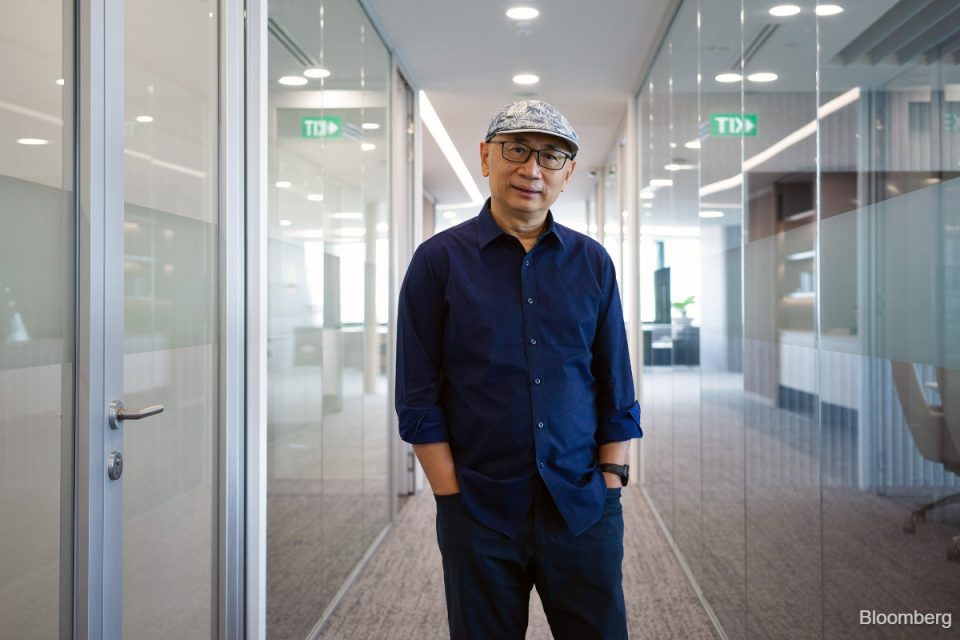
To foster this culture, FengHe’s office in Singapore blends corporate chic with monastic cells. Each analyst sits alone, ensconced in a glass-walled office. Some express their personalities through plush toys and family photos. Many type away in studious silence.
When an analyst decides to pitch an idea, they need to write out a detailed investment thesis before completing a form with more than 100 multiple-choice questions. These run the gamut from a target’s return on equity to how much pollution it produces. The system automatically scores those answers. Anything that gets a mark of less than 60% is automatically rejected.
Hu’s logic is that about two-thirds of his team’s ideas are good and the rest are not; sometimes his own ideas fail to clear the process. It also means that he’ll often approve ideas he disagrees with as long as the system has given them the tick.
Afternoon naps
In many ways, the firm is an extension of Hu’s own personality. In person, he’s energetic, easily shares humorous anecdotes and often sports a jaunty patterned flat cap. But he prefers isolation: each Chinese New Year he leaves his Singapore home to spend several weeks in Hong Kong to escape the city-state’s notorious heat and the endless rounds of social interaction that come with the festivities.
Every morning, Hu wakes at 4am and works in silence. For the next three hours, he reads through the Slack channels. Staff will wake to pages of his feedback, lessons on investing and detailed questions.
By 7am, proposed trades for the entire day have either been authorised or rejected. For the next hour he’ll exercise and eat — sometimes with colleagues who want or need extra attention — before having small group sessions with investment teams. He also joins external meetings with experts, consultants or companies FengHe has backed.
Hu’s own office is a self-contained haven. There’s a mirror and sink to freshen up, a standing desk with a screen and a large banner with Chinese calligraphy that reads “stillness brings wisdom”. A spotless Chinese tea set rests on a dining table. The most genuine piece of furniture is a well-creased tan recliner with a neatly folded blanket where he naps for at least an hour every day after lunch. While a hedge fund boss taking daily naps may seem odd to those in the West, it’s far more common in China.
Investment bottlenecks
There are two major challenges for FengHe’s growth ambitions. The first is convincing staff to become relative cogs in an investment machine. The other is managing billions of dollars using a system that bottlenecks at a single person.
FengHe’s solution is to look for analysts who see this arrangement as a feature, not a bug. Compared with other funds, there’s less need to be an engaging speaker, have an aggressive ‘alpha’ personality or be politically savvy enough to rally internal support. Ultimately, it’s the ideas that count.
His other solution is more typical for hedge funds: throwing money at successful employees. Over 10 analysts at the firm got bonuses exceeding US$1 million on top of their base pay in 2025, said chief executive officer Kwek Hyen Yong — similar to what a high-performing portfolio manager at a large hedge fund might receive.
Still, one recruiter said the feedback they’ve received from people thinking of leaving FengHe is that there’s limited career progression. No matter how good you are, you’ll never get full discretion over your bets, the person said, asking not to be identified. Firms like Millennium Management or Point72 Asset Management have clear pathways for analysts to become portfolio managers.
The other challenge is that once hedge funds hit a certain size it becomes increasingly difficult for a single person to make the final call on the spiralling number of investments. It is clear FengHe has managed to win plenty of support from investors. But even several of its backers told Bloomberg News they weren’t convinced the current system can sustain US$20 billion in assets without broadening responsibility for approving ideas beyond Hu.
Much of the recent inflows have come from private bank networks, along with sovereign wealth funds, endowments and family offices. The investor money is split evenly among the Americas, Asia and Europe-Middle East, the company said.
Growth challenges
The scepticism about Hu’s growth plans isn’t unusual in the hedge fund world. Smaller funds often outperform larger peers because they can make solid returns from lesser known names and themes, just as FengHe has done with bets on the global tech supply chain. But as they get more money, firms need to make bigger bets. That’s why many hedge funds return money to investors when they hit a certain size.
“It’s not uncommon for US$1 billion shops to have this but when they get closer to US$20 billion they might have a problem,” said Melvyn Teo, professor of finance at the Lee Kong Chian School of Business at Singapore Management University, referring to the approach of having a single final decision maker. “The issue for this style is continuity and capacity issues later on.”
To be sure, there are a few high-profile names who have pulled it off. Billionaire Chris Rokos switched back to calling all the shots in 2019 at his eponymous firm, before delivering solid gains in four of the past five years.
And Hu counters one-person risk concerns by saying he’s institutionalised his way of thinking. He no longer originates specific bets, though he’ll often direct analysts to look into ideas or companies. Returns are preserved through aggressive profit taking when a trade hits preset levels, and losses are limited by strict stop-losses. If a book is down 2.5%, 20% of the gross value is cut, while a 5% drop often forces a 40% cut.
“I don’t rely on my personal judgement — I turned my experience into process, into discipline. Then my team follows,” he said, adding he still needs to monitor his staff. “It’s like a speed limit — if you have no speed cameras I think not many people would take it seriously. I am the speed camera.”
A smaller issue for Hu is convincing investors he’s not running an entirely China-focused hedge fund, despite the name and its large contingent of Chinese staffers. Even the multiple-choice questions are bilingual.
The firm had only about 22% of its exposure in Chinese bets as of February, including stocks listed on the mainland, Hong Kong and the US. The rest are largely companies related to technology supply chains, industrial firms, financial services and healthcare providers across the region. One of its biggest winners in recent years was Korea’s Hanwha Aerospace Co.
Frontier days
Hu grew up in Luzhou, Sichuan as the son of teachers. With their encouragement — and the natural isolation that came with life in rural China — he excelled in school and graduated from Renmin University in Beijing with an economics degree in 1990.
He followed the advice of a college alumnus and moved to Shenzhen where he landed an interview in English at a Hong Kong-based trading house. When asked what a stock was, he said he thought it was inventory. Hu got the job because the rival candidates tried to bluff on the same question.
The country’s stock markets were largely dormant then, so he studied for a month in the company library reading texts on global securities. By the time he hit the market, Hu was a relative expert. The industry was so new there were just 13 stocks to trade in Shanghai and Shenzhen.
Those frontier days came with wild profits and dramatic scares. Early players in the e-commerce space provided some of his biggest wins, while his biggest losses came from outright fraud — teaching him important lessons.
“For the first few years, Taiwan was our core holding — the corporate governance is the best,” he said. He later added supply chain companies in Korea, China and the US.
In 2009, he started FengHe and was soon joined by John Wu, the former Alibaba chief technology officer and husband of Trip.com CEO Jane Sun, as a partner. Hu focused on trading stocks while Wu ran a venture capital fund.
Ultimately, Hu wants his firm to have over US$100 billion in assets under management. He may get a helping hand from artificial intelligence.
Wu has begun spearheading an effort that could help solve the firm’s perceived limits using AI. In August, an AI-powered analyst started suggesting trades, with US$100 million in real money and a focus on Japanese equities.
In a cruel twist of fate, the firm hired a Japan specialist from Macquarie Group Ltd soon after, pitting him against the machine. For months, the AI was winning — its performance was up 10% for the year as of February.
But in early March, as the Iran war whipsawed global markets, the human pulled ahead. The AI robot convinced the firm to make bolder bets, leaving it more exposed to losses when the market turned.
“The robot has no fear,” Hu said with a grin.
Uploaded by Chng Shear Lane