
Why doesn’t Australia collect more tax revenue on the sale of its natural resources?
We are a high-income country. We have one of the richest economies per person in the world on paper.
But our obsession with exporting raw materials means our economy is becoming less complex and more exposed to global shocks — and more Australians are wondering what we have to show for it.
According to Harvard University’s index of economic complexity, Australia is ranked 74th out of 145 countries for economic complexity — the second-lowest for an OECD country.
We have dropped 13 places down the international rankings since 2012.
Australia likes to think of itself, culturally and economically, as being part of the global north.
But when it comes to Australia’s position in global supply chains and the politics of the extraction of raw materials, Australia has much more in common with the global south.
See the graphic below.
Commodity exports account for more than 80 per cent of national merchandise export value in countries across Africa and South America — and in Australia. (United Nations Trade & Development, “The State of Commodity Dependence 2025.”)
Is anyone surprised that the current debate about the taxation of Australia’s liquefied natural gas (LNG) has become so highly charged?
Australians are not the only people who care about the taxation of this country’s natural resources. Certain foreign governments, multinationals and billionaires are extremely invested in maintaining Australia’s tax status quo.
What was the point of Australia’s mining boom?
In Canberra last week, public hearings were held for a parliamentary inquiry into the taxation of Australia’s LNG resources.
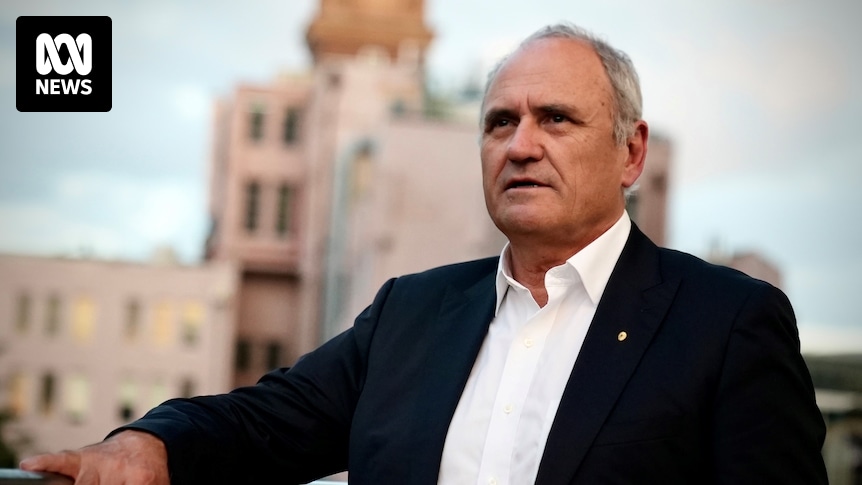
Ken Henry, a former Treasury secretary, gave evidence on Tuesday. And he was exasperation personified.
Dr Henry has been involved in heated debates about resource taxation in Australia for decades. He has been warning about the hollowing out of Australia’s economy for years.
Ken Henry told the gas inquiry that Australia was suffering economically from its failure to properly tax its commodity exports.
He said the cost of Australia’s political mishandling of the early 2000s mining boom had been “enormous”, and he is tired of seeing the same patterns repeat.
As the architect of the ill-fated Resource Super Profits Tax that contributed to the downfall of Kevin Rudd’s prime ministership in 2010, he said Australia could have collected “hundreds of billions of dollars of extra revenue” if our natural resources had been taxed appropriately in the early stages of the mining boom.
He said Australia could have then used that money to reinvest in non-mining parts of our economy to keep them internationally competitive in the past 16 years.
But instead, he said, he is left wondering what it was all for.
“When I was Treasury secretary, the biggest challenge … Treasury faced, in respect of economic management, was not actually the global financial crisis,” he said.
“[It was] how to manage the Australian economy through the mining boom.
“There was such a rush of investment that we experienced an appreciation of the real exchange rate of 70 per cent.
“The real exchange rate, which is the principal or most commonly used measure of Australian competitiveness, still sits 50 per cent above where it was pre-mining boom.
“That mining boom, that rush of investment … has damaged the international competitiveness of every other sector in Australia, and for what?
“For a very small increase in the proportion of the labour force employed in the mining sector … for the extraction of higher volumes of natural resources from the Australian balance sheet by multinational companies.”
‘Stop the crap’ and ‘just do it’
And when it came to the question of raising more tax revenue from the sale of Australia’s LNG resources, Dr Henry had a simple message.
“Just do it,” he said.
“In the national interest, just do it, and stop the crap that the Australian public have put up with for decades now in respect of the taxation of Australia’s finite natural resources.“
He said if Australia’s politicians kept failing to tax our natural resources properly, they would further imperil Australian democracy because Australians were increasingly losing faith in this country’s democratic institutions.
He said everyone should assume, when listening to fossil fuel interests arguing against greater taxation of our natural resources, that self-interest was dominating their argument, rather than Australia’s national interest.
And he said, at the same time, that politicians should also pay much more attention to the damage that burning of fossil fuels was doing to the planet.
“We’re among the top three fossil fuel exporters in the world,” he said.
“Under the Paris Agreement, the carbon embedded in those fossil fuels is not something for which we hold ourselves accountable, or are being held accountable.
“Nevertheless, the burning of these fossil fuels, where they are burned, contributes significantly to greenhouse gas emissions globally. We can choose to turn a blind eye to that … in my view, it’s immoral to do so,” he said.
Fuel security and defeating climate change
Dr Henry’s views struck a chord with Australians. Clips of his comments at the inquiry began circulating quickly online.
A couple of days later, on Thursday morning, one of Australia’s most eminent economists, Ross Garnaut, then delivered a speech at the Sorrento Writers’ Festival that outlined similar arguments to Dr Henry’s.
But Professor Garnaut floated another policy idea.
He said that while Prime Minister Anthony Albanese had made a commitment that Australia would not introduce any new taxes that would increase the cost of Australian coal and gas to its regional trading partners, there was a way around the impasse.
He said if we wanted to significantly improve Australia’s energy self-sufficiency and energy security, we could encourage the local production of renewable energy sources in a way that would not raise the cost of exports of gas or coal, nor reduce investment in Australia.
He said a “fuel security mechanism” could be used to allocate annual quotas for imported fuel, and those quotas would diminish in number every year. The quotas would be sold by auction.
He said it would let the market decide the lowest-cost combination of locally produced fossil fuels and zero-carbon energy that would meet Australia’s self-sufficiency objective for energy.
“If I am right, most of the increased self-reliance [in energy] will come from electrification and biofuels,” he said.
“The balance between green and fossil energy would be determined by relative costs.”
Ross Garnaut says renewable energy will help Australia to improve its energy self-sufficiency and security. (Supplied: University of Melbourne)
He said that would help to turn Australia into a renewable energy and green superpower while boosting productivity and underwriting an economic expansion as our coal and gas exports declined.
And he said if Australia became a large-scale exporter of zero-carbon fuels, it would also help to diversify our exports and provide more stable energy sources to our Asia Pacific trading partners.
Would that see Australia finally climb back up the international rankings for economic complexity?
Different countries, different models
Late last week, Morningstar market analyst Lochlan Halloway circulated a note to clients saying there were legitimate arguments on both sides of the gas tax debate in Australia.
But he said he was sceptical of any proposal that claims it can extract materially more tax from an industry without being a disincentive to exploration and development.
“Our resource endowment belongs to all Australians, who currently receive a smaller share of the windfall than countries like Norway or Qatar,” he wrote.
“But equally, most Australians didn’t invest the capital and take on the enormous project risk that built our gas industry. The ones who did — including Japanese utilities that committed to take-or-pay contracts decades ago when the commercial case was marginal at best — are now facing the possibility that the terms will change.”
But he said every country had its own model, and we could learn lessons from everyone.
He said Norway was the model most commonly cited as proof that high gas taxation and a thriving industry can coexist.
But Norway’s 78 per cent headline tax rate worked because the Norwegian state was not merely a tax collector, but an equity participant, he said.
“The Norwegian government holds direct ownership stakes in individual petroleum fields, covers its share of development costs, and receives a corresponding share of income,” he wrote.
“It is also the majority owner of Equinor, Norway’s state-controlled energy company.
“The tax system is explicitly designed to be broadly investment-neutral, with immediate deductions and loss-refund mechanisms that mean the government absorbs a large share of the downside as well as the upside.”
The Resource Super Profits Tax, designed by then-Treasury secretary Ken Henry and put forward in then-treasurer Wayne Swan’s 2010 budget, was also designed to be investment neutral by taxing miners’ “super profits” (while lowering the company tax rate) and providing a 40 per cent refund on losses.
But the mining industry campaigned aggressively against that model being introduced to Australia, and its campaign was successful.
For what it is worth, Norway’s $3.08 trillion sovereign wealth fund invests the revenues from its oil and gas production. It reported a $350 billion profit in 2025, a return on investment of 15.1 per cent.
Mr Halloway wrote, “adopting a model like [Norway’s] would require a much larger conversation around whether the taxpayer should be the risk bearer of a capital-intensive, volatile industry”.
Ken Henry and Wayne Swan tried to raise that conversation 16 years ago but were shouted down by vested interests in the mining sector, their friends in the media, and “free-market” think tanks like the Institute of Public Affairs (IPA).
Is Australia any more capable, in 2026, of having a fresh conversation about how we best share the spoils of our abundant natural resources?
Having seemingly shelved the idea of a revamped gas tax, at least for now, it does not seem Anthony Albanese thinks so.