
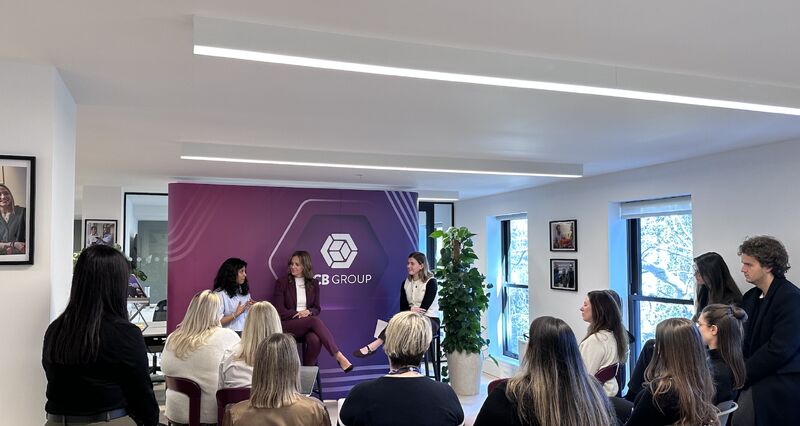
The MENA Fintech Association welcomed BCB Group as a new corporate member as financial institutions across the Middle East and Africa accelerate adoption of blockchain-based payment systems, real-time settlement infrastructure, and institutional digital asset services.
The partnership reflects growing institutional demand for regulated infrastructure capable of connecting traditional banking systems with digital asset markets across the region.
BCB Group provides payment accounts, liquidity services, trading infrastructure, and settlement systems spanning both fiat and digital assets for institutional clients operating globally.
Why MENA Became A Strategic Digital Finance Hub
The Middle East increasingly positioned itself as one of the fastest-growing regions globally for digital finance infrastructure, blockchain adoption, and institutional digital asset experimentation.
Jurisdictions including the UAE increasingly compete to attract fintech firms, digital asset infrastructure providers, payment companies, and tokenization platforms through regulatory modernization and innovation-focused policy frameworks.
That environment created rising demand for institutional-grade infrastructure capable of supporting real-time payments, digital asset settlement, treasury management, and cross-border financial operations.
The MENA Fintech Association itself increasingly acts as a coordination platform bringing together regulators, banks, fintechs, and infrastructure providers across the region.
BCB Group joins the association during a period where financial institutions increasingly seek regulated payment systems capable of supporting interoperability between traditional financial infrastructure and blockchain-based ecosystems.
The company operates across more than 50 countries and serves clients including crypto exchanges, liquidity providers, investment firms, payment processors, and market makers.
Its proprietary BLINC network enables continuous 24/7 settlement and instant payments between institutional counterparties.
The infrastructure focus reflects how digital asset adoption increasingly depends on operational reliability, settlement efficiency, and institutional-grade compliance rather than purely speculative market activity.
Takeaway
MENA increasingly evolves into a strategic global hub for institutional digital finance infrastructure, real-time settlement systems, and blockchain-enabled financial services.
Why Institutional Infrastructure Matters More Than Ever
The announcement highlights broader structural changes occurring across digital asset markets where institutions increasingly prioritize infrastructure quality, regulatory alignment, and operational resilience.
Early crypto market development often focused heavily on exchanges, token issuance, and retail speculation.
The current institutional phase increasingly centers on payment rails, settlement systems, treasury infrastructure, and fiat-to-digital interoperability.
Financial institutions now require systems capable of supporting compliant cross-border transactions, real-time liquidity management, and integrated fiat and digital asset operations simultaneously.
BCB Group positioned itself directly around those institutional infrastructure requirements.
Claire Barratt, Managing Director UAE at BCB Group, commented, “The UAE has firmly established itself as a global hub for financial innovation and BCB Group is committed to playing an active role in shaping that future.”
She added, “This membership gives us a platform to collaborate with the brightest minds in fintech, contribute to the development of a robust and inclusive financial ecosystem, and accelerate our mission of being the trusted infrastructure for global payments.”
The comments reflect how infrastructure providers increasingly view the Gulf region as strategically important for the next phase of institutional digital finance expansion.
The emphasis on enterprise-grade payment infrastructure also highlights how institutional adoption increasingly depends on operational stability and regulatory trust rather than crypto-native experimentation alone.
How TradFi And Digital Assets Continue Converging
The partnership also reflects accelerating convergence between traditional financial systems and blockchain-based infrastructure.
Banks, payment firms, and institutional investors increasingly explore how blockchain systems may improve settlement speed, treasury efficiency, liquidity management, and global financial interoperability.
At the same time, regulators increasingly require digital asset infrastructure providers to operate within clearer compliance frameworks and institutional governance standards.
BCB Group will contribute to MFTA initiatives surrounding payments, digital assets, institutional finance, and regulatory alignment.
The focus on regulatory engagement highlights how institutional adoption increasingly depends on cooperation between policymakers, financial institutions, and infrastructure providers.
Nameer Khan, chairman of the MENA Fintech Association and founder of Fils, commented, “MENA is emerging as a strategically important hub for digital finance, driven by regulatory progress, resilience, and growing institutional adoption.”
He added, “The MENA Fintech Association plays a central role in convening regulators, financial institutions, and technology leaders to support this evolution.”
The comments reinforce how regional financial competitiveness increasingly depends on building coordinated ecosystems linking policy, infrastructure, and institutional adoption.
The convergence between traditional finance and blockchain infrastructure increasingly moves beyond speculative trading into operational financial architecture itself.
Takeaway
What The Membership Signals For Regional Finance
BCB Group’s membership inside the MENA Fintech Association reflects broader regional ambitions to position the Middle East as a leading center for institutional digital finance infrastructure.
Governments, regulators, and private sector firms across the region increasingly invest in payment modernization, blockchain integration, and financial technology ecosystems.
The next phase of digital asset growth increasingly depends less on speculative trading activity and more on scalable infrastructure supporting institutional settlement, treasury operations, and regulated financial services.
Infrastructure providers capable of bridging traditional finance and blockchain-based systems therefore occupy increasingly important positions inside global financial modernization efforts.
The broader significance of the partnership lies in how digital finance increasingly evolves into core institutional infrastructure rather than a separate experimental ecosystem. As real-time settlement, tokenized assets, and blockchain-based financial operations expand globally, regions capable of combining regulatory clarity with institutional-grade infrastructure may become major centers shaping the next generation of global financial connectivity.