
Stablecoin is having its moment, or as described by some, a “stablecoin summer”.
On-chain transactions have climbed from US$27.6 trillion to US$33 trillion. In Singapore alone, US$150 million flowed into four stablecoin startups in a single month.
And on 10 April 2026, the Hong Kong Monetary Authority handed its first two stablecoin issuer licences to HSBC and a Standard Chartered-led joint venture, Anchorpoint Financial.
With so many developments happening in tandem, there’s a lot to discuss about what these developments mean to the industry.
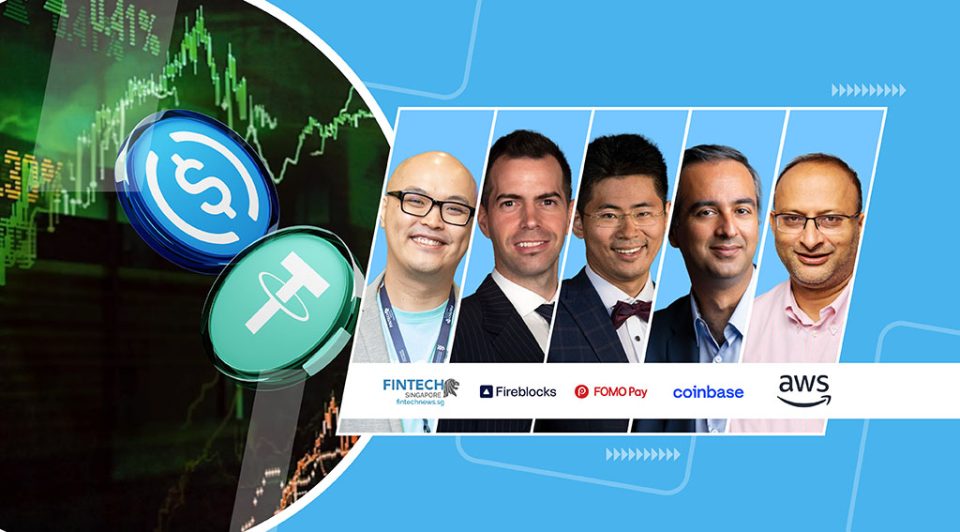
This set the tone for “Why Stablecoins May Become The Backbone of 24/7 Global Trade“, a webinar moderated by Fintech News Network’s Chief Editor Vincent Fong.
The panel brought together Dan Sleep, Head of Business Solutions APAC at Fireblocks; Hassan Ahmed, Country Director Singapore at Coinbase; Naveen Gupta, Head of Business Development for Payments, APJ Leader, at Amazon Web Services; and Zach Yang, Co-Founder of FOMO Pay.
The conversation spanned infrastructure, exchange, cloud, and merchant viewpoints. One core discussion took place: stablecoin adoption in Asia Pacific has cleared the regulatory and proof-of-concept stages in some markets, so what does the production phase actually look like?
Hong Kong’s Bank-Led Licences Set the Regional Benchmark
The webinar opened with the month’s biggest news, as Vincent explored the reasoning behind Hong Kong’s choices for its first batch of licensed stablecoin issuers.
Sleep shared that the HKMA’s decision to award its first two stablecoin licences to note-issuing banks was the panel’s starting point. Of 36 applications submitted under the Stablecoins Ordinance that took effect in August 2025, only two cleared.
That is roughly a 5% approval rate, a number Sleep described as deliberate rather than restrictive. He shares that this wasn’t a coincidence that these are essentially two out of the three note-issuing banks in Hong Kong.
“It comes with the institutional reality, on whether it relates to the tooling, the technology, the infrastructure they’re using themselves, or the standards they bring around AML, KYC, and whitelisting that are quietly embedded into the way HKMA has rolled out their rules.”

Sleep added that trust is a huge factor for these early movers.
Hassan agreed, placing Hong Kong’s move within a broader regulatory wave sweeping major jurisdictions. He described what’s happening as a stablecoin summer, and pointed to the US GENIUS Act as the catalyst, with Singapore’s single-currency stablecoin framework now progressing and similar conversations underway across the UAE, Japan, and Australia.
“Pretty much every major jurisdiction is about this: how do we get stablecoins to be a much more recognised form of money, how do we make sure that it’s in lit venues and there’s adequate consumer safeguards.”
Hasan added that this regulatory harmonisation would help scale up business models from startups and corporates, not only from banks.
Where Are Stablecoins Being Actively Used Today?
On the demand side, the panel identified three immediate use-case clusters: cross-border treasury, B2B payouts, and merchant cross-border acceptance.
Velocity and On-Demand Liquidity
Sleep opened by stripping the conversation back to its core. From Fireblocks’ vantage point, which spans crypto-native participants through to institutional players, the dominant theme across use cases is velocity.
He pointed to the depth and variety of payment platforms across Asia Pacific jurisdictions, each carrying its own frictions, and singled out correspondent banking as a prime example of legacy drag.
Moving money between two Southeast Asian markets through a large US bank can still take two to three days, a delay long accepted as simply part of how cross-border payments work.

“Once you can solve for those aspects, you remove that friction. The cost is less of a play, because there are still embedded costs in operating on-chain and using stablecoins.”
Sleep added that the real prize is float, not cost reduction.
The elapsed time during which money sits in transit creates a performance drag that disappears once settlement accelerates, freeing treasury and transaction banking teams to deploy what he called on-demand liquidity and put assets to work in a more capital-efficient manner.
Sleep pointed to Fireblocks’ newly released Financial Grid Report, a survey of 600+ executives across financial services globally.
Of APAC institutions surveyed, 62% have already committed budget to digital assets this year, with stablecoins accounting for the lion’s share.
A further 43% identified non-bank competitors such as PSPs and fintechs as the critical driver behind that shift, forcing incumbent banks to move faster to defend wallet share while accessing new markets.

Sleep added that C-suite executives are increasingly owning and driving stablecoin strategy directly, rather than delegating to innovation teams. He described it as a quantum shift in how urgency around the issue is being perceived.
FOMO Pay On Volkswagen and Invisible Payments
Yang offered one of the clearest case studies of the session, pointing to a payment solution FOMO Pay launched for the Volkswagen Group Singapore months ago, enabling the carmaker to accept stablecoins as a payment instrument for vehicle purchases and related services.
He broke down the existing payment landscape merchants currently navigate, from bank transfers and cheques to Visa and Mastercard rails, each with its own friction. Credit cards carry high merchant discount rates, while local rails are fast but capped by transaction limits. Telegraphic transfers, meanwhile, remain exposed to correspondent banking delays of T+1 or T+2.

“Stablecoin is born as a global instrument, so it happens to solve the current problem statement from the client space.”
Yang explained that the consumer experience is designed to be invisible. A buyer holding USDC simply pays in stablecoin, while the merchant receives settled local currency on the back end for reconciliation, with no operational change required.
The best payment experience, he encapsulates, is no payment experience at all.
Coinbase On Stablecoin Cards and the B2B/B2C Convergence
Hassan broadened the lens from Coinbase’s viewpoint, distinguishing B2C and B2B flows, each with their own demand drivers.
On the consumer side, he flagged stablecoin-issued cards as the hottest trend in the space right now, citing rapid growth at players like RedotPay, Rain, and Kast, several of which Coinbase Ventures has backed.

“You want to open up the acceptance leg so you can make these stablecoins more useful and add utility for being able to pay for everyday goods and services, but you want to be able to fund that card with something that has higher velocity and more access.”
AWS Gives A Clear View Across the Payment Value Chain
Naveen brought the infrastructure perspective, mapping demand patterns across AWS’s customer base in APJ, which spans large financial institutions, PSPs and online payment gateways, and the mobile wallet operators that have expanded rapidly to reach unbanked populations across Southeast Asia and India.
He observed that B2B and B2C use cases are increasingly converging.
Within banking, he noted a stronger appetite for speedier and more efficient cross-border payments that cut through correspondent banking frictions, alongside growing interest in automated treasury and working capital management tooling for B2B clients.
On the PSP side, he pointed to merchant demand to accept stablecoins as a consumer payment option and the potential for stablecoins to serve as a stable source of value for cross-border merchants seeking to isolate themselves from currency risk.

“From an AWS standpoint, the core value proposition we take to our customers is how we can help them build a resilient, scalable, and secure stablecoin platform, and the underlying tooling behind that remains the same.”
In a way, he closes, it’s more a question of how deliberate it is in pulling everything together to build a platform for tomorrow.
Where Does Stablecoin Adoption in Asia Pacific Go From Here?
The panel converged on a near-term outlook. Sleep expects the global stablecoin market cap, which sits around US$315 billion today, to potentially double again over the next six months.
Real-world asset tokenisation is poised to scale on the back of stablecoin-enabled delivery-versus-payment settlement. More than half of the surveyed financial institutions are still in the pilot or planning stage, and only 16% have reached production. Closing that gap will depend on businesses making the right infrastructure decisions, the right architecture choices, and finding the right entry points.
Hassan expects non-USD stablecoins to take a measurable share of on-chain FX volume, with agentic payments, where AI agents settle micro-transactions in stablecoins, emerging as an early but credible adjacent market.
For banks, fintechs, regulators, and merchants, the immediate question is no longer whether stablecoins belong in the payments stack for stablecoin adoption in Asia Pacific. It is which corridors, currencies, and customer segments to anchor first.
Keen to know more about how leading payment providers are implementing stablecoin adoption in Asia Pacific and their evolving utility as they move towards real-world payment flows? Watch the full webinar replay on YouTube:
Featured image edited by Fintech News Singapore based on image by mehaniq on Freepik