
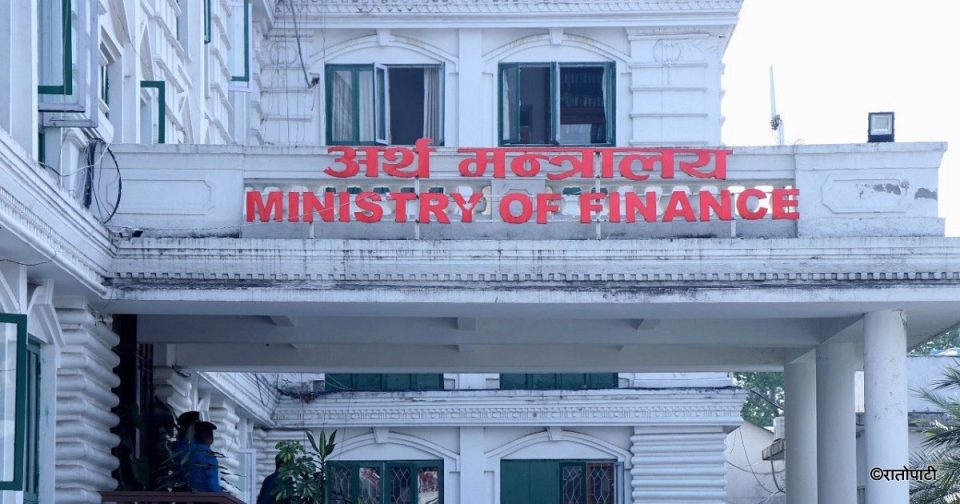
Kathmandu. The Ministry of Finance has issued a white paper on Nepal’s current economic situation, highlighting structural problems in the capital market and announcing plans to broaden its scope.
The white paper, released by the ministry on Monday, concluded that the capital market is dominated by the financial sector and equities. The white paper also pledged immediate legal reforms to bring stability, transparency, and credibility to the market.
According to the data mentioned in the situation paper, the capital market is currently confined to a limited sector. As of Falgun 2082, there were 286 companies listed in the capital market, with equities (ordinary shares) accounting for 99.4 percent of the secondary market transactions.
Banks, financial institutions, and insurance companies dominate the securities in the market. They account for 52.2 percent of the total market capitalization.
The ratio of market capitalization to Gross Domestic Product (GDP) is also on a declining trend. While the market capitalization was over 85 percent of GDP in Asar 2073, this share decreased to 77.7 percent in Falgun, as stated in the white paper.
The paper also acknowledges the reality that despite provisions for listing government bonds in the capital market, their trading has not been smooth in the secondary market. The paper also mentions data indicating that the NEPSE index stood at 2,950.16 points on Chaitra 11, 2082, before the formation of the new government.
The government has put forward various policy and legal reform plans to address these structural and practical problems in the market. The government’s main goal is to expand the scope of the capital market and encourage production-oriented (real sector) companies to enter the stock market, rather than relying solely on banks and financial institutions.
The government has also announced that necessary arrangements will be made to attract investment from Non-Resident Nepalis (NRNs) into the capital market. It is mentioned that the government will develop the bond market, including government bonds, and create an environment for their smooth trading in the secondary market.
The government has announced immediate legal reforms for capital market improvement. The Ministry of Finance has stated that bringing transparency, credibility, and stability to secondary market trading is of utmost importance and has placed it as a high priority.