
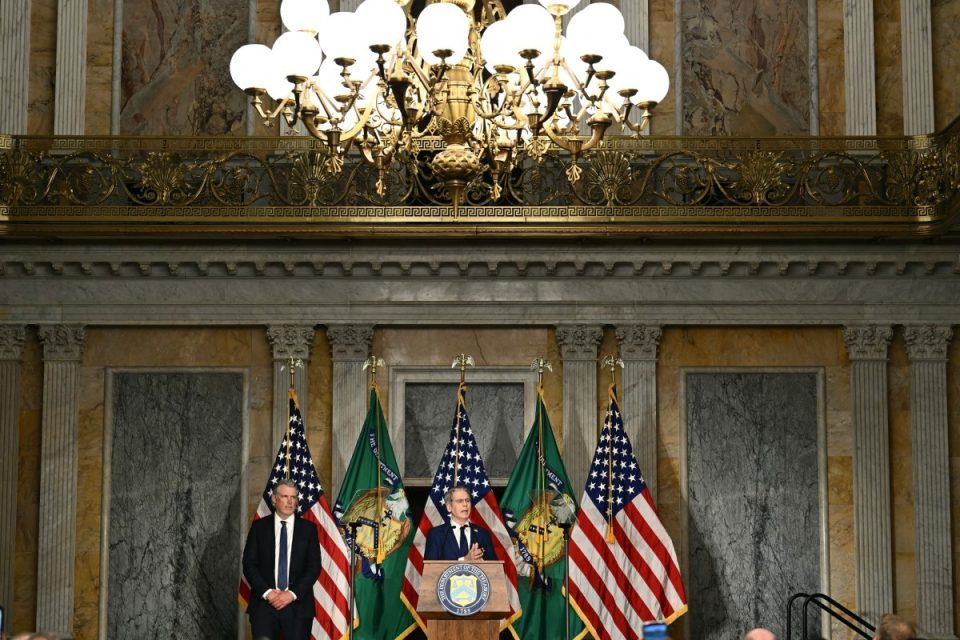
The Trump administration on Monday threatened to cut foreign banks and businesses out of the U.S. financial system unless they sever economic ties with Iran, launching what Treasury Secretary Scott Bessent called an unprecedented campaign to leave Tehran economically isolated.
In a press conference, Bessent said “Operation Economic Outcast” would broaden U.S. sanctions to target foreign entities trading with five sectors of Iran’s economy: digital assets, technology, gold, aviation and shipping. More than 60 individuals, companies and vessels were also immediately sanctioned.
“Our objective is to sever every economic lifeline that sustains this tyrannical regime until Tehran stands alone,” Bessent told reporters.
The campaign makes Iran’s remaining trading partners as much a target of U.S. economic pressure as Iran itself. But Bessent said that President Donald Trump wanted to give foreign governments and companies defined timelines to shut down activities Washington had identified before they faced penalties.
“Every country has a defined timeline to shut down activities,” he said. “If they do not take action, we will do so unilaterally through Treasury authorities.”
Asked why the U.S. Treasury was giving countries time to comply rather than immediately imposing what the administration has called its “economic D-Day,” Bessent said Washington wanted to provide a brief opportunity to unwind business ties rather than risk abruptly destabilizing the global economy.
“We are giving everyone the opportunity to remedy bad behavior,” he said. “Why would I want to blow up the global financial system?”
He warned, though, that the grace period would be short.
“We believe that a warning shot and a level set of expectations is appropriate,” Bessent said. “If people do not want to meet our expectations … they should expect that they will leave the dollar system.”
Bessent added that the Treasury will announce sanctions on a “major financial institution” by the end of this week, offering an early test of how aggressively Washington intends to enforce the new secondary sanctions campaign.
U.S. sanctions generally freeze a target’s assets that are under U.S. jurisdiction and bar American citizens and companies from doing business with it. Treasury can also cut foreign banks off from processing U.S. dollar transactions, a severe penalty because so much global trade and finance is conducted in dollars.
The biggest test may be China, Iran’s largest trading partner.
China bought about 1.4 million barrels per day of Iranian oil last year, according to ship-tracking data cited by Reuters, with the bulk flowing to independent refiners through opaque networks that obscure the oil’s Iranian origin.
Washington has already sanctioned a series of smaller Chinese refiners and shipping companies but has so far stopped short of sanctioning major Chinese banks that facilitate the oil transactions with Iran, a step that could have much wider consequences for ties between the world’s two biggest economies.
Chinese President Xi Jinping is due to visit Washington on Sept. 24, shortly after the U.N. General Assembly in New York, for talks with Trump that both have cast as an opportunity to stabilize ties. Trump has repeatedly signaled that he wants a productive relationship with the Chinese president, raising the stakes of any move against major Chinese financial institutions ahead of the meeting.
Asked Monday what penalties Treasury would impose on Chinese banks and shipping companies if they do not comply, Bessent did not directly respond.
“Every country, every entity should know that they should be prepared to face U.S. sanctions,” he said. “We are going to hold everyone accountable.”
Beijing earlier Monday rejected the U.S. pressure campaign, with Foreign Ministry spokesperson Lin Jian calling sanctions “not conducive to resolving problems.” He added that Beijing would still closely monitor the developments and take any necessary steps to protect its economic interests.
Bessent pointed to the United Arab Emirates, which last week suspended trade with Iran, as evidence that U.S. threats were already changing behavior.
“I would think that the actions that they took last week were not coincident, but likely causal,” Bessent said, predicting other countries would take similar steps.
Iran, meanwhile, has warned of retaliation against countries that cooperate.
Mohsen Rezaei, secretary of Iran’s Supreme National Security Council, said Sunday that Tehran would consider participation in the campaign an “act of war” and threatened to further prevent oil exports from crossing the Persian Gulf.
The escalation comes as Iran’s economy strains under severe pressure from years of U.S. sanctions and nearly six months of war. The rial fell to a record low Monday and a U.S. naval blockade has sharply reduced Iranian oil exports.
Bessent said the new measures left Tehran with only two choices: “complete global isolation and a subsistence economy” or a deal for normalization.
The Trump administration has used similar tactics before, with broad sanctions announcements followed by a drip-feed of Treasury enforcement actions.
In February 2025, Trump ordered the restoration of a “maximum pressure” campaign against Iran, directing the Treasury Department to pursue sanctions violations and drive Iranian oil exports to zero. Treasury followed over the ensuing months with repeated rounds of sanctions, including against Chinese “teapot” refineries, shipping networks, port operators and vessels involved in moving Iranian oil.
As Bessent left the room Monday, reporters shouted questions about whether the new campaign was an acknowledgment that the Iran war could not be won militarily and why the administration had not launched it six months ago.
He did not respond.