
Federal Reserve Chairman Kevin Warsh says he wants the financial markets to figure it all out without the forward guidance of the Fed telling the market what to expect.
At his press conference on Wednesday, Warsh said that he wanted investors to play the ball and not the referee. This struck us as strange since the Fed is the player in the game that sets rates.
A bit more strange was his comment when he was asked about rates and inflation and why rates had not changed. Warsh responded that they had changed. Markets had on their own pushed up rates, he said.
That response, of course, was in our estimation what triggered the jump in the long bond, signaling trouble for the central bank’s credibility.
Here’s what the markets are saying about the new Fed chair’s tenure, two meetings in.
As the forward markets predicted, the Federal Open Market Committee held its overnight policy rate at its effective rate of 3.65%, where it has been since the December 2025 meeting.
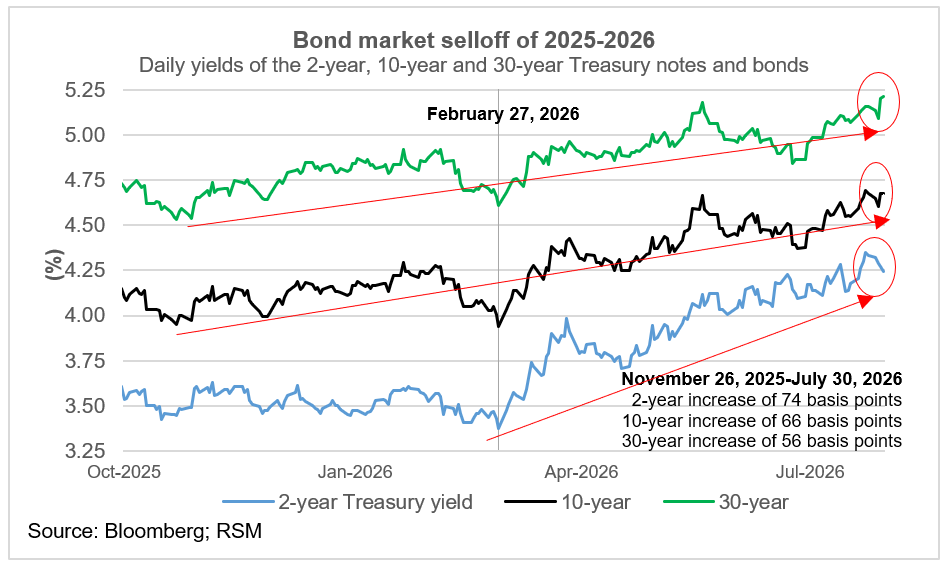
Unfortunately, Warsh’s comments after the June and July decisions were evasive regarding the Fed’s response to inflation, precipitating a weird combination of a drop in the yield on 2-year notes while yields on the 10-year and 30-year bonds jumped.
In our opinion, this divergence in bond yields results from a market now anticipating:
- That the Fed is reluctant to hike its policy rate, causing a drop in the 2-year yield.
- That because of an insufficient policy response by the Fed, investors in long-term Treasuries are now requiring additional compensation for the risk that the real (inflation-adjusted) return on their investment will deteriorate as inflation persists.

Higher bond yields in the global market
The threat of inflation is not limited to the U.S. bond market.
While the U.S. economy is growing faster and is more energy independent than its counterparts among the major bond markets, bond yields in the U.K., Germany and Japan are likewise moving higher in response to expectations of the energy shock’s impact on inflation, reaching yield levels of 15 to 20 years ago.

U.S. equity markets leveling off
Returns in the U.S. equity market are drifting lower in summer trading after more than just recovering from the initial shock of the war.
On the whole, their performance reflects the prospects of earnings growth of corporations operating within a robust economy.
We attribute the recent drop in the tech-dominated indices to the need for diversification as seen in the performance of the Russell 2000.

Uncertainty and asset-price volatility
Volatility in the bond and equity markets has trended higher in 2026, moderating the performance in those sectors but not overwhelming it.
We attribute the hints of volatility to increased uncertainty over the direction of the war and the possible effect of inflation on spending and eventually on economic growth.

The takeaway
The Warsh regime at the Federal Reserve states that it will not rely on forward guidance. The result has been the front end of the curve going one way and the long end going elsewhere.
The RSM Financial Conditions Index is a composite index of the equity, bond and money markets, all of which remain above zero. An index value of zero indicates normal levels of risk and return in the financial markets. Positive values indicate accommodative conditions conducive for investment and growth, while negative values indicate tight financial conditions.
Despite the confusion over monetary policy, overall financial conditions have remained moderately accommodative at 0.7 standard deviations above zero.
The selloff in the Treasury market continues. Equity indices are drifting lower as investors begin to question their sustained performance. The returns in the first seven months of the year remain impressive, nonetheless.
