
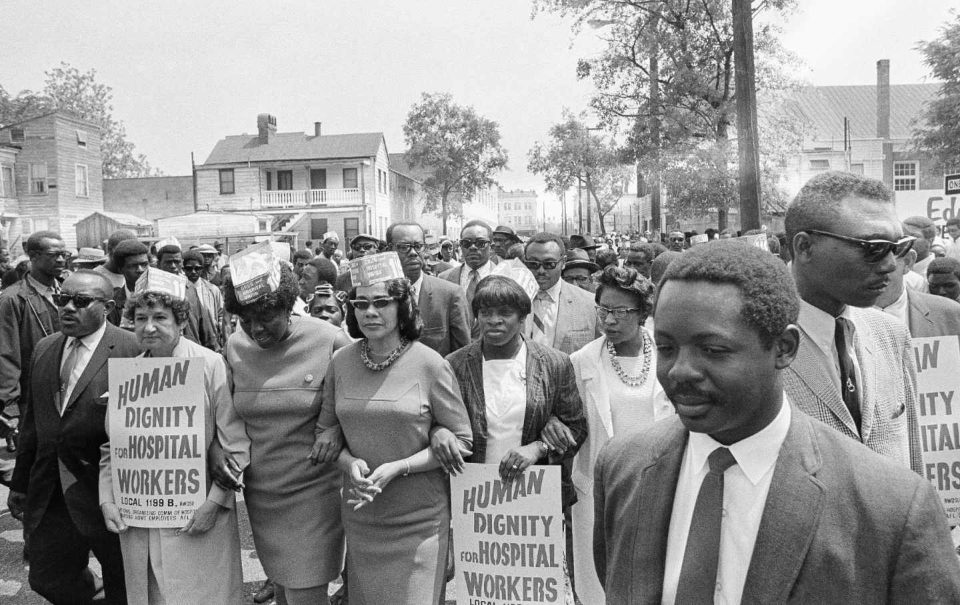
John Holloman was expecting to be disappointed, but he did not expect to be stood up. Dr. John L.S. “Mike” Holloman Jr. was both the president-elect of the National Medical Association, a professional group of Black doctors founded in 1895 in reaction to segregation within the American Medical Association, and the chair of the Medical Committee for Human Rights (MCHR). Informally known as the medical wing of the civil rights movement, the MCHR was a group of physicians and health care workers dedicated to ending segregation and the substandard care Black people faced in the United States.
Holloman was in Washington, D.C., on December 16, 1965, for what should have been a tense meeting between leaders of the civil rights movement and the federal government. The meeting was to be hosted by Secretary John Gardner, the recently appointed head of the US Department of Health, Education, and Welfare (HEW). It had been a year since the passage of the Civil Rights Act, which desegregated facilities that provided public accommodations and received federal dollars, yet in that time there had been little success in desegregating Southern hospitals. The civil rights groups were there to find out if anyone at HEW was going to actually enforce the law.
Gardner never showed up. Angry, Holloman sent Gardner a telegram, which the press soon received, pointing out that Gardner had “met freely with the conservative elements of the health profession. We wonder if your failure to meet with us has racial implications and may be symptomatic of the reluctance of your department to come to grips with the discriminatory practices in health care.” The civil rights leaders held a press conference the next day, where they argued that HEW had an opportunity to end segregation in health care and that it would blow this chance if it didn’t take action.
We’ll never know what transpired on that day. Gardner insisted that he missed the meeting as a result of a scheduling mix-up. Perhaps Gardner would have taken on their cause without the public embarrassment. But either way, a few weeks later Gardner began gearing up his staff to go to war with Jim Crow health care in the South. And this fight he knew would be different, because Gardner had a secret weapon against white supremacy: the recently passed single-payer health care system for the elderly, Medicare.
We all get sick and injured, especially as we get older, and we all need access to health care. But health isn’t just the absence of sickness but the capability to choose and lead the healthy lives we want with dignity. How healthy we are is partially the result of the bodies we are born with, but it’s also driven by the environments we live in, the information we have access to, and the resources available to us to access care. As a result, the conditions under which we can find that access is central to any politics of freedom.
The ability of the market alone to provide health care fails in ways that are as predictable as they are absolute. There’s a reason every modern country has a government program or mechanism for ensuring health care. Markets are great at distributing things based on people’s willingness to pay, but there are some goods that should be distributed by need. No rational person seeks out expensive health care for fun or enjoyment, and sickness isn’t something that is earned—but that falls upon us. Yet our society adds a necessary condition to receiving health care, which is having money.
Popular
“swipe left below to view more authors”Swipe →
The history of health care in the United States also shows us another reason to keep the market in check when it comes to our freedom: Markets can perpetuate segregation and other unjust forms of exclusion. That was the case with the Southern hospital system under Jim Crow. Medicare played a key role in the destruction of the Jim Crow system in the South. And to understand how that happened, we need to see how health care evolved after the New Deal.
Just months after World War II ended, in a special message to Congress, President Harry Truman made the full case for single-payer health care. “Everyone should have ready access to all necessary medical, hospital and related services,” he argued, and he recommended “solving the basic problem by distributing the costs through expansion of our existing compulsory social insurance system.” This plan would have citizens “pay regularly into a common health fund, instead of paying sporadically and unevenly when they are sick.”
Truman’s argument for the government’s role in health care still speaks to us. He noted that the past reduction in mortality rates “have come principally from public health and other community services,” and that “in the past, the benefits of modern medical science have not been enjoyed by our citizens with any degree of equality. Nor are they today. Nor will they be in the future—unless government is bold enough to do something about it.”
With the Cold War heating up, Truman’s push failed. Senator Robert Taft of Ohio declared, “It is to my mind the most socialistic measure this Congress has ever had before it,” and said, inaccurately, that it came from the Soviet constitution. It wasn’t just that the specter of communism made this an effective attack line. The medical industry led an overwhelming campaign to stop single-payer health care. The American Medical Association deployed resources at a scale unheard of before, waging the most expensive lobbying campaign up to that point.
Given the circumstances, Republicans understood that they had a chance, at this historical moment, to provide an alternative to public health insurance by subsidizing private insurance through the tax code. They used the 1954 Tax Act to secure the employer deduction for health care. The Wall Street Journal applauded the law for being “a part answer to the false lures of socialized medicine.” In addition to creating a private employer-based social insurance system through the tax code, the federal government funded the construction of hospitals without putting any conditions on the private medical and insurance industries. One of the most important ways in which federal money was extended without any additional controls was with the Hospital Survey and Construction Act of 1946, often referred to as the Hill-Burton Act.
Hill-Burton required that funded hospitals promise not to discriminate on the basis of race. Yet Southern Democrats ensured that this funding wouldn’t be used to challenge Jim Crow. First, they had a measure added to the legislation that declared hospitals were private entities that couldn’t be regulated by the federal government, only by the states. This shielded hospitals from public accountability and meant that they could discriminate against Black doctors and other medical professionals in hiring and staffing. Another provision allowed federal funding for segregated hospitals and segregation by race within hospitals, as long as they were purportedly of equal quality of care, which they never were. This funding stream deepened segregation in Southern health care; 65 of 67 counties in Alabama used Hill-Burton money to build hospitals that were segregated. A Social Security Administration official noted that “those of us who were involved in that bill took the position that if that was the price we had to pay for getting this legislation through, we would pay for it.”
This is exactly the kind of publicly funded discrimination that Brown v. Board of Education was designed to stop. Argued twice over two years, Brown was decided unanimously by the Supreme Court in May 1954. The court ruled that “separate but equal” was unconstitutional, and in a follow-up ruling determined the applicable remedy for segregation in schools. Government officials should “take such proceedings and enter such orders and decrees consistent with this opinion as are necessary and proper to admit to public schools on a racially nondiscriminatory basis with all deliberate speed the parties to these cases.”
The court took this monumental action, but a funny thing happened in the aftermath of that ruling: nothing. As legal scholar Gerald N. Rosenberg shows, in 1955, roughly 12 in 1,000 Black children attended a school with whites in the South. Five years later, that number was virtually unchanged, about 16 in 1,000. It took the Civil Rights Act of 1964 to desegregate schools. The number of Black children attending a school with whites in the South went from 2 percent the year the Act passed to 32 percent four years later, and 86 percent six years later. While the Supreme Court can be effective at holding back change, it controls no funding and depends on elite power structures to carry out its decisions. What really creates change is popular mobilization and legislation.
Brown should have applied to the wave of new public hospitals the federal government was funding in the late 1950s under Hill-Burton. Yet there was no mechanism to force action, and the business of white supremacy carried on as normal. The Department of Health, Education, and Welfare (HEW), responsible for carrying out the Hill-Burton funding of hospital construction, refused to investigate whether hospitals were “of like quality” and acted as if the Brown decision didn’t apply to them.
Into this fight came a wave of newly energized doctors and other medical professionals, all finding inspiration from the ongoing civil rights movement. In 1963, Holloman and several of his friends created the MCHR, which coordinated with civil rights leaders in the South to help provide frontline services for protesters. When Martin Luther King Jr. led a march for voting rights across the Edmund Pettus Bridge from Selma to Montgomery, Alabama, the protesters faced a violent police response. Members of the MCHR, including Holloman, were there providing medical services to those that had been beaten.
At the same time, two major political achievements had cleared Congress. President Lyndon Johnson used his knowledge of the Senate to pass the Civil Rights Act of 1964, in which Title VI prevented racial discrimination by any program or entity that received federal funds and allowed agencies to enforce it themselves rather than waiting for uncertain lawsuits in the courts. In the aftermath of Johnson’s huge reelection win, Congress also passed a sweeping set of public programs. Medicare, a single-payer system for the elderly, would be signed into law on July 30, 1965. The interconnection between these two laws was the opening the medical civil rights movement was looking for.
Trying to set up a major single-payer health care system, even one that would only provide insurance for the elderly as Medicare did, was daunting. From coverage baselines, to funding mechanisms for hospitals, to setting up a system to inform elderly people about their ability to use it, the launch of Medicare was a chaotic and fast-moving affair. A hundred offices had to be opened, with thousands of people hired, to make the program work. Congress accepted a window of only one year as the time for the entire program to go live and begin providing insurance on July 1, 1966. Though it would have made their lives easier, those implementing the program believed at the time that Congress wouldn’t have accepted a two-year implementation because it wanted the benefits to promptly get to those who needed them.
The numbers involved were staggering. Seventeen million people over the age of 65 had to be asked whether they would sign up for supplemental insurance as part of the program. Officials mailed out a series of punch cards for people to select their preference, which were then processed. In all, 19 million Medicare cards would be printed and mailed out. The response was overwhelmingly fast, as the elderly were excited to sign up for coverage. Government officials recorded a 95 percent response. Medicare made its deadline, going live within one year, and it remains popular to this day.
But these logistical problems paled in comparison to the political challenge of reconciling Medicare with the Civil Rights Act of 1964. The question of whether Medicare funding would go to segregated hospitals became an immediate flash point. And the task of dealing with the problem fell to John Gardner, who took over as secretary of HEW.
In the summer of 1965, as Medicare was in the process of being passed in Congress, many Southern hospitals were segregated, even though the Civil Rights Act was already a year old. The United States Commission on Civil Rights found that two-thirds of the Southern hospitals receiving federal funding in the sample they studied had continued segregated practices. Selma Baptist Hospital in Selma, Ala., for example, refused to accept any Black patients at all.
The tight deadline for Medicare implementation created a game of chicken between segregated hospitals and the Johnson administration. Everyone knew that news coverage of senior citizens’ not getting care because hospitals lacked funding would be a PR disaster for the new program. The hospitals also understood that if they could get the administration to budge on the strictness of desegregation requirements, say by splitting them into tiers to be implemented over many years, they could fight to keep delaying change indefinitely.
The first thing the administrators at HEW had to work out was the pace of desegregation. They agreed that they wouldn’t follow the “all deliberate speed” criterion that was used for schools in the wake of Brown. They would instead require full desegregation at the very beginning for hospitals to be certified and receive Medicare funding. The second matter to work out was creating a legion of bureaucrats capable of carrying this out. As the medical historian David Barton Smith describes, a crusade of reformers, civil rights activists, and health care experts aligned to carry out an almost impossible task.
This was needed, as the resistance from white Southerners was fierce. A common tactic was for car rental agencies, working in cahoots with local police, to arrange for the visiting inspectors to use rental cars that had already been falsely reported stolen. If the inspector pushed too hard, they could be arrested for driving a stolen vehicle. OEHO managers would have to be on standby for quickly dealing with these and other trumped-up charges against their employees. Sometimes the threat of violence was more direct. One Mississippi hospital administrator told a government investigator, there to discuss desegregation, that “I called some of the boys in the KKK when you arrived. I didn’t know you were going to be such a nice fellow. You better leave while you can.” One federal manager in Baltimore found a cross burning in her front yard.
Government investigators had one advantage though. They could rely on Black people themselves, especially those in the medical community. HEW investigators would show up in a town and connect with the local NAACP or church group, who would in turn put the investigators in touch with Black workers at hospitals and individuals who had received segregated care. These workers had to be careful, as state and local police would follow the investigators; Black workers could be fired if they were suspected of cooperating with federal HEW authorities. In a typical episode, a Black employee told HEW investigators how to find the hidden, segregated break rooms for Black employees. While on inspection tours, administrators would try to guide them away from such cramped, substandard work rooms—but the investigators would already have a map drawn for them by those who worked there.
Holloman and the MCHR played a crucial role through their extensive documentation of the practice of segregation in hospitals. They coordinated with local nurses and doctors to compile all this information using a 23-question form they created to catalog exactly how segregation worked. They conveyed this information by filing hundreds of complaints with HEW, information they used in their investigations. One HEW official later noted that of the 500 documented cases of segregated hospitals that he saw, 300 of them came just from the MCHR.
The other advantage they had was the funding that Medicare controlled. Administrators and other executives understood that their business model wasn’t sustainable in the post-Medicare world without having access to it. Take an example in Texas. Because it concerned Johnson’s home state, desegregation in Texas state hospitals was politically sensitive to the president. A Black doctor who worked on civil rights in the US Surgeon General’s Office named Richard Smith was sent to Marshall County Hospital, in Lady Bird Johnson’s home county, to have a specially coordinated inspection. He was greeted by pickup trucks filled with men carrying rifles, a menacing group who said they’d be his unplanned escort to the hospital. The intimidation attempt didn’t slow Smith. After a day of meetings, the hospital’s administrator openly refused to cooperate with desegregation. Though surrounded by guns and resistance, the government had the ultimate weapon: “Fine,” Smith said, “but you just tossed away $100 million in Medicare funding.” A week later Smith got the call from the chairman of the hospital’s board, who informed him that they fired that administrator and wanted to know what they had to do to desegregate and receive Medicare funding.
The hardball strategy worked. In April, with three months left until the start date, only half of the hospitals in the country met their requirements. By July 21, less than half of a percent of hospitals weren’t certified for Medicare. True to the government’s word, those handful of hospitals that ignored the Civil Rights Act were denied funding. As Wilbur Cohen, who worked on the launch of both Social Security and the Great Society, later reflected, “In one day Medicare and Medicaid broke the back of segregated health services.”
The effects were immediate and dramatic. Segregated health care was horrific for the Black people who had to suffer under it. Infant mortality rates serve as a simple, but devastating, illustration. Up until that point, 40 Black infants would die for every 1,000 born, rates that resemble countries like India or Iraq now. In 1965, Black newborns were four times more likely to die of pneumonia and gastroenteritis than white newborns. These were two common causes of death among newborns that had become significantly easier to treat with medical advancements in administering antibiotics and fluids to babies. These life-saving improvements, and the expansion of Hill-Burton hospitals to carry them out, passed Black families by. The desegregation of hospitals collapsed these rates, with the overall rate of Black infant deaths falling by nearly half within a decade. The infant mortality rate in Mississippi fell by 25 percent in just the first year. This period of medical desegregation was the only convergence in Black-white infant mortality rates since World War II.
Universal public programs can create levels of access that the private sphere and marketplace will never match. Public programs can overcome and break persistent and widespread discrimination and ensure that citizens have access to the fundamental supports they need to live free lives. The market alone can’t provide health care to everyone, because it will quickly exclude those that need it the most. By making health care broadly available—independent of race, income, or preexisting conditions—the government can help ensure our freedom. In the 1960s, the government used federal funding as a mechanism to break Jim Crow. President Barack Obama used the same kind of funding mechanism to push an expansion of Medicaid with the Affordable Care Act. Under the passed law, states that wouldn’t expand Medicaid to working-class people would jeopardize all their Medicaid funding. Losing this funding is something states wouldn’t risk, and it was assumed all states would follow with expansion. When the Affordable Care Act came before the Supreme Court, it was this Medicaid funding requirement that Chief Justice John Roberts successfully stripped out of the law as a price to pay for it to survive. As a result, millions, overwhelmingly in the South, remain excluded from health care.
Copyright © 2021 by Mike Konczal. Adapted from Freedom from the Market by Mike Konczal. Published by The New Press. Reprinted here with permission.