
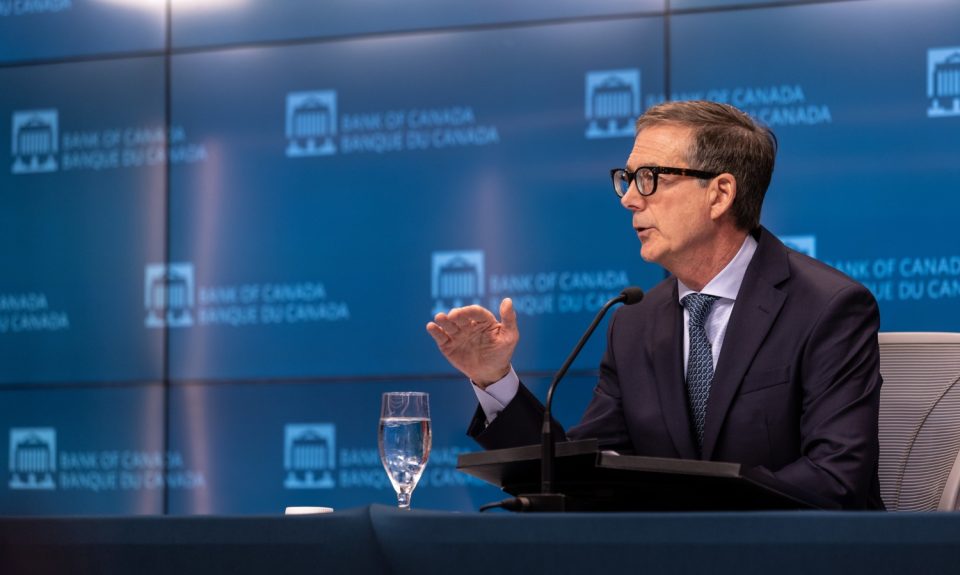
“With continued evidence that underlying inflation is easing, [the BoC’s] Governing Council agreed that monetary policy no longer needs to be as restrictive and reduced the policy interest rate by 25 basis points,” the BoC said in its decision announcement. “Recent data has increased our confidence that inflation will continue to move towards the 2% target.”
Canada’s annual rate of inflation fell to 2.7% in April (down from 2.9% in March). That’s the lowest it has been in three years. However, the BoC said there are still inflation risks, and that it continues to monitor the “balance between demand and supply in the economy, inflation expectations, wage growth and corporate pricing behaviour.”
Many economists anticipate further cuts to the benchmark rate before the end of the year.
So, what does this mean for your finances? The central bank’s benchmark rate guides the interest rates on various financial products and loans, including guaranteed investment certificates, lines of credit and mortgage rates. It has far-reaching implications, whether you’re buying your first home, renewing your mortgage, repaying a student loan or living off retirement income. We take a look at how the BoC’s policy rate works, how it is set and what it means for you.
Inflation is down. Does it *feel* down?
— MoneySense (@MoneySense) February 28, 2024
What is the Bank of Canada interest rate?
To understand the BoC’s policy interest rate, also known as the overnight rate, it helps to know about inflation.
Inflation, as measured by the Consumer Price Index (CPI), is a persistent increase in the level of consumer prices or a persistent decline in the purchasing power of money. Gradual inflation over time helps keep the economy strong by making increases in wages and expenses predictable for businesses and consumers. But inflation that exceeds the norm makes it more difficult for people to afford everyday expenses.
The BoC aims to keep inflation stable at 2%—or within the target range of 1% to 3% per year. That’s where the overnight rate comes into play: It’s the BoC’s primary tool for achieving its inflation target. The overnight rate influences how the banks will set their own rates. It acts as a sort of barometer for the rate at which major banks borrow and lend among themselves. When the BoC raises the overnight rate, it becomes more expensive for banks to borrow money, and those costs get passed on to borrowers through higher interest rates.
Video: How the Bank of Canada’s interest rate affects you
What happens when the Bank of Canada raises or lowers interest rates?
If the economy struggles to grow or experiences a shock, as it did during the COVID-19 pandemic, the BoC can slash interest rates to help boost economic activity. When the overnight rate falls, people and businesses pay lower interest on new and existing loans and mortgages, and they earn less interest on savings. This generally leads to more spending, which in turn helps strengthen the economy.
Conversely, an economy that is growing too quickly can lead to high levels of inflation. In this scenario, the BoC might raise the overnight rate. Lenders subsequently raise interest rates for loans and mortgages, which discourages people and businesses from borrowing, reduces overall spending and helps bring inflation under control.
During normal economic times, the BoC typically increases its benchmark rate in increments of no more than 0.25%. Prior to the April 2022 rate increase, the BoC hadn’t raised the overnight rate by more than 0.25% in one shot since May 2000—a period of more than 20 years.
How often does the Bank of Canada review interest rates?
In 2020, to help Canadians anticipate and prepare for changes in interest rates, the BoC introduced an annual schedule of eight fixed policy-rate announcements. On these specified dates, it reports whether or not it is changing the overnight rate. In special circumstances, such as national emergencies, it may announce rate changes on other non-specified dates—just as it did on March 13 and 27, 2020, in response to the economic situation caused by COVID-19 lockdowns.
Historically, the overnight rate has fluctuated based on large-scale events affecting the economy. On the heels of the 2008 financial crisis, the rate fell from 4.5% to 0.25%. Between 2010 and 2018, it gradually increased to 1.75%. It then fell sharply in early 2020 in response to the pandemic. Inflation picked up quickly as the economy reopened in 2021 and 2022, peaking at 8.1% in June 2022. In response, the central bank began hiking its key interest rate at a pace not seen in decades.
What is the prime rate?
Not to be confused with the BoC’s policy interest rate, the prime interest rate is a percentage used to set interest rates on several different types of loans, including lines of credit, student loans and variable-rate mortgages.
Each of Canada’s six major banks—Bank of Montreal (BMO), Bank of Nova Scotia (Scotiabank), Canadian Imperial Bank of Commerce (CIBC), Royal Bank of Canada (RBC), Toronto-Dominion Bank (TD) and National Bank of Canada—can set their own prime rate, but they tend to use the same rate. The prime rate is currently 5.95%.
How is the prime rate set?
When the Bank of Canada increases or slashes its overnight rate, prime rates typically adjust by a similar amount. Most lenders reset their prime rate almost immediately after the BoC changes its benchmark rate.
That’s why changes in the overnight rate prompt a sort of domino effect on variable-rate loans offered by banks—their interest rates are typically expressed as “prime plus” or ”prime minus” a percentage. For example, a bank may offer a product at a rate of “prime minus 1%.” At a prime rate of 2.45%, a product listed at “prime minus 1%” would mean the customer pays 1.45% in interest.
How does a change in the interest rates impact you?
When prime rates increase or decrease, so do variable rates. This domino effect can impact borrowers with a variable-rate mortgage, home equity line of credit (HELOC), student loan, line of credit or another type of variable-rate loan.
“If the prime rate goes up by 1%, people who are spending a couple thousand dollars a month on their mortgage could see that [amount] rise substantially,” says Jesse Abrams, CEO of online mortgage broker Homewise. “Over five years, we could be talking $30,000 to $40,000. That extra 1% can be pretty significant.”
However, this does not apply to borrowers with a fixed-rate loan, such as a fixed-rate mortgage. A fixed rate is “locked in,” meaning the rate is guaranteed by the lender for the duration of the loan or mortgage term. In this instance, the borrower continues to pay the same rate regardless of what happens in the mortgage market.
Changes in the prime rate also influence the interest earned in high-interest savings accounts (HISAs) and other investment vehicles, like GICs. When the overnight rate increases, individuals can earn higher interest on their savings, because financial institutions have more latitude to compete on the interest rates they offer. Conversely, individuals who are retired or living off fixed income from a savings fund can be negatively impacted when the overnight rate drops.