
Amid geopolitical and economic uncertainty, Canadians trust and value human advice more than ever, Fidelity report shows
TORONTO, June 1, 2026 /CNW/ – Today, Fidelity Investments Canada ULC (Fidelity) released the 21st edition of the Fidelity Retirement Report. Based on a survey of 2,000 Canadians, the report examines how individuals preparing for and living in retirement are adapting to a rapidly changing environment shaped by economic pressures, geopolitical uncertainty and AI.
“This year’s report reflects how much the retirement landscape continues to evolve,” said Peter Bowen, Vice President, Tax and Retirement Research at Fidelity. “Canadians are facing geopolitical uncertainty, rising economic pressures and increased use of AI. Our research shows that in this increasingly complex environment, financial advisors are more critical than ever in helping Canadians to cut through the headlines, navigate AI trends and stay on track toward their retirement goals.”
Key themes and findings
AI enters the retirement conversation
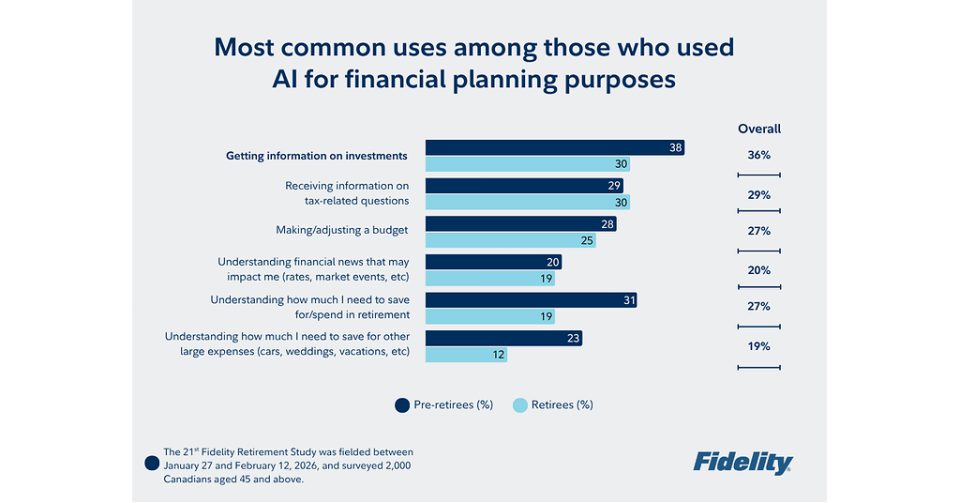
- AI usage – 26% of pre-retirees and 11% of retirees are using AI for financial planning.
- Most common uses – Getting information on investments (36%), tax (29%) and budgeting (27%).
- Regional differences – AI usage is most common in Ontario (22%) followed by the Prairies (18%), BC (17%), Quebec (15%), and the Atlantic provinces (14%).
- New Canadian use higher – Respondents born outside Canada (30%) are twice as likely to use AI for financial planning compared to those born in Canada (16%).
- Financial advisors are also leading adopters – A majority (83%) of financial advisors expect to increase their use of AI in 2026.1
|
_____________________________ |
Trust and confidence gap with AI, human financial advice most valued
- Confidence still building – Almost two-thirds (65%) of respondents who use AI say they are only “somewhat confident” in the information they receive.
- Early stage of trust – Just 5% of those who use AI consider it to be their most trusted source of financial information.
- Advisors most trusted source of information and advice – In contrast, 88% of those who use an advisor reported them as their most trusted source.
“AI may have the ability to process large amounts of information very quickly, but financial advisors remain the most trusted source of financial and retirement planning among respondents. Trust is built through context, judgment and personal understanding, helping Canadians interpret information, navigate uncertainty and make decisions aligned with their goals,” said Michelle Munro, Director, Tax and Retirement Research at Fidelity.
Rising uncertainty, mortgages complicate retirement outlook
- Top worries in 2026 – Canadians continue to worry about inflation (80%), turmoil in world politics (60%), economic growth (60%), as factors impacting their retirement.
- Geopolitics impacting investment decisions – 31% of pre-retirees and 34% of retirees worried about turmoil in politics said that the current market environment has caused them to move at least some of their assets into more conservative investments such as GICs, bonds and cash.
- Mortgages also high on the list – Similar to last year, debt continues to play a role as more than half (51%) of pre-retirees and 22% of retirees have a mortgage, with most pre-retirees (68%) and retirees (54%) not expecting to pay it off within a decade.
The steady role of human financial advice in this uncertain environment
- A written plan leads to a more positive outlook on retirement – 86% of pre-retirees and 90% of retirees with an advisor and a written financial plan feel positive about retirement compared to 53% of pre-retirees and 76% of retirees without advice and a plan.
- Greater confidence in achieving goals – 51% of Canadians who work with an advisor feel closer to achieving financial goals compared to those without (33%).
- More optimistic about investment growth – 52% of Canadians with an advisor feel optimistic that there will be lots of opportunities for future investment growth than those without (31%).
- Ongoing value beyond a financial plan: A financial advisor not only helps Canadians develop a financial plan, but also provides ongoing guidance to help them stay on track when conditions change.
Are Canadians thinking about withdrawal plans? Key opportunity in 2026
Each year, Fidelity highlights a key retirement planning opportunity for Canadians. In 2026, the focus is decumulation (the process of converting savings into income).
Only 8% of pre-retirees and 18% of retirees have a detailed decumulation plan for retirement. Many retirees report withdrawing savings on an as-needed basis rather than following a structured strategy.
“Saving is only half the equation; how Canadians turn savings into income is just as important,” added Munro. “Having a clear withdrawal plan can help Canadians make more informed decisions, avoid costly missteps, and feel more confident that their savings will support them throughout retirement.”
Get more retirement insights
For Canadians interested in learning more about the latest retirement trends, tax and retirement experts Michelle Munro and Jacqueline Power will provide their insights on this year’s results across Fidelity platforms:
- For financial advisors: English FidelityConnects webcast on June 3 at 11:30 a.m. EST with Michelle Munro and Jaqueline Power with a podcast episode to follow.
- For financial advisors: French FidelityConnects webcast on June 3 at 11:30 a.m. EST with Jacqueline Power with a podcast episode to follow.
- For investors: The Upside webcast on June 8 at 12:30 p.m. EST with Michelle Munro and Jaqueline Power
- Access written commentary about the 2026 Retirement Report on Fidelity Canada’s social media channels and Fidelity.ca.
About the 2026 Fidelity Retirement Report
This year’s study was fielded between January 27 and February 12, 2026. 2,000 Canadians were surveyed (48% male, 52% female), with a median age of 62. A disproportionate sample of pre-retirees and retirees were surveyed to allow for regional and gender analysis. The results were then weighted to reflect the national proportionate distribution of those 45 years of age and older. Total sample results are accurate to +/- 2.31 percentage points, 19 times out of 20.
About Fidelity Investments Canada ULC
At Fidelity Investments Canada, our mission is to build a better future for our clients. Our diversified business serves financial advisors, wealth management firms, employers, institutions and individuals. As the marketplace evolves, we are constantly innovating and offering our clients choice of investment and wealth management products, services and technological solutions all backed by Fidelity’s global capabilities. With assets under management of $401 billion (as at May 25, 2026), Fidelity Investments Canada is privately held and committed to helping our diverse clients meet their goals over the long term. Fidelity funds are available through financial advisors and online trading platforms.
Commissions, fees and expenses may be associated with investment funds. Read a fund’s prospectus or offering memorandum and speak to an advisor before investing. Funds are not guaranteed, their values change frequently and investors may experience a gain or loss. Past performance may not be repeated.
Find us on social media @FidelityCanada
www.fidelity.ca
Listen to FidelityConnects on Apple or Spotify
SOURCE Fidelity Investments Canada ULC

For more information, please contact: Chris Pepper, Vice-President, Corporate Affairs, Fidelity Investments Canada ULC, M: (416) 795-7762, E: [email protected]; Catherine Fiorino, Communications Manager, Fidelity Investments Canada ULC, E: [email protected]