

Don’t miss the latest market commentary from the Farm Futures team. Sign up for the complimentary morning and afternoon market newsletters!
Overnight trends:
Corn: Steady to down 1 cent
Soybeans: Up 1 to 2 cents
Wheat: Up 2 to 6 cents
Price snapshot as of 6:50 a.m. CST.
Asian stock markets were mostly in the red on Friday, closing with variable losses. European markets were lightly mixed in midday trading. On Wall St., the Dow slumped 302 points lower ahead of the opening bell to 52,484 amid a global computer chip selloff.
Energy futures were back on the rise after the U.S. initiated airstrikes for the sixth consecutive day in Iran. Brent crude oil futures were up almost 2% overnight, closing in on $86 per barrel. Gasoline futures were up more than 1.5%. The U.S. Dollar tested fractional gains.
Weather outlook
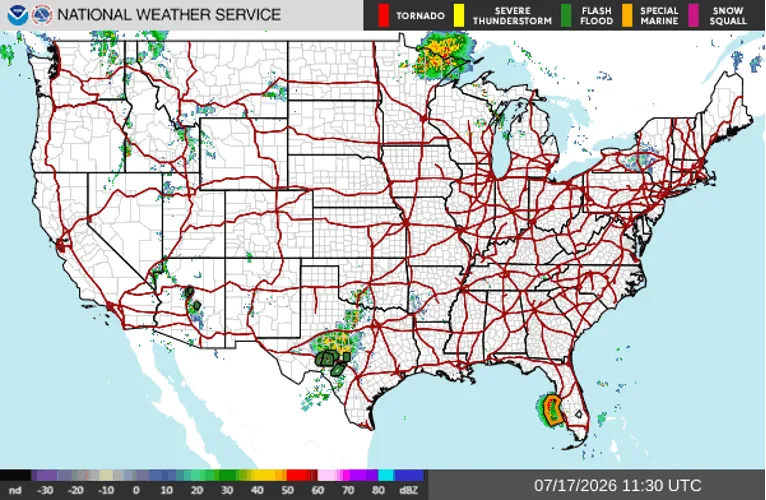
The latest 72-hour precipitation map from NOAA shows some light to moderate showers possible east of the Mississippi River over the next several days, particularly in Indiana, which could receive another 0.5” to 0.75” between today and Monday. Official 6-to-10-day forecasts call for seasonally wet conditions spreading across the Plains into the western Corn Belt between July 22 and July 26, with cooler-than-normal conditions continuing to develop through the Great Lakes region during this time.
Meantime, take a quick glimpse at where rains are currently happening:
Corn prices faded slightly lower overnight
Prices are hoping for a rebound heading into the weekend after incurring moderate cuts on Thursday. Prices may continue to struggle to balance robust domestic and export demand against the expectations of a 16-billion-bushel crop this season. Hot, dry weather could derail those projections, obviously, so keep a close eye on mid-range forecasts as we head into what is typically the hottest part of the summer.

Here’s an overview of how December corn futures have performed over the past three months.
Corn export sales in the week through July 9 only reached 24.7 million bushels in combined old and new crop sales. Old crop sales fell to a new marketing-year low and slumped 61% below the prior four-week average. Total sales were also below the entire range of analyst estimates, which came in between 31.5 million and 82.7 million bushels.
Corn export shipments fared better, with 62.5 million bushels. That was still 9% below the prior four-week average, however. Mexico, Japan, Vietnam, South Korea and Colombia were the top five destinations.
Grain prices tilted lower for much of June, only to find some footholds earlier in July. That begs the question – what’s next? That’s anybody’s guess, but there are plenty of supply and demand signals lurking in the background that could inform the direction moving forward. We asked various industry experts what they thought, and they returned with plenty of relevant advice in the latest edition of Top Tips – click here to learn more.
The put open interest total decreased to 296,647, versus a call open interest total of 547,528, which has the put/call open interest ratio holding steady at 0.54. Implied volatility for December contracts eased to 21.2% with 126 days until expiration.
Soybean prices set the stage for Friday gains
Prices saw some light technical buying overnight as nearby contracts closed in on the $12 per bushel benchmark. Demand has been healthier in recent weeks, marked by a flurry of flash sales to China earlier in July. Domestic crush has also been robust. However, quality and production expectations are also high right now, which could dampen future rally prospects. August and September futures were up around 1 to 2 cents heading into Friday’s session.

Here’s an overview of how November soybean futures have performed over the past three months.
The rest of the soy complex was mixed. September soymeal futures faded almost 0.5% lower, while September soyoil futures climbed more than 1.5% higher.
Soybean exports found 69.2 million bushels in combined old and new crop sales in the week through July 9 — a rare win over corn in recent months after significantly surpassing the other commodity’s volume. Old crop sales were up noticeably week-over-week but faded 23% below the prior four-week average. Total sales were toward the higher end of analyst estimates, which ranged between 36.7 million and 80.8 million bushels.
Soybean export shipments inched 5% higher than the prior four-week average, with 16.7 million bushels. Egypt, Mexico, China, Japan and Indonesia were the top five destinations.
“It’s important to recognize that succession planning is really people planning,” notes Tim Schaefer, founder of Encore Wealth Advisors. “So, start there. People bring motivations, fears, assumptions, habits and histories to the table. Recognizing barriers early — and understanding the concerns behind them — can turn a stuck process into real momentum.” Schaefer walks through five ways that farm succession planning can get bogged down in his latest Transitions & Strategies blog — click here to learn more.
Soybean open interest puts increased to 131,989 but were still noticeably below call volume of 203,595, with that ratio increasing slightly to 0.65. Implied volatility eased to 16.0% for November futures, with 98 days until expiration.
Winter wheat prices moved back into the green
Rising oil prices, spurred by ongoing fighting overseas (particularly in Iran, Russia and Ukraine) helped generate some overnight technical buying that led to moderate gains early today. Tightening global stocks are also in the mix right now, but the ongoing U.S. winter wheat harvest could put a lid on gains. CBOT futures were up a little over 0.25% overnight, with HRW futures rising 1% higher.

Here’s an overview of how December Chicago SRW futures have performed over the past three months.
Wheat export sales in the week through July 9 only gathered 8.6 million bushels, which was 38% below the prior four-week average. That also missed the mark among analyst estimates, which ranged between 9.2 million and 22.0 million bushels.
Wheat export shipments fared much better, with 15.5 million bushels. That was a 25% improvement versus the prior four-week average. Mexico, the Philippines, Japan, Taiwan and Honduras were the top five destinations.
And finally, the 2026 Husker Harvest Days will be here before you know it, and you can register ahead of time for complimentary tickets. There are also three “can’t miss” activities according to Nebraska Farmer senior editor Curt Arens. Those include a hands-on skid-steer experience, nitrogen management research plots and the first-ever NCBA stockmanship and stewardship training. Click here to learn more.
Open interest for CBOT wheat puts (65,713) remain well below call volume (104,868), with the ratio now at 0.63. Implied volatility on September futures eased to 37.9% with 35 days until expiration.