
July’s data reveals a widening divide between USDT and USDC as card top-ups crossed $1 billion and payments ranked second in crypto funding.
In 2026, stablecoins became one of the fastest-growing segments, peaking at nearly $320B of total capitalization and now settling down closer to $308B. Their role extends well beyond market size: stablecoins are widely used across crypto for trading, settlement, payments, remittances, and other financial activity.
In this stablecoin digest, the CryptoRank Research team analyzed the key metrics of stablecoins and the crypto payments sector. We broke down everything from market dynamics and on-chain activity to crypto payments and venture funding.
Stablecoin News: July 2026 Highlights
July’s main developments centered on institutional infrastructure for regulated stablecoins.
-
Open USD. On June 30, Open Standard announced Open USD (OUSD), a consortium stablecoin backed by more than 140 companies, including Visa, Mastercard, Stripe, BlackRock, and Coinbase. The model distributes most reserve income to partner companies and places governance with an independent partner board rather than a single issuer.
-
Circle National Trust. On July 10, Circle received final OCC approval to establish First National Digital Currency Bank, N.A., doing business as Circle National Trust. The institution will initially provide federally regulated digital asset custody for Circle and its affiliates; USDC reserve management is a planned future capability.
-
Visa Stablecoin Platform. On July 16, Visa announced the Visa Stablecoin Platform (VSP), a managed environment for institutions to mint, store, transfer, and redeem stablecoins, beginning with Open USD.
-
Ripple Mint. On July 23, Ripple launched Ripple Mint, a web and API interface for institutions to mint, redeem, bridge, and monitor RLUSD. Ripple also expanded RLUSD to Base, Optimism, Ink, Unichain, and the XRPL EVM Sidechain.
-
Mastercard × BVNK. On August 3, just after July ended, Mastercard completed its acquisition of BVNK for up to $1.8B. BVNK provides infrastructure connecting fiat and stablecoin payments across more than 130 countries. Mastercard said it will use the technology for cross-border remittances, business payments, payouts, settlement, and treasury operations.
Stablecoin Market Dynamics
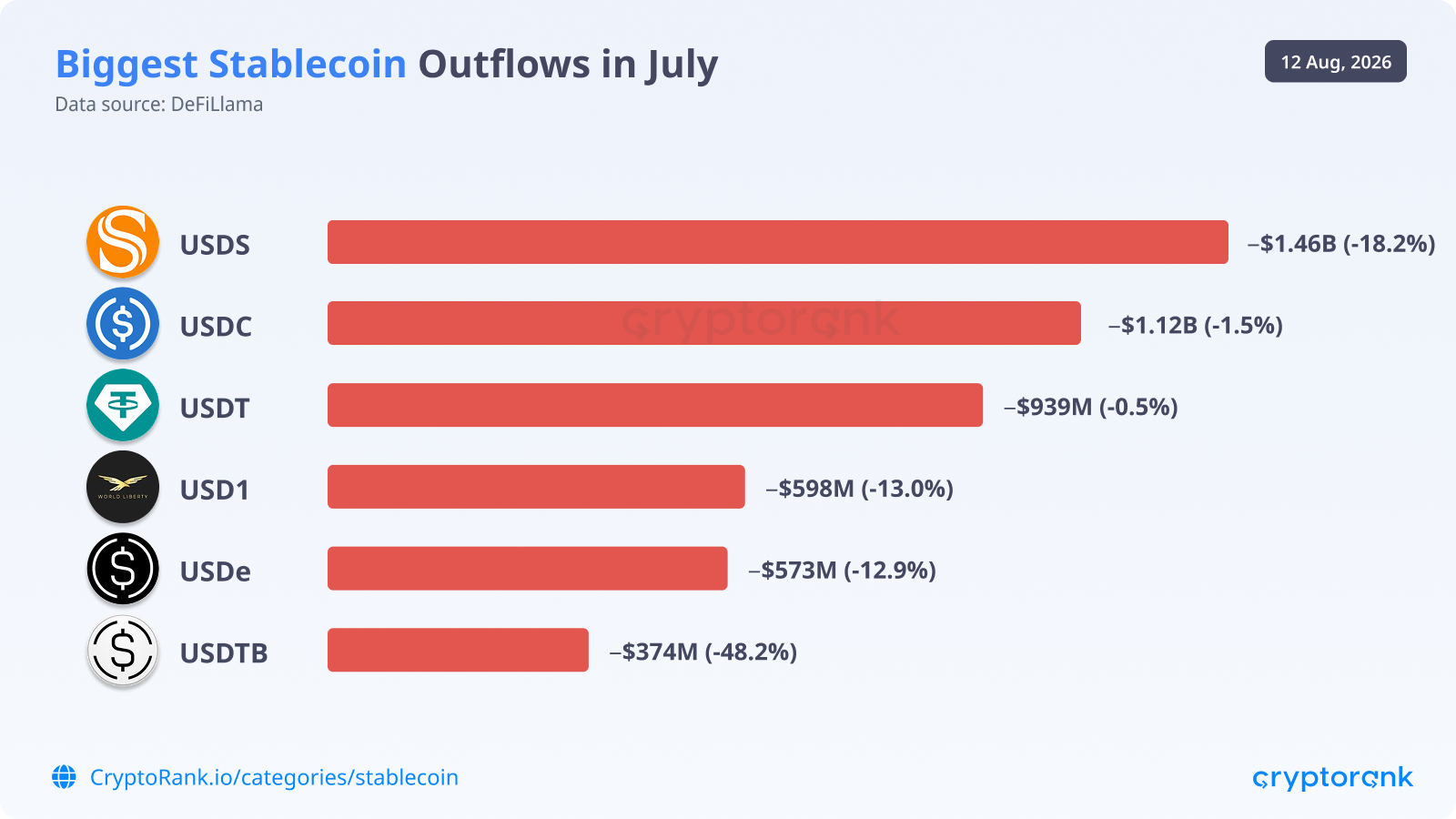
Total stablecoin market cap ended July at about $308.3B, down roughly 1% from $311.4B in June. Stablecoin supply has now held within a narrow range for the tenth straight month, hovering around the $300-320B mark without any meaningful new issuance.
A marked expansion began in late 2023 from around $130B, and stablecoin supply more than doubled over the next two years to pass $300B by early 2026. Net flows stayed negative for a third straight month in July, with roughly $13.3B leaving the market from May through July. That’s the longest stretch of stablecoin outflows since the 2022-2023 drawdown, when supply contracted for nearly a year after the Terra collapse.
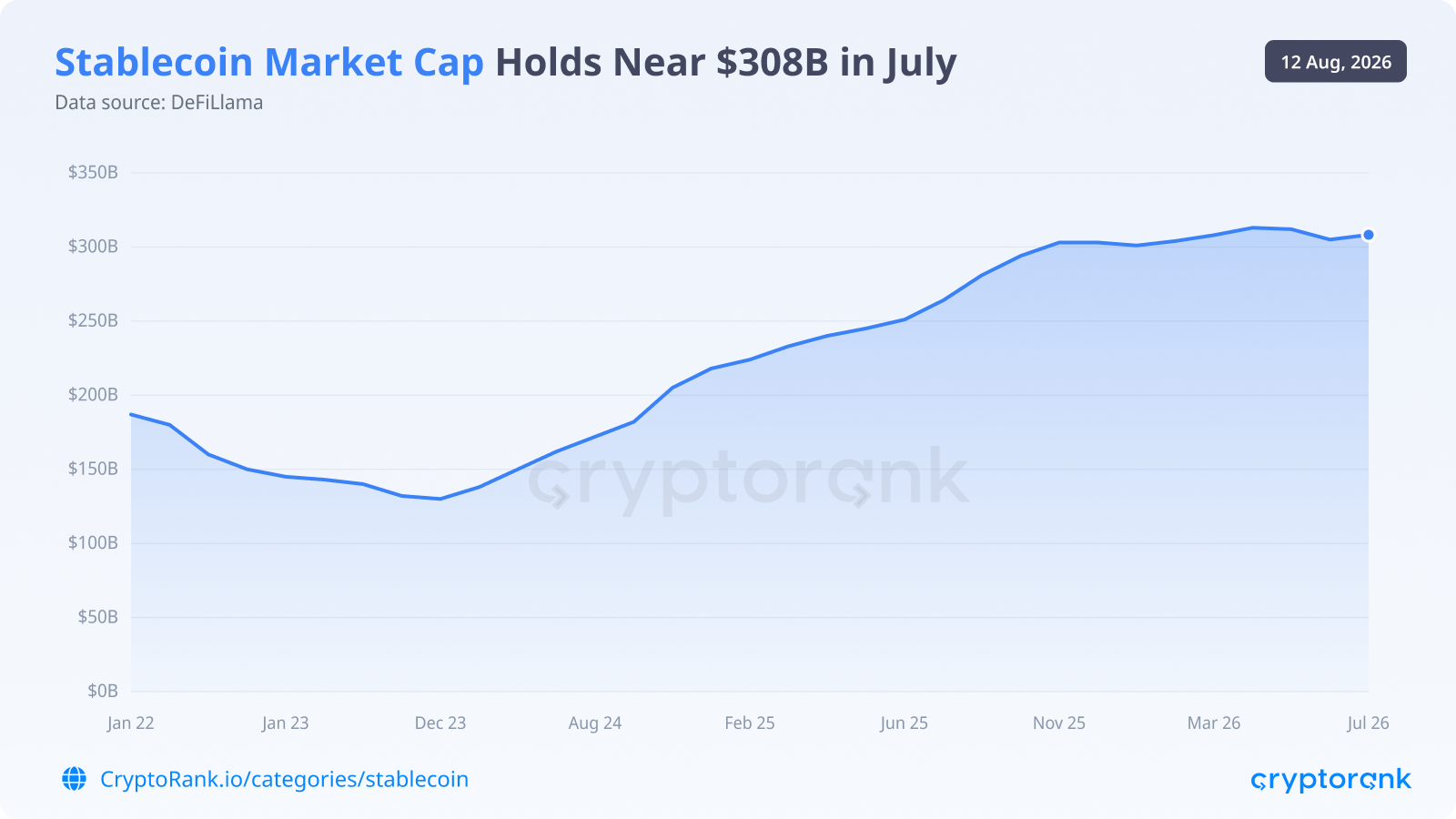
The biggest gains came from institutional and RWA-style dollars. Global Dollar (USDG) added about $485M (+17%) on the launch of the Robinhood Chain. Its supply rose from roughly $2.78B to $3.03B in the first week of July, assisted by its revenue-sharing model and MiCA taking full effect on July 1.
BlackRock’s tokenized treasury token BUIDL grew about $444M (+20%) on a single week of inflows into Avalanche, where its holdings rose more than 55% to over $600M. Agora’s AUSD gained about $72M (+38% off a smaller base) as it expanded onto Monad and added Pendle yield incentives.
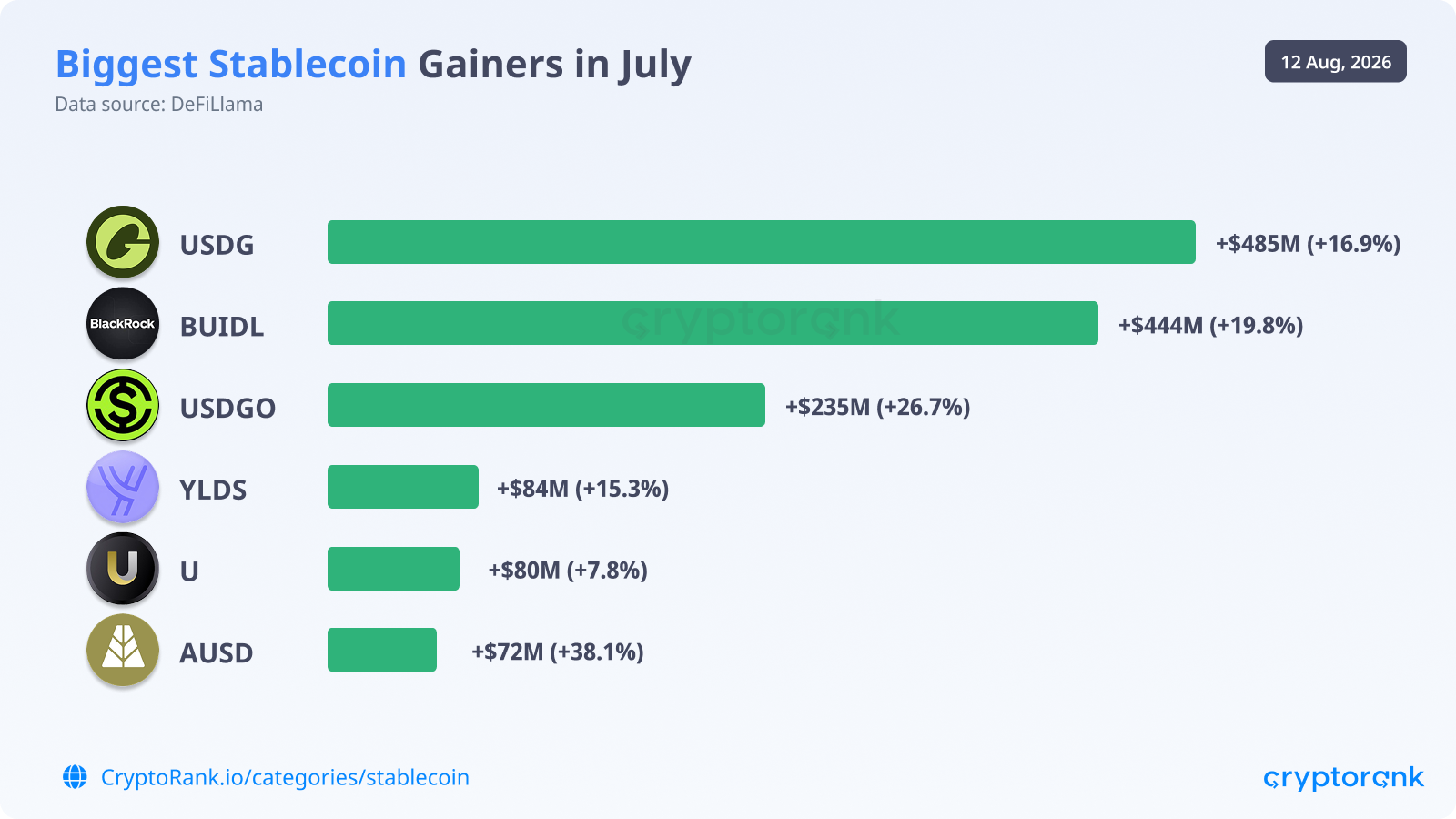
The outflows had no single common driver. The largest was USDS at about −$1.46B, followed by USD1, whose ~$598M decline tracked pressure on World Liberty Financial‘s wider ecosystem. The rest, including USDC and USDT, were ordinary supply swings.
On-Chain Stablecoin Activity
The distribution across blockchains has remained broadly stable over the past year: Ethereum and Tron together carry about 80% of all stablecoin supply. The leading chains’ combined share has changed little, so the more meaningful shifts are occurring among smaller networks.
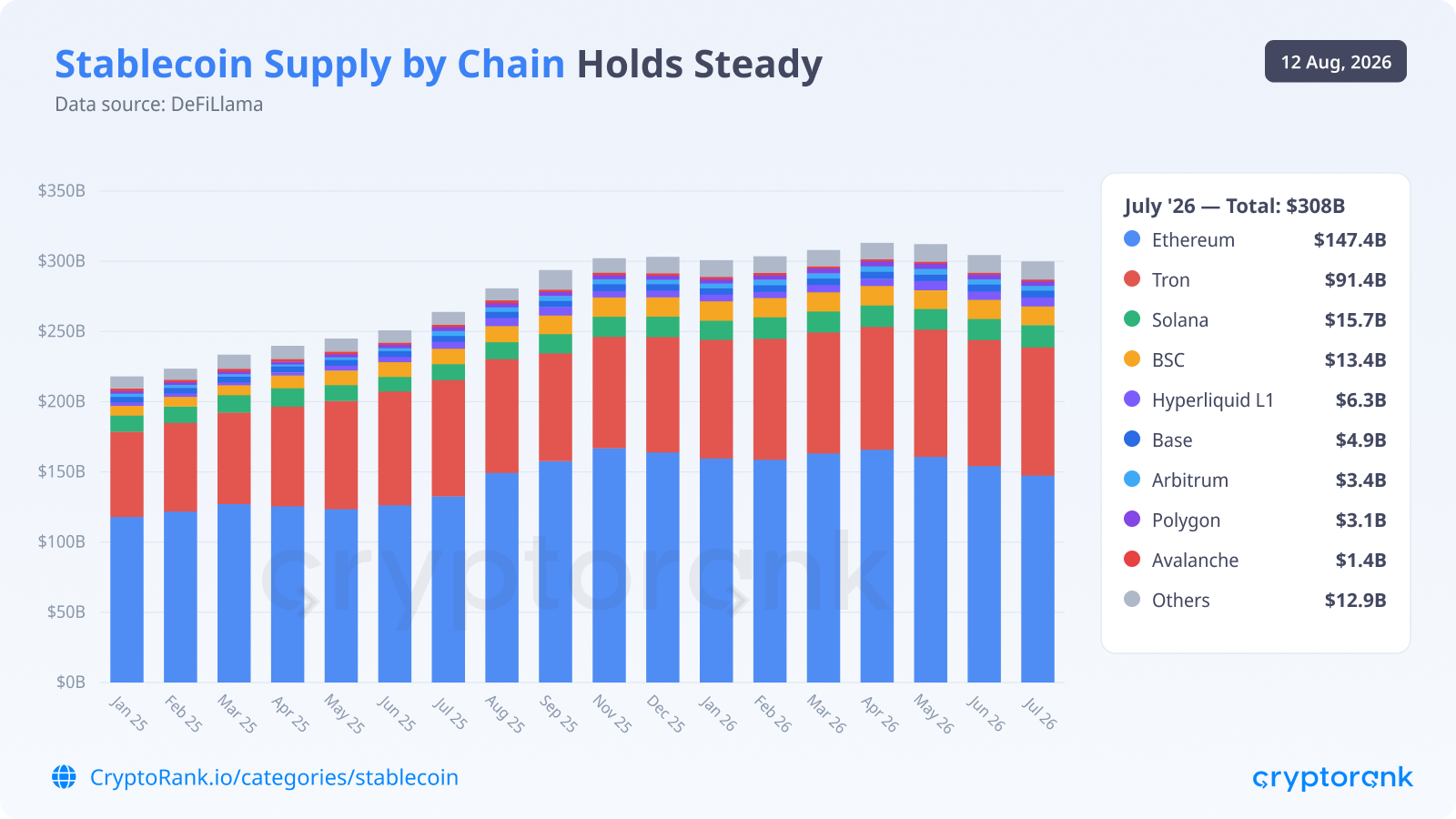
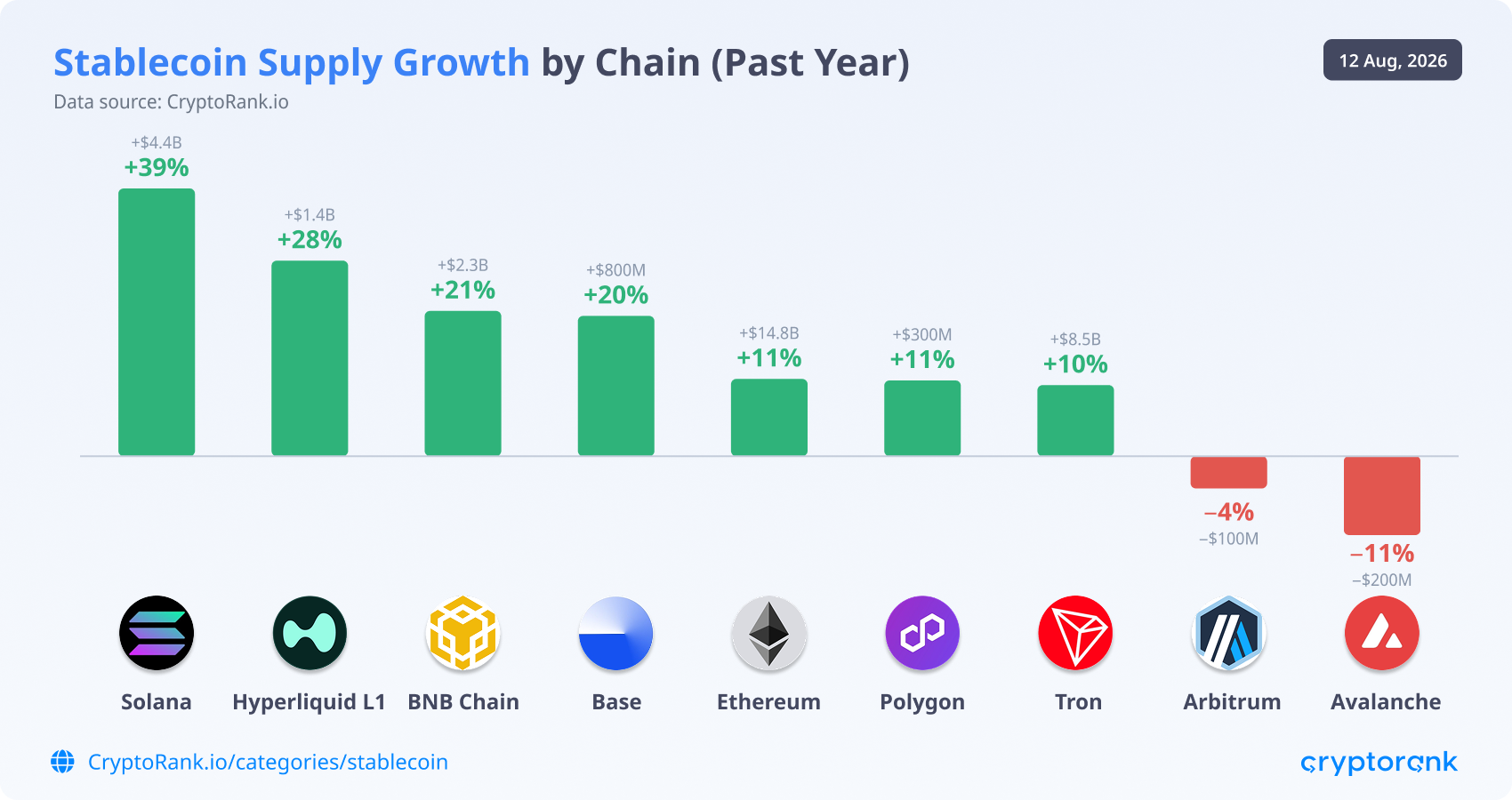
Solana led growth among the large chains, up about 39% to $15.7B, but the mix matters more than the total. A year ago, USDC was about 70% of Solana’s stablecoin supply. Today, it is closer to 43%. USDC supply on Solana shrank from roughly $8B to $6.7B, even though it grew globally. The gap was filled by newer stablecoins, USDGO, USD1, BUIDL, USDG, and PYUSD, several of them the same institutional issuers driving growth elsewhere. Solana went from a USDC chain to the one new issuers reach for first.
Hyperliquid L1 grew about 28%, almost entirely from USDC. The chain has a well-developed perpetual trading ecosystem, anchored by its own perp DEX that leads the sector by trading volume. USDC is the main collateral traders post against their positions there, so that activity shows up directly as USDC held on the chain. Its USDC supply rose from about $4.9B to $6.2B over the year, while every other stablecoin on the chain stayed under $180M combined.
Transaction Count
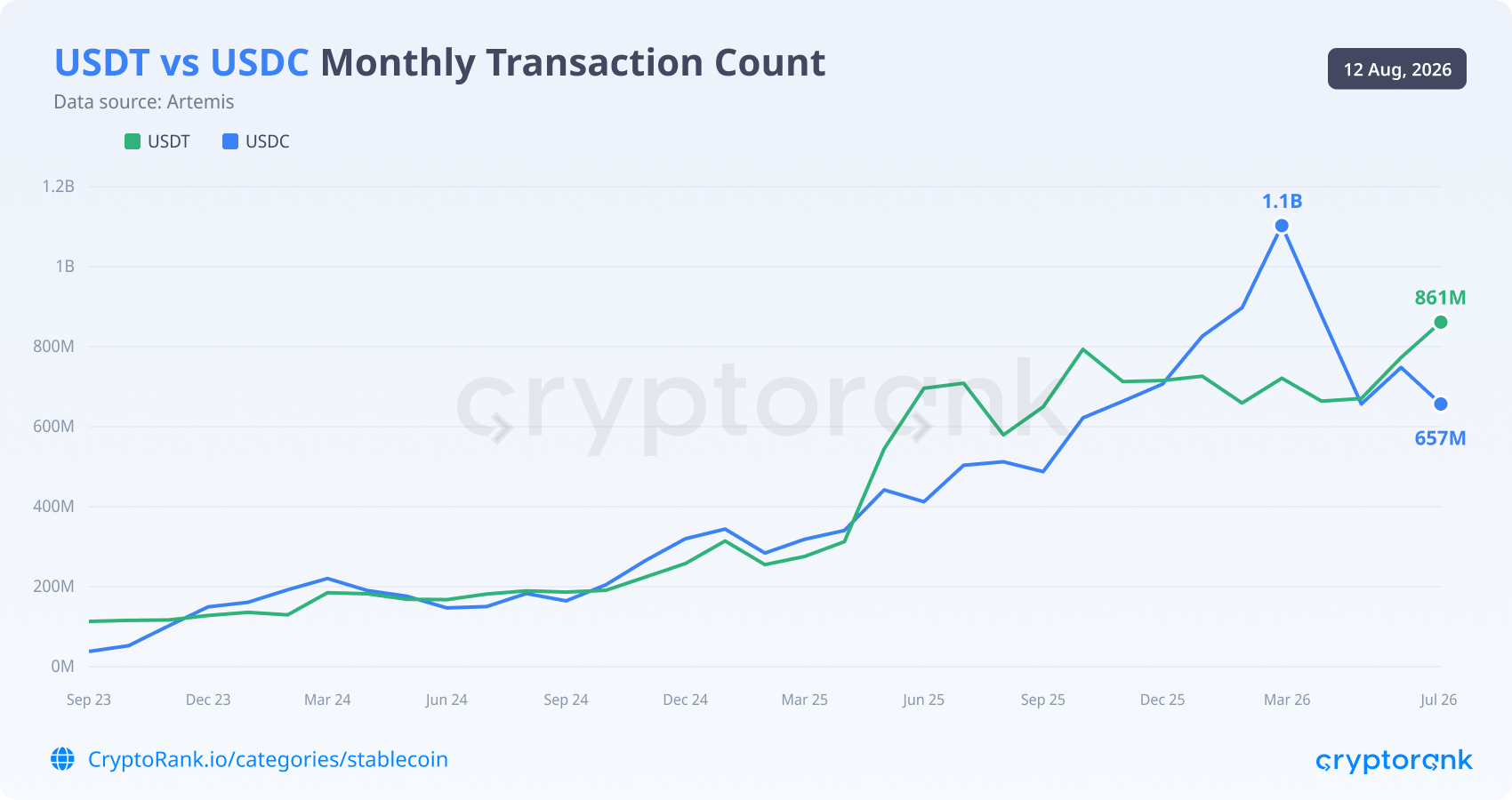
USDT and USDC are the two largest stablecoins by supply, together representing over 84% of the stablecoin market, so their on-chain movement is a fair read on the market as a whole. The charts below break down transaction count for each.
USDT and USDC transaction counts tracked each other closely through most of 2025, but split apart over the past year. USDT reached an all-time high in July 2026 at 861.4M transfers, up 11.4% from 773M in June, continuing a steady climb.
USDC went the other way. Its count ran ahead of USDT through the start of 2026 and peaked at about 1.1B transfers in March, briefly the more active of the two. It has fallen since, down to 656.7M in July, a 12.2% drop from June and about 40% below the March peak. The two now sit far apart, with USDT setting records while USDC has retraced most of its 2026 gain.
On-Chain Stablecoin Transfer Volumes
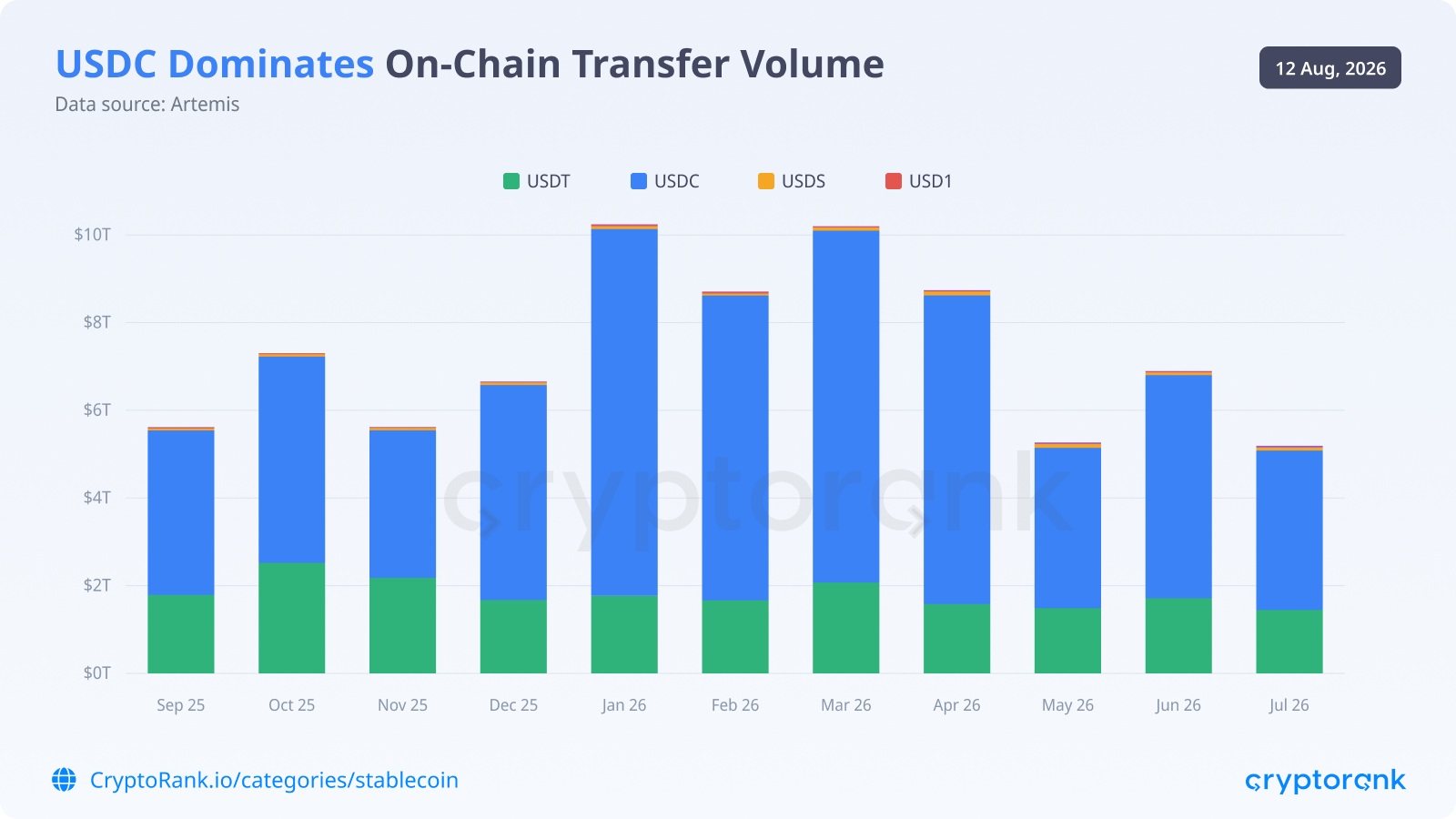
USDC transferred more value on-chain than USDT in each month shown, often by a factor of 2-3. In July, total stablecoin transfer volume was about $5.2T: USDC accounted for roughly $3.6T and USDT for $1.4T. Combined with transaction counts of 656.7M for USDC and 861.4M for USDT, the data imply a larger average transfer size for USDC. USDT, meanwhile, was used more frequently.
That split may partly reflect how each token is positioned. Circle holds a MiCA e-money license in the EU, while USDT lacks equivalent authorization, and USDC is integrated into Visa and Mastercard settlement programs. These factors may help explain USDC’s larger role in institutional and on-chain settlement. In this dataset, USDT records more transactions but has a smaller average transfer size.
Crypto Payments
The next stage of stablecoin adoption is payments. While market metrics show how much liquidity exists on-chain, payment data shows how that liquidity is increasingly being used in the real world.
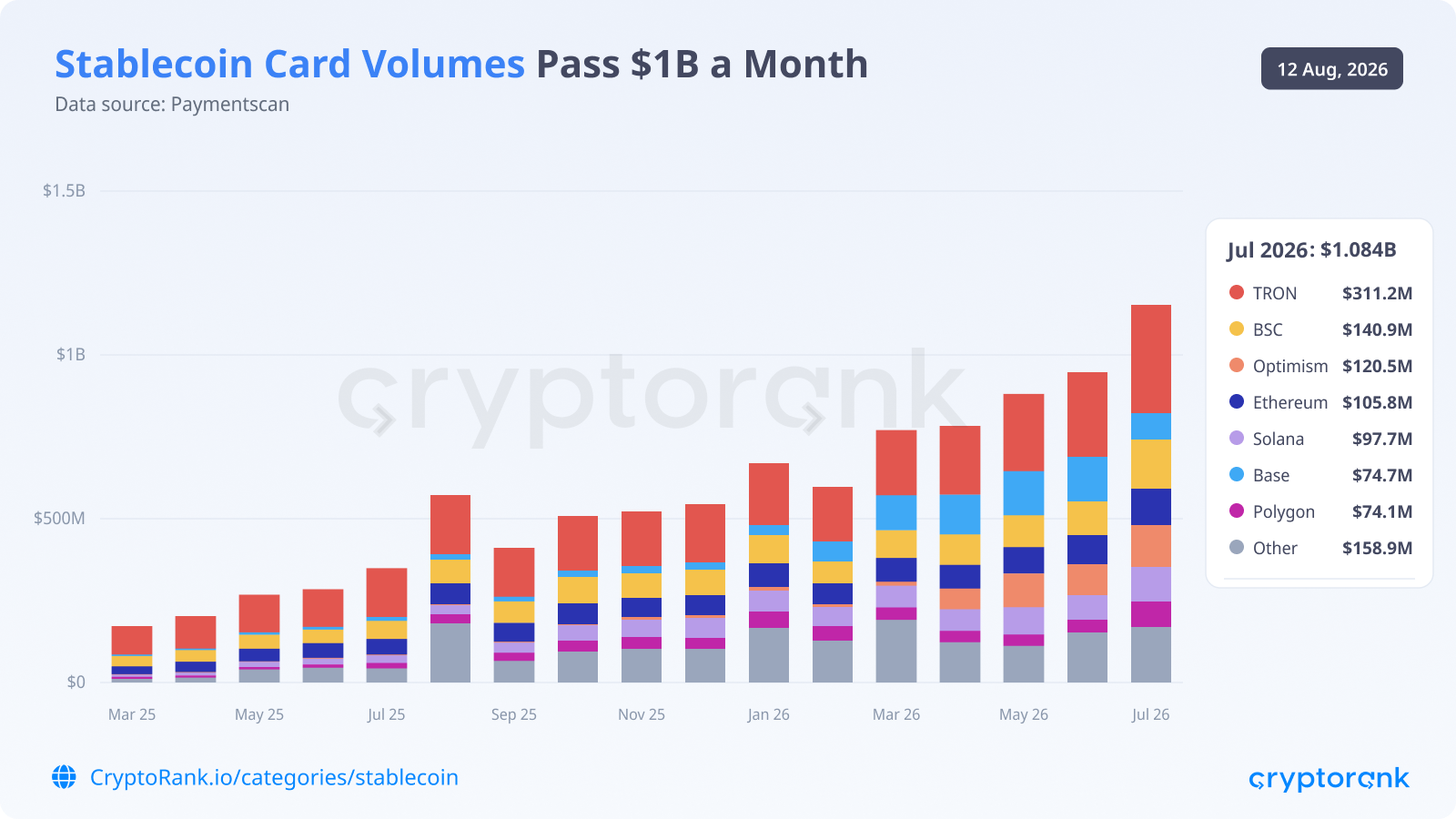
Crypto payment cards pass $1B a month
Monthly stablecoin card top-up volume crossed $1B for the first time in July, reaching about $1.084B, up 15.9% month over month and several times higher than at the start of 2026. Cards are becoming one of the clearest real-world use cases for stablecoins, and the pace has not slowed.
Card top-ups remain concentrated on cheap, high-throughput chains rather than the ones that lead DeFi. TRON alone handled $311.2M, nearly 30% of identified top-up volume, and together with BSC ($140.9M) accounted for over 40% of the total.
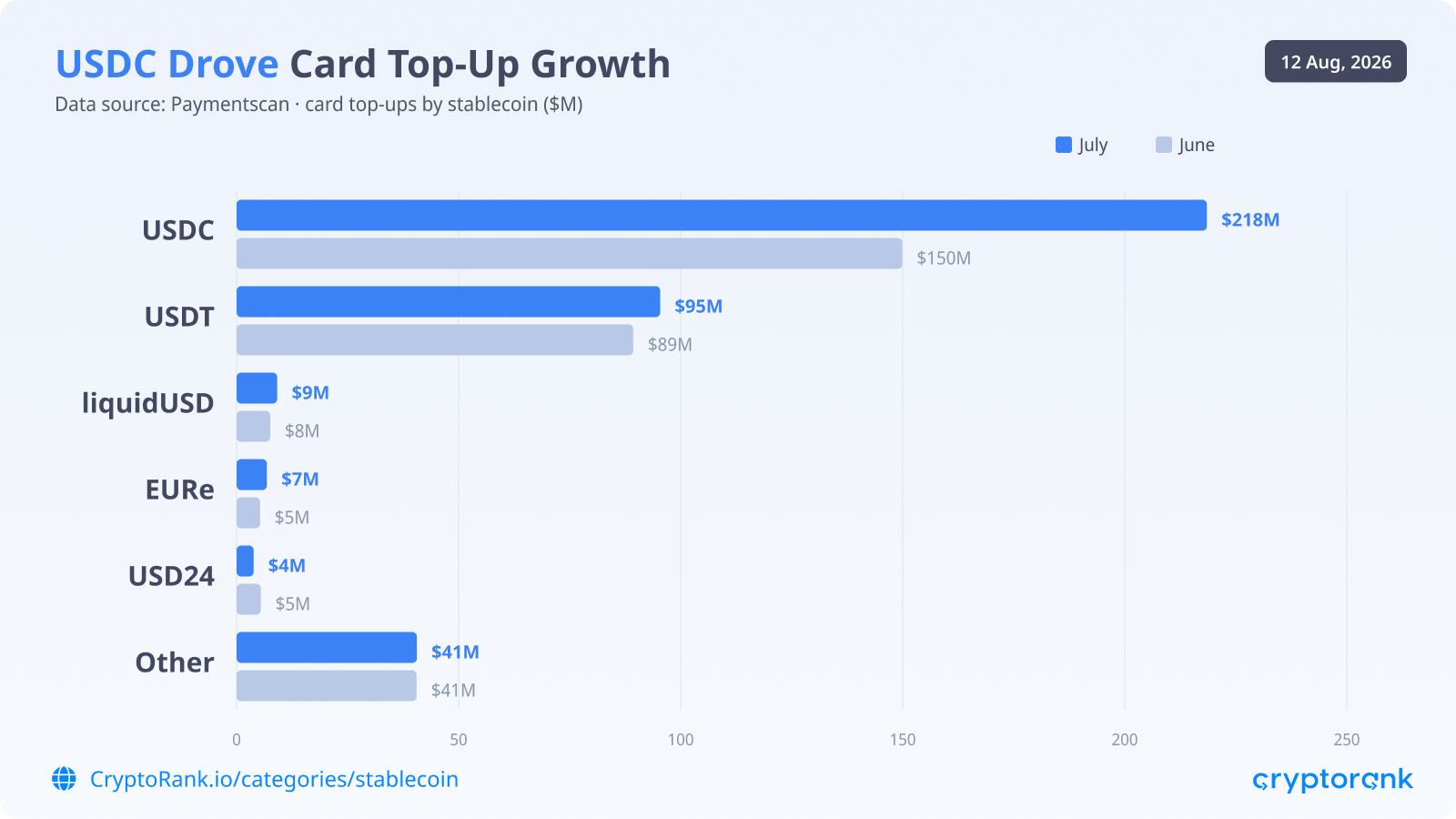
The month’s jump was led by USDC, up 46% against just 7% for USDT. It added more volume on its own than every other stablecoin combined and now makes up well over half of identified top-ups, the reverse of the two tokens’ ranking by supply.
That fits USDC’s role across the rest of this report: the regulated, payment-integrated dollar that consumer programs default to. On cards it settles more than twice USDT’s volume, the reverse of the two tokens’ ranking by supply, where USDT is far larger.
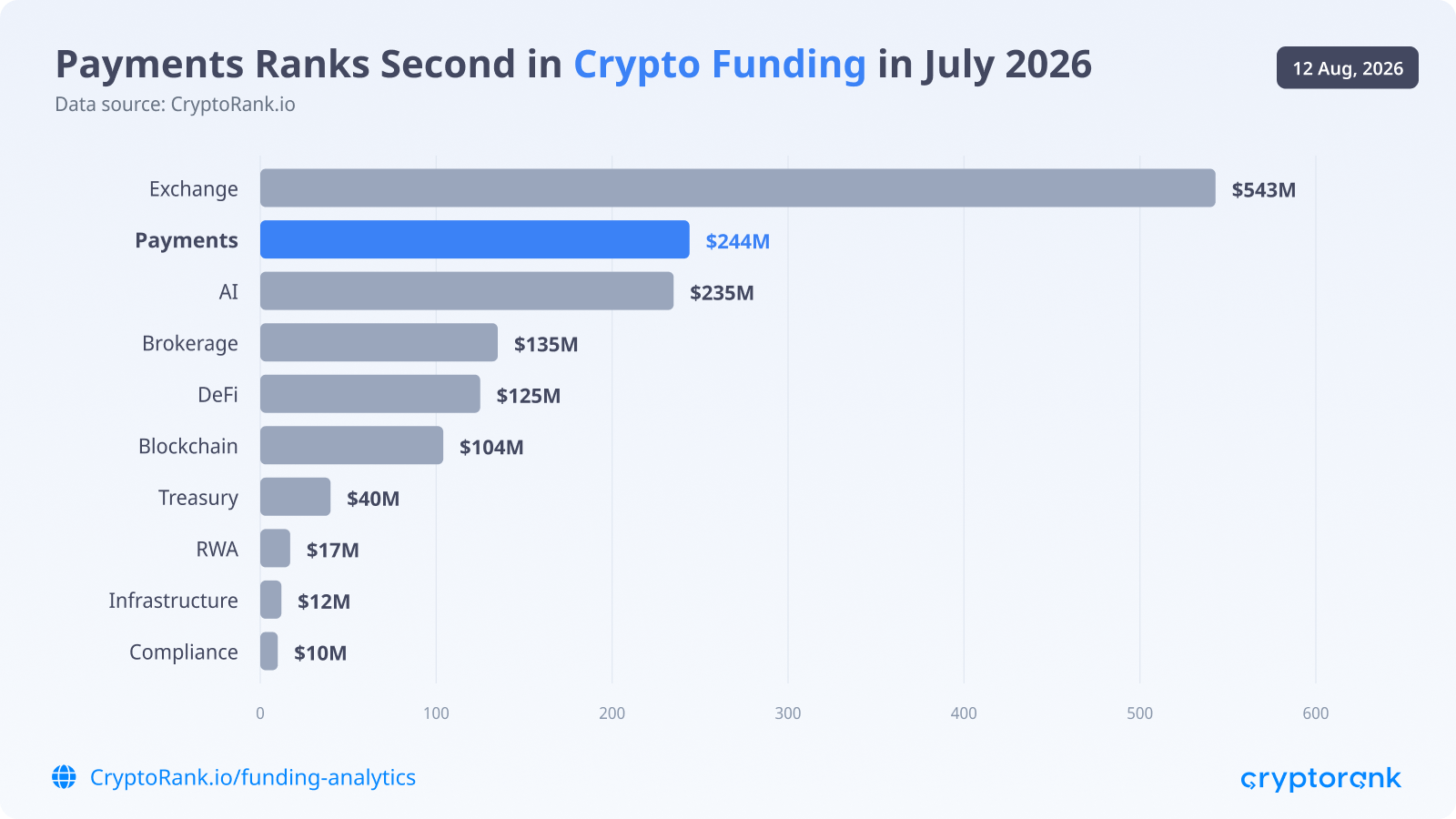
Payments Ranks Second in Crypto Funding in July 2026
Payments stayed near the top of crypto venture funding in July, raising about $244M across 4 VC rounds. That put it second by capital raised, behind only Exchange, and third by deal count.
The month’s largest payments round was Augustus Investors‘ $180M Series B at a $1B valuation, led by Tiger Global Management. Two stablecoin infrastructure startups followed with Series A rounds: Velocity ($38M, co-led by Dragonfly and FirstMark) and Cyclops ($20M, led by Nava Ventures), both building stablecoin settlement rails for enterprise payments.
Conclusion
July looked like a weak month only if you measure stablecoins the way you measure a token. Supply sat flat near $308B and kept bleeding, but that flatness is starting to mean maturity rather than stagnation: the same dollars are being turned over harder, run through cards, settlement, and payment rails instead of sitting idle or chasing yield. A stablecoin market that grows by usage rather than issuance behaves less like a crypto asset and more like actual money plumbing, and that is the more durable kind of growth even if it never shows up in market cap.