
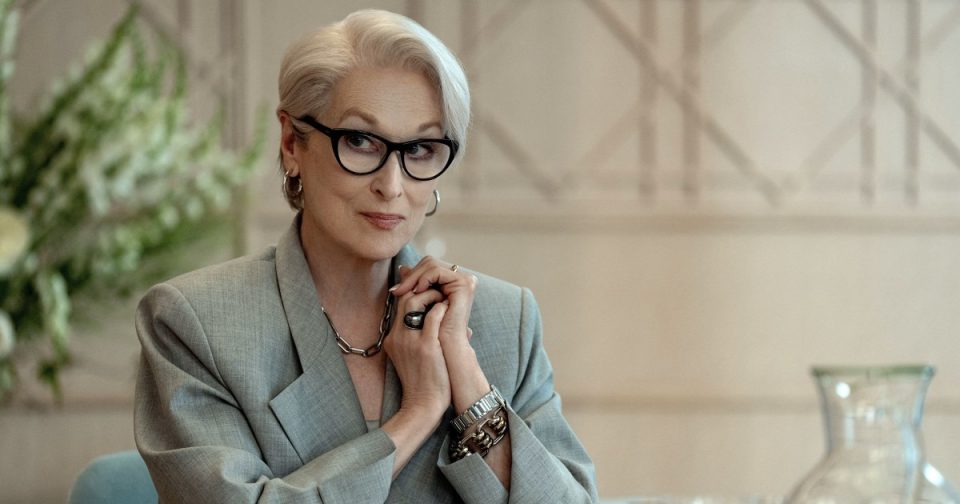
What some viewers thought was an AI-generated meme in “The Devil Wears Prada 2” was actually drawn by a human artist.
Subscribe to read this story ad-free
Get unlimited access to ad-free articles and exclusive content.

The highly anticipated sequel to the 2006 classic dominated the box office this weekend as its original cast returned to the story of the fictional magazine “Runway” 20 years later.
One clip from the new film shows a slew of internet memes disparaging editor-in-chief Miranda Priestley, played by Meryl Streep, including one of Priestley as a fast-food worker, with the text: “Would you like some lies with that?”
The meme, which was on screen for only a brief moment, looked to many audience members as an intentional depiction of AI slop, part of the film’s satirization of the modern state of media.
But when the artist who drew it, Alexis Franklin, shared online that the image was hand-painted, many viewers expressed their surprise and excitement that the meme, despite its appearance, wasn’t AI-generated at all.
“Absolutely no disrespect to Queen Meryl, but this is something I would’ve painted in my free time, so when they asked me to do this it was nothing but fun,” Franklin wrote in an Instagram post. She said that “The Devil Wears Prada” director David Frankel asked to commission her for the piece.
Franklin’s post, which included a time lapse of her artistic process, accrued hundreds of comments praising her work as well as the film’s decision to hire a human artist for the project.
One commenter wrote that it was “so refreshing it not being AI.”
“Ai replacing artists 🙅🏻♀️ artists replacing ai 🙂↕️,” wrote another.
Franklin told NBC News that the digital painting took her a few days of on-and-off work to complete, and that she was “fairly compensated.”
She wrote in an email that she was going for a “cheap, plastic look that reminded me of the photoshopped 2010’s meme aesthetic.”
But that plastic look has also spurred some commenters to ask if she intended to mimic the look of AI, particularly with certain stylistic choices like the blurring of menu text. (Illegible text has been a telltale sign of AI-generated imagery as models struggle to replicate small details.)
“Technically I was trying to make it look artificial, but emulating AI was not on my mind when I painted it,” Franklin wrote. “It feels like the power of suggestion has taken hold in that regard. I’ve had people point out regular, human micro-errors in the piece and claim I did it intentionally to nail the ‘AI slop’ of it all, which is amusing.”
Still, Franklin, a professional illustrator for nearly a decade, said some people are still having trouble believing that the work is her own. She’s received accusations of faking her Priestley painting despite the time lapse she shared and her public portfolio of work from long before AI images became commonplace online.
It’s part of a growing phenomenon that has troubled media experts. As generative AI technology gets increasingly sophisticated, people are not only more likely to believe AI-generated images are real, but they’re also more likely to believe real images are AI.
“This mass hypervigilance prevails because people don’t want to be fooled, leading them to see signs on the walls that aren’t really there or that have very simple, reasonable explanations,” Franklin wrote. “And it’s hard to know what the solution is.”
She added that she understands people’s skepticism, especially when it comes from a place of wanting to support human artists. But she said it also has the potential to hurt those artists.
“AI is so prevalent now, it feels like people have forgotten how it got that good — it studied us,” Franklin wrote. “The techniques it uses are ours!”