
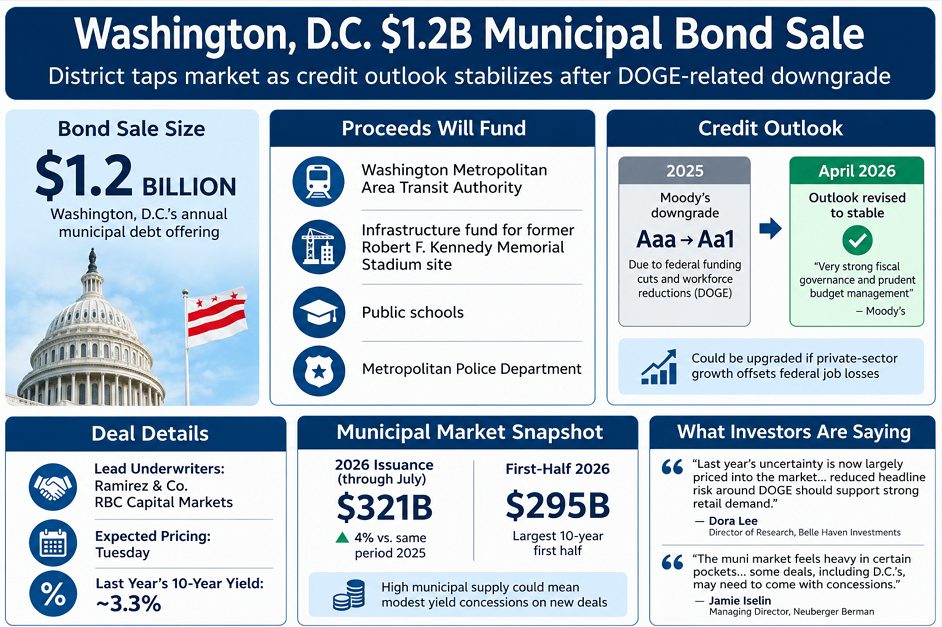

Washington, D.C., is returning to the municipal bond market this week with a $1.2 billion debt offering, marking its annual bond sale as the district’s credit profile shows signs of stabilization following last year’s downgrade tied to federal workforce reductions.
The financing will support the district’s six-year capital improvement program, including investments in the Washington Metropolitan Area Transit Authority, redevelopment infrastructure at the former Robert F. Kennedy Memorial Stadium site, public schools and the Metropolitan Police Department.
The offering follows a turbulent period for the nation’s capital. In 2025, Moody’s Ratings downgraded Washington’s general obligation credit rating to Aa1 from Aaa, citing concerns over federal funding reductions and government workforce cuts linked to the now-defunct Department of Government Efficiency (DOGE) and the Trump administration’s efforts to shrink the federal workforce.
However, Moody’s improved the district’s outlook from negative to stable in April, pointing to Washington’s strong fiscal management and disciplined budgeting. The agency also indicated the rating could improve if private-sector job growth helps offset losses in federal employment.
Market participants say much of the uncertainty surrounding the federal downsizing has already been absorbed by investors.
“Last year’s uncertainty is now largely priced into the market,” said Dora Lee, director of research at Belle Haven Investments. She added that reduced concerns surrounding DOGE and the limited supply of Washington, D.C.-exempt municipal bonds should continue to support strong retail investor demand.
The transaction, led by Ramirez & Co. and RBC Capital Markets, is expected to price Tuesday. During last year’s bond sale, the district’s 10-year bonds were issued at yields that are now trading around 3.3%.
The offering also arrives amid one of the busiest municipal bond markets in recent years. Municipal issuance has reached approximately $321 billion so far this year, up about 4% from the same period in 2025, according to Bloomberg data. First-half issuance totaled roughly $295 billion, the highest level in a decade.
Despite expectations for healthy investor demand, some market strategists believe the wave of new municipal issuance could require issuers to offer slightly higher yields to attract buyers.
Jamie Iselin, managing director at Neuberger Berman, said the municipal market has become crowded in certain sectors, meaning some offerings—including Washington’s—may need to come with pricing concessions despite their generally strong credit quality.