

Bloomberg News
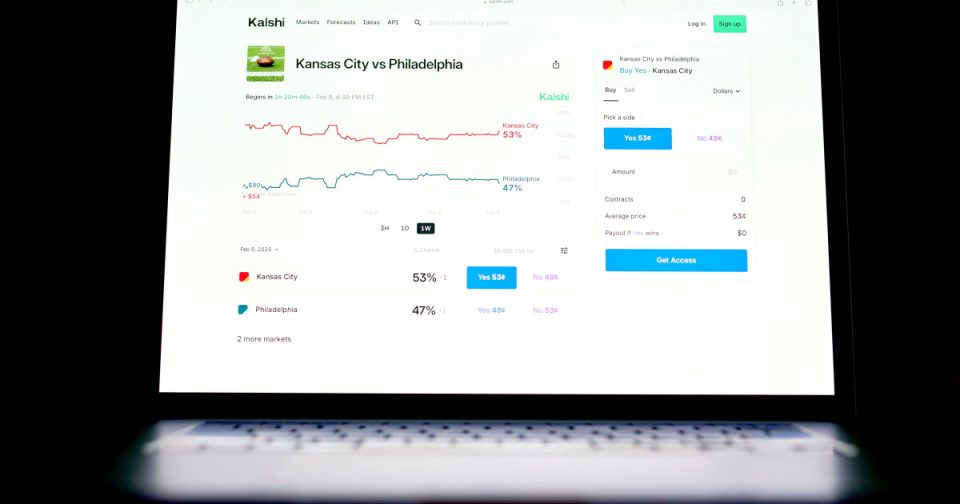
When Kalshi started taking bets on whether the unfunded liability of Illinois’ five pension systems will top $145 billion this year, it was the latest signal that the municipal bond market won’t be able to ignore prediction markets.
Processing Content
Prediction markets allow traders to bet on the outcomes of events, with blockchain currencies enabling certain decentralized markets to manage trades through smart contracts.
Some argue prediction market platforms can be a force for good, prodding issuers toward better pension funding or faster audits, for example.
Others worry the platforms are essentially black boxes, vulnerable to manipulation, and could replace democratic accountability with financial incentives to game the system.
Financial markets have readily embraced prediction markets as a mainstream crowdsourced provider of real-time probability signals and risk-hedging tools.
“By tapping into the ‘wisdom of the crowd,’ prediction markets promise unique signals about the future,” Coalition Greenwich strategists wrote in a January report.
The muni market has been slow on the uptake, but the Illinois pension debt wager sets the stage, said Tom Doe, founder of Municipal Market Analytics.
“It’s not a big step; it’s a small step, but … it’s a natural progression” of the expansion of those platforms into the muni market, he said.
Potential muni wagers could involve credit ratings, whether an issuer is filing a disclosure, or stacking up one credit against another. Users could bet on an index outperforming another or where municipal rates will be in three months, Doe said.
Betting on munis isn’t exactly new. Some market participants had internal wagers about which would default first:
“The market needs a derivative instrument,” Doe said. “It needs a neat way of managing credit risk before the credit problems manifest. It’s been an unusually long period of time since there’s been any credit disruption in the municipal market. It’s due.”
Currently, prediction markets cannot play a role in hedging munis, said Matt Smith, founder of Spline Data, at the recent Bond Buyer Tech Forum.
Munis “have a liquidity diversion problem that would also translate to prediction markets somehow, but … the flexibility of the prediction markets makes it so that you might be able to encompass that in a smaller bucket,” Smith said. “If you can get people interested in using that as a hedge product, then great.”
However, the problem with muni hedging is “everybody wants the same side of the train,” he said. “You’ve got this long-only asset class, and so the natural desire for any other muni-related asset class is to be short.”
Kalshi is “actively looking into” ways to structure prediction markets that would be the most useful for hedging, Kalshi spokesman Jack Such said.
“There’s nothing live yet,” he said, but Kalshi is working to ensure that “when we do figure out the right structure, the experience and infrastructure is already in place.”
“Over the long term, we want these markets to be deeply liquid and able to do institutional size,” he said. “Liquidity takes so long to build, it’s years away from being institutional-ready for some of the more niche contracts. [But] we do want people who have institutional size to be able to hedge right now.”
Polymarket “continue[s] to see growing institutional interest in how prediction markets can inform views on risk and other market-moving events,” a spokesperson for the platform said by email.
The Commodity Futures Trading Commission oversees prediction markets in the U.S.
A spokesperson for the CFTC said by email it “is currently fielding public comment on our recent Notice of Proposed Rulemaking surrounding prediction markets.”
The notice, published in the
The CFTC spokesperson said, “Under federal law in the Commodity Exchange Act, prediction markets are considered swaps and therefore the CFTC has exclusive jurisdiction to regulate them.”
In April, KBRA became the first bond rating agency to announce a ban on employee participation in prediction markets. In
Moody’s Ratings updated its securities trading policy in May to address prediction markets.
“Moody’s securities trading policy prohibits employees from participating in prediction market transactions when the subject matter relates to, involves, or could be influenced or affected by non‑public information learned through their roles at Moody’s, or relates to events or outcomes they can influence in their roles,” a Moody’s spokesperson said by email.
Fitch Ratings did not respond to questions about its prediction market policies by press time, and S&P Global Ratings declined comment.
California, Illinois, Maryland and New York have banned state employees from making bets in prediction markets.
“Depending on the market in which the platforms are listing contract bets, we think that they have substantial opportunity for manipulation, and it seems like a week doesn’t go by without some new story of somebody distorting a market because they took out a position,” said Amanda Fischer, COO and policy director of Better Markets, a nonpartisan financial reform nonprofit.
Fischer, who served as chief of staff and senior counselor to the Securities and Exchange Commission chair during the Biden administration, said the CFTC was meant to regulate financial derivatives used by commercial businesses to hedge their risk in the economy — for example, an airline trying to hedge against potential oil price shocks.
“There’s a lot of risk there,” Fischer said of prediction markets and public finance. “I’m skeptical that prediction markets are the right vehicle to hedge [muni bond] exposure, but even more so than that, I have a lot of legal and regulatory concerns.”
She pointed to the lesser resources and the structure of the CFTC, which doesn’t lend itself to policing markets with the same rigor as the SEC, she said; even within that structure, she noted, the CFTC has never used its authority to take a contract down.
“You [could] start having bets that look a lot like betting on muni bonds themselves, and having that market exist outside of the SEC, where the underlying bond is regulated, is not a great idea, in my view,” she said, warning of a “disjointed” regulatory system. “And then, if the proxy that you’re betting on in a prediction market is more attenuated from the actual bond, it’s less of a good hedge.”
Regarding the CFTC’s new rules, Better Markets called the regulator “an industry cheerleader,” with Director of Securities Policy Benjamin Schiffrin saying in
The CFTC proposal “permits betting on elections despite the risks such bets pose to democracy,” he said.
The Biden-era CFTC tried to block Kalshi from venturing into election betting, but the Trump administration dropped that case, Fischer said. Soon after, Kalshi began listing sports betting contracts.
“We’ve seen now that the volume in sports betting has exploded. They’re getting into more and more exotic bets,” she said. “The biggest downstream consequence to muni finances from prediction markets is … [states are] going to lose all the gambling revenue to the extent that these platforms cut into sports betting.”
If prediction markets are seeping into the world of public finance, that doesn’t necessarily mean state or local governments can do much about it.
After Illinois tried to tax prediction markets in its latest budget, Kalshi argued in a June 23
The CFTC itself has sued nine states — Kentucky, Illinois, Arizona, Connecticut, New York, Rhode Island, Wisconsin, Minnesota and New Mexico — to block enforcement of state gambling laws and assert its supremacy in the regulation of event contracts, according
Kalshi has adopted an aggressive legal strategy and is involved in lawsuits against roughly 23 states, according to the prediction market litigation tracker compiled by
Kalshi’s Such said the Commodity Exchange Act requires designated contract markets, like Kalshi, to maintain open access. “You can’t have preferential access… It’s a core principle of ours,” he said.
By following orders from state governments “it would be violating that principle,” he said. “So we’re almost forced to sue first, lest we be forced by some state government to do something” that conflicts with open access.
“State bans run counter to the CFTC’s established framework for regulating prediction markets,” the Polymarket spokesperson said. “We look forward to addressing these claims through the appropriate legal process.”
The growing list of lawsuits against states coincides with various alleged manipulation incidents.
Last week, Spotify revealed that artificial streaming, or “botting,” had pushed the song “Earrings” by Malcolm Todd to number one on its charts. By the time Spotify fixed its charts, Kalshi had already paid traders who bet on the song,
Such confirmed Kalshi has an open investigation into the incident. He noted Kalshi has a surveillance team empowered to punish incidents of manipulation or refer them to the CFTC.
“Chairman [Michael] Selig has been clear that anyone who commits fraud, market manipulation, or insider trading will face the full force of the law,” the CFTC spokesperson said. “We continue to coordinate with our interagency partners and exchanges to hold lawbreakers accountable.”
Polymarket monitors for insider trading and other illegal activity, the Polymarket spokesperson said, arguing that blockchain offers added transparency and efficient tracing of suspicious activity.
“Our internal process has led to nearly 100 wallet referrals to law enforcement to date, including the referrals that resulted in the only arrests and first and second prediction markets insider trading cases charged in the United States,” the spokesperson said.
States and watchdogs have filed their own lawsuits. On June 26, the National Association of Consumer Advocates
And in March, Michigan Attorney General Dana Nessel sued Kalshi, casting the event contracts the platform offers as a form of gambling, local news station
“We at Better Markets think the law is really clear, and that this is an easy decision for the Supreme Court, where it will eventually get settled,” Fischer said, noting that New Jersey is seeking a hearing before the court. “The Supreme Court, as recently as 2018, said that sports betting was the purview of the states.”
Meanwhile, financial innovation is proceeding apace, though challenges remain.
For one, prediction market contracts need to be larger to handle institutional interest, MMA’s Doe said.
Kalshi’s Such said they’re on it.
“On some of our markets, we will have a question where the market itself will have a lower amount of volume than the size of what someone wants to hedge with,” he said. “So we’ve been setting up the infrastructure on the institutional side to do block trades. That’s something we’re very aware of.”
Another challenge is the industry has to “disconnect the gambling connotation” from prediction markets, which are an extension of what’s already occurring in the derivative world on the Chicago Mercantile Exchange and the Chicago Board of Options Exchange, both of which are looking into them, Doe said.
Justin Marlowe, research professor at the University of Chicago’s Harris School of Public Policy and director of the Center for Municipal Finance, said prediction markets offer interesting opportunities in munis.
“The fundamental problem in the municipal market is that it’s a long-only market, and that limits who participates, that limits the kinds of risk management tools that are available to both issuers and investors,” Marlowe said. “If there was a way to short, that opens up a whole new world of possibilities.”
Marlowe has two University of Chicago students looking at ways to develop a revenue testing model for local sales taxes that “could be the foundation for an algorithm that could be the basis for pricing on a prediction market,” he said.
The model incorporates traditional data as well as unstructured data scraped from the internet using artificial intelligence: blog commentary, Reddit posts, investor conference calls and so on. They’re planning to pilot the initiative in a number of cities, including the Chicago area.
“The idea is that we could … eventually have a situation where you could have a prediction market on next quarter’s county sales tax collections. Or for jurisdictions that depend on income taxes, you could have that kind of a prediction market in place,” he said.
The University of Chicago is not the only institution interested in prediction markets. Universities across the country “are actively exploring what it would be like to post what would essentially be nonprofit prediction markets,” Marlowe said.
Prediction markets could also become a risk management tool for governments.
“If you are the CFO of a large city, and you’re very confident that you’re going to turn your financial statements around in a timely way, then you wouldn’t necessarily bet public money on this, but it would allow for you to send a very clear signal to bond investors, or for you to send a very clear, dynamic signal to credit rating agencies,” Marlowe said.
But he also stressed the need for guardrails and “smart regulation,” and acknowledged the possibility the finance world is “just getting caught up in this unstoppable wave of all things gambling and betting. … There’s no denying that this is a huge trend,” he said.
If these platforms are to be useful to the muni market, there needs to be an environment of transparency and accountability, where “we’re going to hold ourselves to a much higher standard than sports betting and some of the other markets out there,” Marlowe said. “Not to disparage them, but it’s different when it’s public money and the public sector.”
Marlowe said the muni market will likely confront the prediction markets question more squarely later this year.
“My sense is that at some point in the next few months, we will see some kind of a municipal finance industry convening around us, a gathering of people, probably from the banks, probably from the buy side, and elsewhere, just to kind of take stock of what’s happening” in prediction markets, he said.
Such said Kalshi is interested in hearing from the muni market. “Some of our best markets and best ideas have been suggested to us,” he said. “We’ll take any and all suggestions.”