
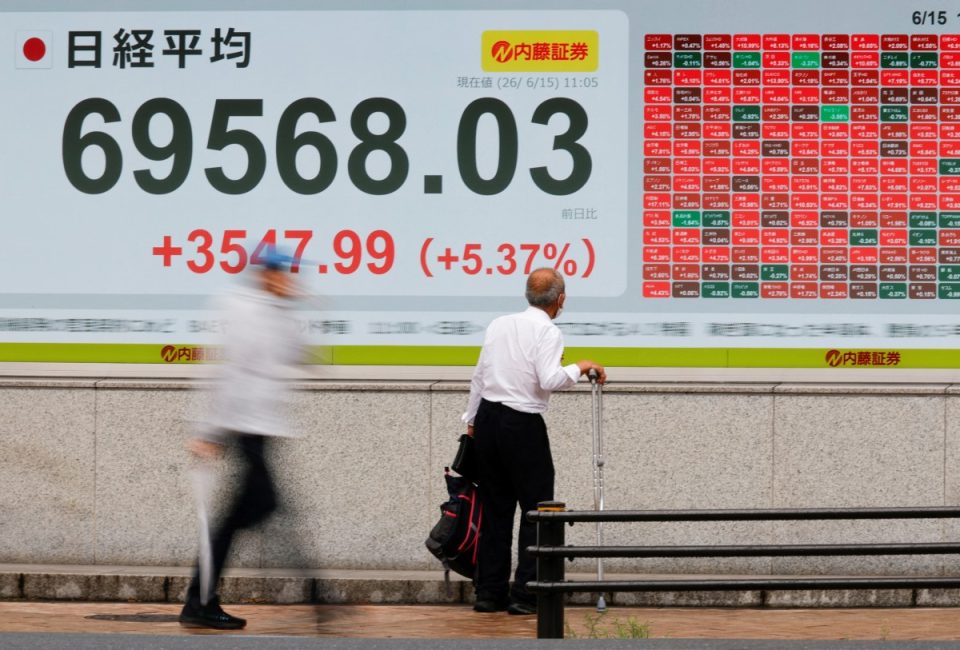
Japanese equities rallied to an all-time high, while government bond yields tumbled on Monday, after news that the United States and Iran had agreed on a framework for a deal to end their war, fuelling relief across markets.
The U.S. and Iran on Sunday agreed to halt the U.S. blockade of Iran and reopen the Strait of Hormuz, a preliminary pact that sent oil prices falling but leaves the fate of Iran’s nuclear programme to further negotiations.
The memorandum of understanding is scheduled to be officially signed on Friday in Switzerland.
The Nikkei 225 Index jumped as much as 5.5 percent to 69,657.09, surpassing the 69,000 level for the first time. The broader Topix climbed 3.8 percent to 4,028.06.
“This is simply the market reacting to the ceasefire deal – nothing more, nothing less. Even a rise of around 4 percent does not look unnatural,” said Shingo Ide, chief equity strategist at NLI Research Institute.
“The key issue going forward will be the substance of the agreement itself and whether it is actually implemented and upheld.”
Japanese government bond yields fell on easing inflation concerns. The benchmark 10-year JGB yield fell 5.5 basis points to 2.58 percent, while the 20-year JGB yield slid 7.5 basis points to 3.445 percent.
The two-year yield, the most sensitive to Bank of Japan policy rates, lost 2 bps to 1.39 percent. The five-year yield fell 4 bps to 1.86 percent. Yields move inversely to bond prices.
In currencies, the Japanese yen gave up earlier gains against the greenback, and was little changed at 160.19 per dollar.
Japanese markets have been whipsawed by developments in the Middle East. Japan, which depends on the region for about 95 percent of its oil imports, has seen the yen come under pressure and bond yields rise amid concerns that higher crude prices could lift import costs.
The Bank of Japan is holding a two-day policy meeting ending Tuesday. It is widely expected to raise its policy rate to a 31-year high of 1 percent and signal its readiness to keep pushing up borrowing costs.
In equities, despite geopolitical turmoil, strategists have been bullish on Japanese stocks on a wave of optimism over AI investment and the fruit of corporate governance reforms pushed by the Tokyo Stock Exchange. The Nikkei is up about 31 percent for the year.
NLI’s Ide said the blue-chip index could temporarily rise to 70,000, but that level looks rich relative to fundamentals and would need additional positive drivers, such as a full reopening of the Strait of Hormuz, to hold.
“The valuation for Japanese equities is still low but there is caution for the Nikkei’s current level,” said Hiroyuki Ueno, chief strategist at Sumitomo Mitsui Trust Asset Management.
“Today’s gain is probably partly led by demand for short covering. There are some investors who must buy Japanese stocks today. But market players who are long on Japanese stocks would not scoop up stocks at this high.”
On Monday, all but two of 33 industry sub-indices of the Tokyo Stock Exchange rose. There were 198 advancers on the Nikkei index against 27 decliners.
The largest percentage gainers in the Nikkei index were Murata Manufacturing up 17.2 percent, followed by Ibiden, gaining 16.8 percent. The biggest losers were CyberAgent, down 3.3 percent, followed by Kikkoman, which lost 3.2 percent.
Reuters