
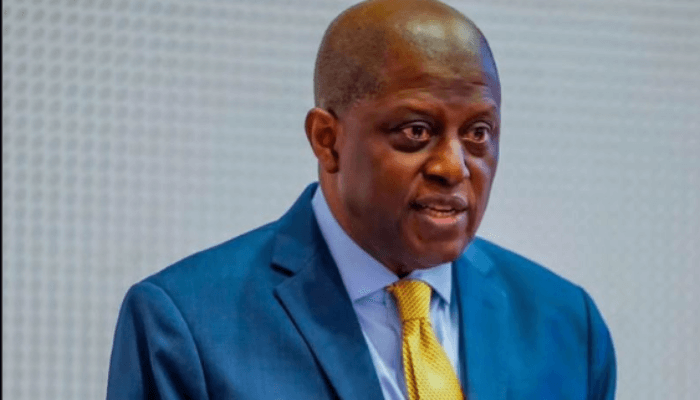
The Central Bank of Nigeria (CBN) reduced its exposure to financing the gederal government in 2025 while expanding its balance sheet to more than N138 trillion, reinforcing governor Olayemi Cardoso’s efforts to restore monetary discipline after years of heavy fiscal support.
The apex bank’s 2025 audited financial statements seen by BusinessDay showed claims on the federal government through debt securities declined to N26.40 trillion at the end of december from N26.74 trillion a year earlier.
The bank attributed the reduction to lower ways and means advances, although the accounts did not disclose a standalone year-end balance for the overdraft facility.
The balance sheet, however, continued to expand, with total assets rising 18.1 percent to N138.66 trillion from N117.43 trillion a year earlier, while liabilities increased to N138.07 trillion. At the group level, total assets stood at N138.86 trillion.
The figures suggest the CBN is gradually unwinding extraordinary financing provided to the government while rebuilding its financial position under reforms introduced by Cardoso, who has sought to restore investor confidence through tighter monetary policy, foreign exchange market reforms and greater transparency.
Read also: FRSC’s Amendment Bill: Good Intentions, Poor Optics
The accounts also showed a sharp improvement in Nigeria’s gross external reserves, which climbed to US$45.75 billion at the end of 2025 from US$40.19 billion a year earlier, providing 8.77 months of import cover for goods and services.
However, the stronger reserve position did not translate into an improvement in the country’s net external asset position. Net foreign assets declined 1.42 percent to N31.51 trillion from N31.96 trillion, reflecting a 4.22 percent increase in liabilities to non-residents.
The divergence highlights an important distinction between gross reserves and the central bank’s net foreign asset position, indicating that while foreign exchange buffers strengthened, rising external obligations partly offset the gains.
The CBN said the decline in government claims reflected a reduction in ways and means advances, a lending facility that became controversial under the previous administration after ballooning well above statutory limits and raising concerns over inflationary financing of fiscal deficits.
While claims on the federal government through debt securities fell by about N348.6 billion during the year, the bank cautioned that the N26.40 trillion figure should not be interpreted as the outstanding ways and means balance because the summary financial statements do not separately disclose that amount.
Profitability was mixed during the year. The CBN posted a bank-level surplus of N86.81 billion, down from N165.69 billion in 2024 despite total income of N9.76 trillion. Group profit, however, rose sharply to N136.44 billion from N38.84 billion in the previous year.
Under the Fiscal Responsibility Act (FRA), the bank said N69.45 billion, representing 80 percent of its operating surplus, was payable to the federal government.
Read also: Group calls for strong action to protect environment
Despite the larger balance sheet, the accounts showed paid-up capital and reserves stood at N599.24 billion, underscoring the importance of asset quality, liquidity and valuation in assessing the bank’s financial position.
Presenting the annual report, Cardoso said the bank remained focused on restoring macroeconomic stability through policies aimed at curbing inflation, stabilising the naira and strengthening the financial sector.
“In the review year, the Bank remained focused on curbing inflation, strengthening the financial sector, and stabilising the naira to firmly position the economy on a path toward sustainable growth,” Cardoso said.
He said policy reforms helped improve confidence in Nigeria’s foreign exchange market, contributing to greater exchange rate stability and stronger external inflows.
“Major milestones achieved in 2025 were the stability and increased predictability of the exchange rate, and the moderation in inflation,” he said, adding that reforms including the introduction of the Nigerian FX Code and the Electronic Foreign Exchange Matching System strengthened transparency and professionalism in the market.
Cardoso said the Nigerian economy expanded 3.87 percent in 2025 compared with 3.38 percent a year earlier, while headline inflation slowed to 15.15 percent in December, its lowest level since November 2020.
He also pointed to progress in banking sector reforms, including ongoing recapitalisation – at the time , enhanced corporate governance requirements and the introduction of the Non-Resident Bank Verification Number (NRBVN) platform aimed at attracting diaspora participation in the financial system.
The governor said Nigeria’s improving macroeconomic fundamentals had contributed to better international perceptions, citing rating upgrades by Fitch, Moody’s and S&P, as well as the country’s exit from the Financial Action Task Force grey list.
Looking ahead, Cardoso projected continued economic recovery, forecasting GDP growth of 4.49 percent in 2026, supported by foreign exchange reforms, banking sector recapitalisation, gradual monetary easing and tax reforms.
“In 2026, the Bank will continue to prioritise price stability, support output growth, pursue measures to attract foreign investment, sustain foreign exchange market stability, reinforce financial system soundness, and strengthen fiscal-monetary policy coordination,” he said.
Analysts say the latest accounts are likely to reinforce the CBN’s message that it is moving away from quasi-fiscal interventions towards a more orthodox central banking model.
“While the rise in gross reserves and the reduction in government financing signal progress in rebuilding policy credibility, the decline in net foreign assets illustrates that external liabilities remain an important constraint on the strength of Nigeria’s overall external position,” Chuks Ude, an Abuja based financial analyst told BusinessDay.
…

