
Gas fermentation specialist Calysta—which operates a demo-scale plant making single-cell protein for aquaculture and petfood markets from methane—has brought in a new CEO. The company is now urgently seeking new funds after its joint venture partner in China said it was ending financial support.
New CEO Berend Jan Kingma, who joined July 1, is former CEO of East African agrifood scale-ups InspiraFarms and FirstWave Group and former managing director of the FrieslandCampina China joint venture, with an early stint in his career at McKinsey.
He has experience in emerging markets, capital-intensive businesses and scaling operations, most recently serving as CEO at Miro Forestry in Ghana.
‘A severe shortage of working capital’
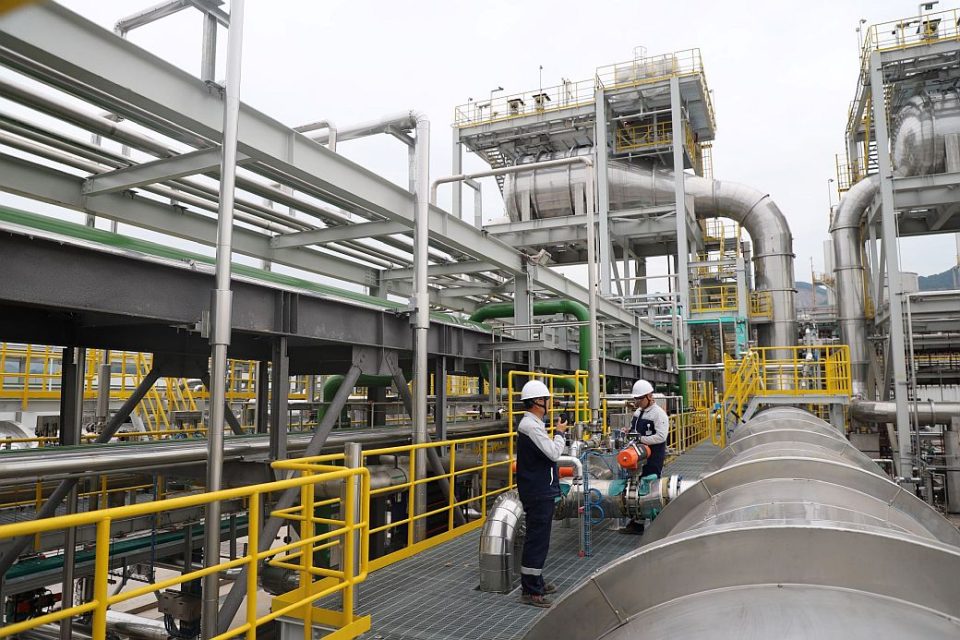
Calysta’s facility in Chongqing, China—created via a joint venture with animal nutrition company Adisseo to produce microbial protein under the FeedKind brand—recently halted production.
In a June 18 filing on the Shanghai Stock Exchange, Adisseo said it had chosen not to renew a loan to Calysseo following a failed bid by the JV to secure external financing but would continue working with Calysta to “to seek solutions.”
According to Adisseo: “Due to the inherent complexity and uncertainty of biotechnology R&D, compounded by the greater-than-anticipated difficulties in production scale-up phase, Calysseo Chongqing is currently facing a severe shortage of working capital.
“It urgently requires substantial and sustainable financial support to complete technical upgrades, thereby enabling the resumption and continuation of its production. Furthermore, its economic viability faces significant challenges within the feed substitute protein market. As the joint venture fails to meet the conditions to benefit further proportionate financial assistance, the company, acting on the principle of prudence, has decided not to continue providing additional financial assistance.”
Calysseo’s unaudited 2025 financial results report total assets of $78.7 million, liabilities of $63.9 million, revenue of $710k and a net loss of $15.5 million.
Cofounder: ‘The focus is on debottlenecking downstream processing’
Calysta cofounder Alan Shaw PhD, who was president and CEO until June, remains non-executive chair of the board. He did not say how long Calysta has to secure the necessary funds, and what options are being explored if they do not materialize.
He told AgFunderNews: “The focus in the factory is on debottlenecking downstream processing. This will enable higher throughput at designed capacity and correspondingly lower the cost of goods produced. We are finalizing restructuring of our organization and along with this, and [seeking] to raise the funds needed to implement the necessary investments.”
He added: “Calysseo started producing FeedKind through innovative gas fermentation technology in 2024, when full approval was received by Chinese government. Since then, Calysseo has proven full productivity in upstream processing, demonstrating that we can create high-quality protein through our technology. Now, we are shifting towards operational excellence by setting up the organization and the processing for commercial success.”
Since FeedKind became commercially available in 2024, Calysseo has shipped thousands of tons to the local aquafeed market, claimed Shaw. “We see a strong increase in local demand; high fishmeal pricing demonstrates the market need for sustainable, vegan, natural and nutritionally high-quality alternatives.”
The firm, which expects approval to sell into the Chinese petfood market in Q3, 2026, “needs more product available to be shipped to Europe, as petfood brands are commercially ramping up, after introductions of new petfood products containing FeedKind in the last year,” he added.
“The current decisions show the commitment moving from a technology provider to become an actual market player in protein supply for fish feed, animal feed and petfood.”
Protein from air
Founded in 2011 by Alan Shaw PhD, and Josh Silverman, PhD, Calysta is one of a small group of startups using gases instead of purified sugars to feed microbes that produce protein.
This can lower input costs, simplify sterilization, allow for longer campaigns because there is less risk of contamination, and potentially leverage waste or byproduct gases.
It’s not for the faint-hearted, however. Specialized bioreactors optimized for effective gas-liquid mixing and safety measures for handling gases can add to capital costs, and some of the sustainability claims don’t necessarily apply to first-generation plants. Scaling the technology is expensive, and finding affordable, sustainable sources of “green” hydrogen is also challenging.
Two players in the space—Novonutrients and Arkeon—have recently gone out of business (although the former’s assets were recently acquired by Biosphere). However, Danish gas fermentation firm Unibio recently unveiled plans to build what it claims will be the “world’s largest single-cell protein plant” in partnership with petrochemical giant Saudi Industrial Development Group (SIIG) in Saudi Arabia.
Finnish startup Solar Foods has also secured €77.8 million ($89.2 million) in grants and loans from Business Finland towards its first commercial-scale “protein from air” facility, although the funds are contingent upon securing additional financing.
According to Biosphere cofounder Brian Heligman, PhD, gas fermentation has three core value propositions. First, it can convert very low-cost feedstocks such as methane into high-volume products that would be uneconomic to make from refined sugars. This could enable producers in regions such as the Middle East or Permian Basin to turn captive methane supplies into higher-value products.
Second, it could support waste remediation by converting complex waste streams such as industrial pollutants into useful products.
Third, it lends itself to “distributed or forward-deployed production,” such as the applications covered by Biosphere’s $9 million military contract, enabling critical materials to be manufactured at the point of need using locally available feedstocks.
And while the cost and complexity of legacy systems is the major constraint to practical deployment, tech such as UV sterilization could simplify systems and lower costs, he claimed.
Further reading:
Biosphere picks up NovoNutrients assets in gas fermentation shakeout
The bioeconomy runs on sugar. Solarferm wants to run it on gas