

An old rule of thumb in investing says that when stocks go down, bond prices go up. This idea is called “negative correlation” — bonds and stocks tend to behave in opposite ways. But what if that is no longer true?
There’s a lot of concern among investors that bonds are no longer “safe” compared to stocks. IMF research from February shows that bond returns have become more positively correlated with stocks since 2020 — when stocks go down, bonds go down.
One reason for this change could be the rising levels of government debt in the U.S. and around the world. More issuance of government debt means more supply of bonds — and unless investor demand for bonds rises to meet that supply, that means interest rates will go up, and the price of bonds will go down.

Image source: Getty Images.
If bonds are moving more in lockstep with stocks, some investors might feel more comfortable allocating bond investments to the riskier portion of their portfolio. If so, the international Vanguard Emerging Markets Government Bond ETF (VWOB +0.48%) could be a better choice than the popular Vanguard Total Bond Market ETF (BND +0.27%).
Let’s look at these two bond ETFs and see which could be a better choice amid uncertainty in the bond market.
Vanguard Emerging Markets Government Bond ETF (VWOB): 923 bonds, 65 countries, 3 years of 9.65% annualized returns

Vanguard Emerging Markets Government Bond ETF
Today’s Change
(0.48%) $0.32
Current Price
$67.44
Key Data Points
Day’s Range
$67.39 – $67.50
52wk Range
$64.33 – $68.41
Volume
497.1K
The Vanguard Emerging Markets Government Bond ETF offers exposure to 923 international bonds issued by foreign governments of 65 countries. It charges an expense ratio of 0.15%. The fund’s top holdings include government debt from Saudi Arabia (13.2% of the fund), Mexico (10.9%), Turkey (6%), Indonesia (5.90%), and the United Arab Emirates (5.90%).
This fund has delivered annualized returns of 3.68% for the past 10 years, 9.65% for the past three years, and 11.32% last year. All of these returns have outperformed the Vanguard Total Bond Market ETF by a wide margin.
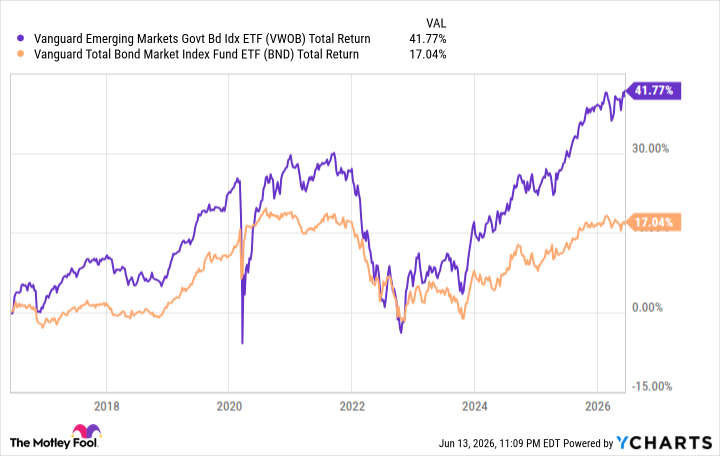
VWOB Total Return Level data by YCharts
Why have emerging market bonds delivered better returns? Because emerging-market governments are seen as riskier borrowers, they must pay higher interest rates on their government debt — and that means higher returns for their bondholders. If you buy emerging-market bonds, you are taking a risk that some countries’ governments might fall into political instability or economic crisis and default on their debts. Sometimes this happens; IMF research shows that since 1960, 147 countries have defaulted on their debts.
But for the past 10 years, that risk has been worth taking. The Vanguard Emerging Markets Government Bond ETF has strongly outperformed U.S. bonds (as represented by the Vanguard Total Bond Market ETF).
Vanguard Total Bond Market ETF (BND): 11,455 U.S. bonds, 10 years of 1.7% annualized returns
So if the Vanguard Total Bond Market ETF has underperformed the emerging markets fund, why should anyone buy it instead? Because it’s an easy, low-cost way to get broadly diversified exposure to U.S. bonds. The Vanguard Total Bond Market ETF holds 11,455 U.S. bonds, including government bonds and corporate bonds. Its expense ratio is only 0.03%.
This U.S. bond fund has delivered annualized returns (by net asset value) of 1.7% for the past 10 years, 3.95% for the past three years, and 5.04% for the past year. Its returns haven’t been impressive for the past 10 years, but the Vanguard Total Bond Market ETF is rated by Vanguard as less risky (2 out of 5 on the risk/reward scale) than the emerging markets fund (rated as 3 out of 5).

Vanguard Total Bond Market ETF
Today’s Change
(0.27%) $0.20
Current Price
$73.33
Key Data Points
Day’s Range
$73.32 – $73.50
52wk Range
$72.34 – $75.23
Volume
156.1K
If you believe that U.S. debt is generally safer than emerging markets debt, you want to own dollar-denominated bonds with no foreign currency risk, and you just want a simple, low-cost way to own lots of bonds and are willing to accept potentially lower returns, then the Vanguard Total Bond Market ETF could be a good choice. It ranks among the best bond ETFs.
But let’s look at what happened in 2022, the last time there was a big year-long downturn in the stock market. That year, the S&P 500 index lost 18%. Instead of going up, both Vanguard bond funds went down along with the U.S. stock market.
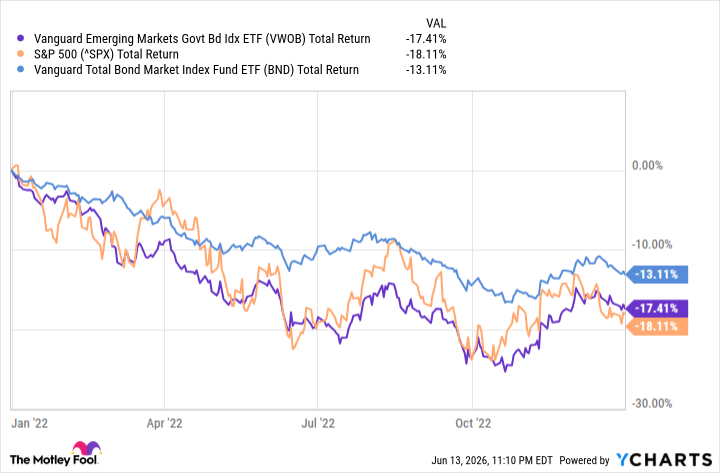
VWOB Total Return Level data by YCharts
The Vanguard Total Bond Market ETF outperformed the S&P 500 by about 5%, and the emerging markets bond fund didn’t perform much worse than U.S. bonds — it outperformed the S&P 500 by 70 basis points. Bonds might no longer be a safe haven. In that case, could it be time to accept more risk from bonds — and better potential returns?
Why buy VWOB instead of BND?
I own the Vanguard Total Bond Market ETF, and I don’t plan to sell it. But if you believe that bonds are getting riskier, and that bond prices are likely to go down (or up) along with stocks from now on, some traditional reasons to buy the Vanguard Total Bond Market ETF might not apply.
Emerging market debt can be riskier than U.S. Treasury bonds and most U.S. corporate bonds. But for long-term investors who are comfortable with that risk, the Vanguard Emerging Markets Government Bond ETF could be a better buy.