
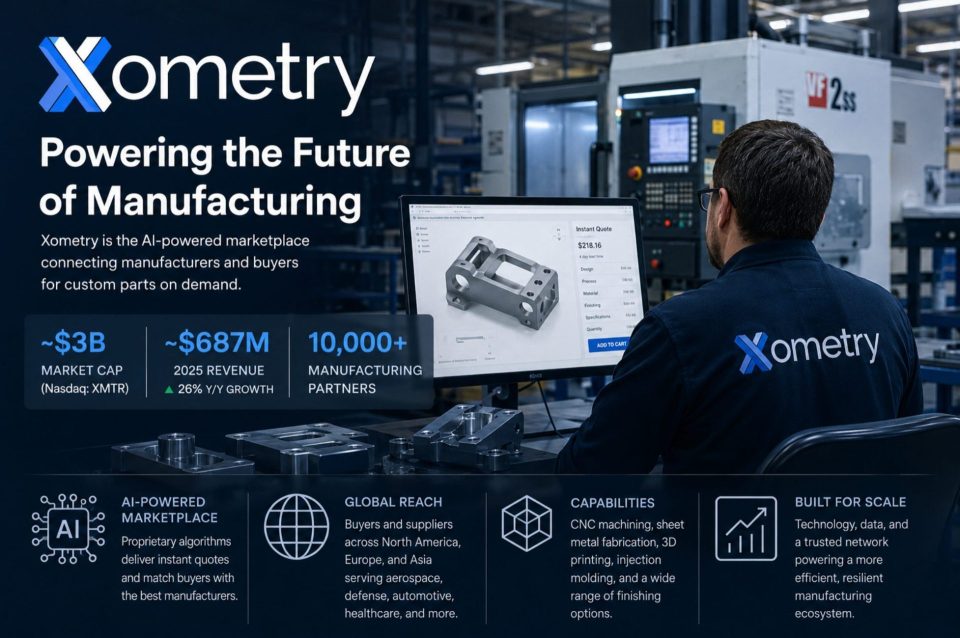

On a recent earnings call, Xometry executives spent less time talking about machine shops and more time discussing artificial intelligence, supply-chain volatility, and the mounting pressure manufacturers face to source parts faster and cheaper. The shift reflects how dramatically the North Bethesda-based company has evolved from its origins as an online marketplace for custom manufacturing into a publicly traded industrial technology platform now valued at roughly $3 billion, with annual revenue approaching $700 million.
For much of the past two years, manufacturers have wrestled with rising labor costs, geopolitical disruptions and uneven industrial demand. Those pressures have created both opportunity and scrutiny for Xometry, whose algorithm-driven marketplace connects buyers with thousands of independent manufacturers capable of producing everything from aerospace components to medical-device parts. As customers demand shorter lead times and more flexible sourcing options, the company has pushed aggressively to expand internationally, deepen its supplier network, and integrate AI tools designed to automate quoting, procurement, and supplier matching. Revenue climbed nearly 26% in 2025 to approximately $687 million, continuing a growth trajectory that has made Xometry one of the most closely watched manufacturing-technology companies in the public markets.
What makes Xometry particularly significant is that the company sits at the center of a broader transformation reshaping industrial procurement and manufacturing supply chains. The custom-manufacturing sector has historically relied on fragmented supplier relationships, manual pricing systems, and localized production networks. Xometry is among a small group of companies attempting to digitize that infrastructure at scale, positioning itself as both a manufacturing marketplace and an AI-driven procurement platform. Its network now spans tens of thousands of suppliers and buyers across industries, including aerospace, defense, automotive, and healthcare, placing the company in competition not only with traditional manufacturing intermediaries but increasingly with industrial software firms, distributors, and logistics platforms racing to modernize global sourcing operations.
The stakes have grown alongside the company’s ambitions. Public-market investors who once rewarded growth at almost any cost are now demanding profitability and operational discipline from technology companies tied to industrial markets. At the same time, traditional manufacturing distributors and procurement firms are accelerating their own digital investments while AI has become both a competitive advantage and an investor expectation. For Xometry, the challenge is no longer simply proving that manufacturers will buy parts online. It is whether the company can scale its marketplace model fast enough to become an essential digital layer of the industrial supply chain before larger incumbents, cyclical manufacturing slowdowns and shifting investor sentiment narrow the opportunity.
The Founders’ Marketplace Vision
Xometry was founded in 2013 by Randy Altschuler and Laurence Zuriff, two entrepreneurs whose backgrounds combined technology, finance and marketplace businesses rather than traditional manufacturing. Their partnership reflected a broader belief emerging across the technology sector at the time: that large, fragmented industries could be reorganized through software platforms that could connect buyers and suppliers more efficiently than conventional intermediaries.
Altschuler brought significant operational and entrepreneurial experience to the company. Earlier in his career, he founded OfficeTiger, an outsourcing and business-services firm that grew rapidly by helping corporations move administrative operations offshore before eventually being sold to RR Donnelley in a deal reportedly worth more than $250 million. After the sale, Altschuler spent time in venture capital and politics before returning to technology startups. His experience building operationally complex businesses and marketplace-style customer networks heavily shaped Xometry’s early strategy.
Zuriff came from the investment and finance world, with experience in private equity and venture capital. His background added financial discipline and strategic planning expertise at a time when Xometry was attempting to build credibility inside an industrial sector that historically moved far more slowly than consumer or enterprise software markets. Together, the founders saw an opportunity inside a manufacturing procurement system that remained surprisingly manual despite broader advances in cloud computing, automation, and e-commerce.
At the time, manufacturers seeking custom parts often spent days or weeks collecting quotes from suppliers, while small and mid-sized machine shops struggled with inconsistent order flow and limited access to enterprise customers. Xometry’s central idea was that software could reduce friction on both sides of the transaction by automating quoting, pricing and supplier matching. In the company’s early years, the founders spent significant time recruiting suppliers individually, persuading machine shops to trust a platform-driven procurement model that many initially viewed skeptically.

Venture Capital and the IPO Boom
The timing proved advantageous. Growing concerns around supply-chain resilience, reshoring discussions and advances in digital manufacturing technologies created demand for more flexible sourcing networks. Younger procurement professionals were also becoming increasingly comfortable using online platforms for industrial purchasing decisions, opening the door for marketplace models that might have faced stronger resistance a decade earlier.
Xometry’s rise has been fueled not only by demand for digital manufacturing services but also by nearly a decade of aggressive venture backing from investors betting that industrial procurement could eventually resemble other large online marketplaces. Since its founding, the company has raised roughly $200 million across multiple funding rounds from investors including T. Rowe Price, Dell Technologies Capital, BMW i Ventures, GE Ventures, Foundry Group and Highland Capital Partners.
Several of those investors brought more than capital. Backed by industrial giants such as BMW and GE, Xometry gained early credibility within manufacturing circles at a time when many suppliers still relied on traditional procurement methods. As the company expanded, larger institutional investors, including Durable Capital Partners and ArrowMark Partners, joined later funding rounds, helping finance international expansion, acquisitions, and the continued development of Xometry’s AI-driven quoting engine.
The company’s biggest financial turning point came in 2021, when Xometry went public on Nasdaq under the ticker XMTR. The IPO raised roughly $300 million and briefly pushed the company’s valuation above $3.7 billion during the pandemic-era technology boom, when investors aggressively backed software-driven marketplaces and supply-chain technology platforms.
Building a Digital Manufacturing Platform
That capital accelerated Xometry’s expansion beyond its original marketplace model. In 2021, the company acquired Thomas, the industrial sourcing platform founded more than a century earlier, in a deal valued at approximately $300 million. The acquisition gave Xometry access to a massive industrial buyer audience and supplier database while significantly expanding its role in industrial discovery and procurement search. The company later expanded internationally through the acquisition of Shift, a European manufacturing marketplace that became Xometry Europe.
Today, Xometry’s business extends well beyond simple parts sourcing. The platform supports CNC machining, injection molding, sheet metal fabrication, 3D printing, and other manufacturing processes while increasingly positioning itself as a procurement and supply-chain software provider. Its AI-powered quoting system can generate pricing estimates within seconds, dramatically compressing timelines that traditionally required multiple supplier interactions. The company also generates revenue through supplier services, financial products and advertising tied to the Thomas platform.
The strategy reflects broader shifts occurring across industrial markets. Manufacturers are under growing pressure to reduce procurement costs, diversify supplier networks and respond more quickly to supply-chain disruptions. At the same time, advances in AI and automation are transforming industries that historically relied on labor-intensive workflows. Xometry is attempting to position itself as the digital infrastructure layer connecting those trends.
Competition and Wall Street Pressure
Competition, however, is intensifying. Industrial distributors such as Fastenal and Grainger continue investing heavily in digital procurement capabilities, while software companies and manufacturing startups are pursuing AI-driven sourcing tools of their own. Traditional manufacturers have also become more aggressive about building direct digital relationships with customers rather than relying on third-party marketplaces.
Investors are also applying new pressure. While technology companies tied to AI have attracted renewed enthusiasm across Wall Street, public markets have become less forgiving toward unprofitable growth companies. Xometry has continued prioritizing expansion and market share growth, but analysts increasingly focus on margins, operational efficiency, and the company’s path toward sustained profitability.
Economic uncertainty adds another layer of complexity. Industrial production cycles remain sensitive to interest rates, capital spending slowdowns, and broader manufacturing demand. Aerospace and defense customers continue providing growth opportunities, but softness in certain consumer and industrial segments has created uneven order patterns across manufacturing markets.
A Defining Test for Industrial Tech
Even so, Xometry occupies a rare position inside the industrial economy. Unlike many software companies attempting to enter manufacturing from the outside, Xometry operates directly within procurement and production workflows, giving it access to valuable operational data across thousands of buyers and suppliers. That data advantage could become increasingly important as AI tools reshape sourcing, pricing and manufacturing decisions.
For the Washington-Baltimore region, Xometry’s growth also carries broader significance. The company has emerged as one of the region’s most prominent technology businesses outside the federal contracting sector, helping establish a larger industrial-tech presence in the Mid-Atlantic. Its trajectory reflects a wider shift occurring across the regional economy, where software, logistics and advanced manufacturing are increasingly intersecting.
The next phase of Xometry’s evolution may ultimately depend on whether it can balance the demands of a public company with the operational complexity of modern manufacturing. The opportunity remains enormous: global manufacturing procurement accounts for trillions of dollars in annual spending, much of which still operates through fragmented, offline systems. But turning that inefficiency into a scalable, profitable digital marketplace remains one of the more difficult challenges in industrial technology.
For now, Xometry is betting that manufacturers facing rising costs, geopolitical instability and accelerating supply-chain complexity will increasingly prefer software-driven procurement over traditional sourcing relationships. Whether that vision produces the next dominant industrial platform — or collides with the realities of cyclical manufacturing economics — will likely determine the company’s next decade.
