
Pulse Alternative
Alternative Investments

Wealth advisers race to serve small investors who own huge pools of capital


Longstanding lines separating institutional and retail investors are getting blurred as the private market dismantles old barriers.

As smaller investors amass more wealth, many are working with their financial advisers to increase their allocations to alternative investments.

That trend is revealing a new reality, with far-reaching consequences for wealth advisers and the alternative-asset industry: A growing number of retail investors in the high- and ultra-high-net-worth tiers now resemble institutional investors in some important ways.

When it comes to investing time horizons, risk appetite, market savvy and investable assets, it’s becoming more common to see institutional-grade qualities in small investors who command very large pools of capital.

Opportunities for access to those pools are driving wealth advisers and institutional consultants into each other’s arms as both professions navigate the wealth channel’s growing desire for alternatives. Their joint efforts to cash in on the trend are fueling demand for institutional-grade research capabilities to meet the needs of small but highly capitalized investors, who are upping their interest in more exclusive investments, such as private equity drawdown funds.

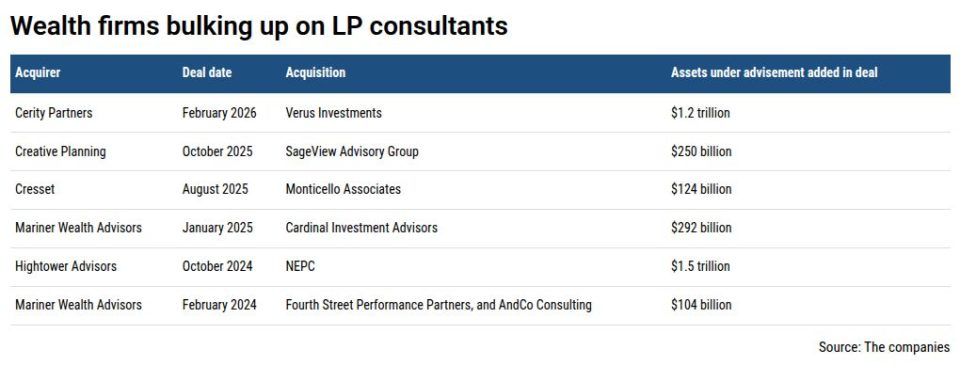
That was a big part of the logic last year when Cresset, a national registered investment adviser catering to high-net-worth individuals, acquired Monticello Associates, an investment consultant best known for advising endowments and foundations, as well as very high-net-worth families, typically with fortunes of $30 million to $100 million or sometimes higher. Both kinds of clients demand advanced, high-touch investment research and support backed by expertise in private deals.

“We had what everybody really wanted, which is the super-high-net-worth, extremely high average account-size, family-office business that the institutional consulting world had, and that has an extremely large and deep moat around it,” said Grady Durham, founder of Denver-based Monticello.

Most wealth managers lack expertise in alternative investing, and their clients’ private market allocations tend to be 5% or lower, versus more than 50% for many big endowments and foundations. National firms, including Hightower Advisors, Creative Planning, Mariner Wealth Advisors and Cerity Partners, are all addressing that knowledge gap through acquisitions of specialists with deep research and institutional pedigrees.

Through those clients, they also gain ready access to wealthy individuals with potential for lucrative, new fee-earning accounts. Indeed, many of Monticello’s wealthy clients are themselves on the investment committees of some of the endowments and foundations the firm has advised.

Others have turned to partnerships, recruitment or outsourcing of the CIO function to alts specialists.

The growing push to bulk up on high-caliber alts advice underscores the value that wealth managers see in the intertwined disciplines of research, technology and data, which are crucial to the ongoing convergence of the public and private markets.

Hundreds of mass-market RIAs rely heavily on online marketplaces like iCapital and CAIS, the industry leaders, for their investment research, deal sourcing and due diligence on fund managers. CAIS itself outsourced that function to Marsh-owned Mercer, one of the world’s largest institutional investment consultants, while iCapital mainly draws on in-house researchers.

Related read: Barbarians meet their new gatekeepers: ‘wealthtech’ middlemen

Strategic partnerships and mergers with high-end research firms help diversify revenue streams and add scale, bringing other benefits. Durham said that the addition of Monticello, whose clients had over $120 billion in assets at the time of the deal, boosts Cresset’s ability to negotiate lower management fees to fund managers.

The rush by wealth advisers to pair up with institutional research firms highlights the limitations of having a legacy public-market bias in investment management. Most wealth advisers were trained in a world where alternatives barely existed, and chief investment officers of larger firms overwhelmingly focus on the 60-40 allocation model across public equities and bonds.

“For wealth management to at least provide a solution for private markets, you really need seasoned professionals to do that,” said Robert Picard, head of alternatives for Hightower, and a veteran of building private markets platforms at Carlyle and First Republic’s private bank.

Hightower acquired NEPC, an institutional research firm, in 2024. Before the deal, Picard said, Hightower advisers sourced and vetted private-market opportunities but lacked systematic market intelligence at the asset-class level. Now they receive periodic updates on private credit, private real estate and private equity—complementing the public markets commentary already provided by chief investment strategist Stephanie Link.

Most mid-market RIAs lack fluency not just in asset classes but in the full stack of private markets knowledge: structures, multi-asset portfolio construction and the tax planning considerations of illiquid allocations.

“They get it with public stuff, but less on alts,” said Igor Tiguy, an independent director of alternative investments outsourced to small and medium-sized RIAs and family offices.

Tiguy estimates that only 1% to 3% of RIAs have an in-house director of alternatives, someone capable of selecting managers, sizing sleeves across asset classes, and navigating the range of fund structures. “It barely exists,” he says of the role, “partially because it’s early in terms of adoption for that side of the industry.”

The most direct route for larger platforms has been recruiting senior alternatives professionals from the institutional world—people whose careers were built at private equity firms, endowments, or in structured products, rather than in wealth management.

Tiguy said there are several thousand independent RIAs with assets in the $300 million to $3 billion range—the segment where the expertise gap is most pronounced. But the experienced private markets specialists those firms need simply aren’t choosing to work there.

“They’re just not choosing to be at a billion-dollar RIA who’s working with 200 average $5 million-sized families,” Tiguy says. Instead, that talent favors working for institutional consultants, single-family offices, large multi-family offices and funds-of-funds.

Picard said Hightower has assembled a team to push the firm toward “more and more family office-like services.” The firm’s new Hightower Signature Wealth unit aims to provide investment advice that mirrors what institutional investors receive from GPs, he said.

Wealthy individual investors already are increasingly behaving like institutions in how they evaluate and choose their advisers— scrutinizing investment platforms, demanding access to pre-IPO and other early-stage opportunities, and expecting analytical rigor previously reserved for pension funds and endowments.

Some institutional specialty firms are going further, becoming asset managers themselves. Mercer said earlier this year that it would acquire AltamarCAM, an alternatives manager. Mercer made a similar move in 2025 with its acquisition of SECOR Asset Management, a boutique firm serving pensions, endowments and family offices.

Cliffwater has made the full transition. Once a top advisory firm, it has transformed into a market-leading manager of private market interval funds, with its Cliffwater Corporate Lending Fund among the largest in the category.

PitchBook News

This article originally appeared on PitchBook News


Source link

Related posts

Skybound launches with $38M to back early deeptech founders

George

Metals From Copper to Gold Slump as Inflation Fears Roil Markets

George

Gov’t reviews commodity supply amid geopolitical pressures

George

Leave a Comment