

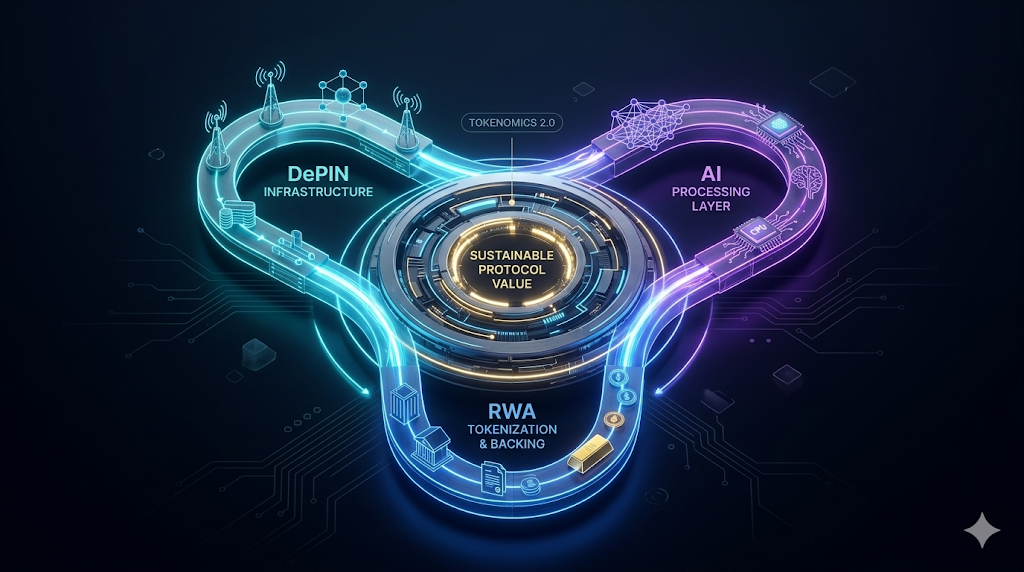
In digital asset investing, a flywheel represents a self-reinforcing economic loop where momentum generated by one aspect of an ecosystem feeds directly into another, accelerating growth exponentially. This mechanism provides a definitive answer to how modern digital assets create sustainable, long-term value. Investors actively prioritize protocols that intelligently redirect user transaction fees into contributor rewards, ensuring structural expansion driven by real utility rather than speculative hype.
The Core Mechanics of an Investment Flywheel
How Value Capture Feeds Growth
The economic architecture of this self-reinforcing loop unlocks the potential for exponential scaling once critical mass is achieved. While initial bootstrapping requires upfront capital expenditure via structured token emissions, an expanding user base allows organic revenue streams to progressively replace artificial dilution. Data from digital asset research platforms in mid-2026 highlights that networks prioritizing real, sustainable cash flows over speculative inflationary rewards consistently demonstrate superior pricing resilience during systemic market consolidations.
The Role of Token Burns and Deflation
Token burns and deflationary design principles act as powerful value-accrual catalysts within digital asset ecosystems. By programmatically reducing the circulating supply relative to network transaction velocity, the protocol embeds a structural scarcity mechanism into the asset. When accelerating utility-driven demand interacts with a shrinking supply curve, it provides strong fundamental support for the asset’s long-term valuation. This deflationary framework serves to shield early-stage supporters from aggressive supply dilution historically prevalent in legacy token models.
Deflation further optimizes the network’s feedback loop by enhancing the economic purchasing power of incentives distributed to core contributors. As the native token captures structural value, the real economic value of rewards allocated to network validators, node operators, and developers appreciates proportionally. Industry insights from the first half of 2026 confirm that decentralized physical infrastructure networks (DePIN) and protocols leveraging balance-driven “burn-and-mint” or buyback models consistently demonstrate superior structural sustainability compared to their purely inflationary, reward-first counterparts.
Why Flywheels Drive Crypto Tokenomics in 2026
DePIN and the Burn-and-Mint Equilibrium
Decentralized Physical Infrastructure Networks rely entirely on the burn-and-mint equilibrium to monetize physical hardware deployment globally. Users who require access to decentralized storage or wireless data must burn native cryptocurrency to generate fiat-denominated usage credits. Simultaneously, the protocol automatically mints new tokens to generously reward the independent operators supplying the physical hardware. This brilliant dual-mechanism ensures that token demand perfectly scales alongside actual real-world network utilization and commercial enterprise adoption.
This specific framework successfully solves the historical challenge of mobilizing and managing distributed physical capital efficiently. As network coverage improves, the service becomes vastly more attractive to paying enterprise customers. The resulting surge in paid usage directly strengthens the reward budget, attracting even more global infrastructure providers to the ecosystem.
Autonomous AI Agents and Liquid Markets
Autonomous artificial intelligence agents are currently reshaping on-chain markets by functioning as independent, profit-generating economic entities. These zero-human companies operate seamlessly via smart contracts, earning revenue, managing complex treasuries, and deploying capital without any manual intervention. By constantly trading and reinvesting their profits directly on decentralized exchanges, these software agents massively deepen the underlying cryptocurrency liquidity pools. This continuous, automated transaction volume serves as a flawless, tireless engine for the entire ecosystem.
The convergence of artificial intelligence and blockchain infrastructure establishes a completely new paradigm for digital capital formation. As these autonomous businesses mature, they relentlessly funnel their generated profits back into tokenized yields and decentralized lending platforms. This creates a self-sustaining financial loop where machine-driven economic activity endlessly accelerates market expansion.
Institutional Real-World Asset Yields
Real-world asset tokenization provides the low-risk foundational anchor required to stabilize highly volatile cryptocurrency ecosystems. Traditional institutional capital demands predictable, legally enforceable yields generated by government bonds, private credit, and commercial real estate. By bringing these massive traditional assets on-chain, decentralized finance protocols successfully offer sustainable returns that do not rely on speculative token inflation. This integration seamlessly bridges the stability of legacy banking with the frictionless efficiency of modern blockchain architecture.
Tokenized assets act as a massive liquidity magnet, aggressively pulling institutional wealth directly into the Web3 economy. Once this institutional capital enters the decentralized ecosystem, it is frequently utilized as premium collateral across various decentralized lending markets. This massive influx of pristine collateral significantly lowers borrowing costs, accelerating the financial velocity of the entire network.
Analyzing Successful Crypto Economic Models
Liquidity and Trading Volume Loops
Decentralized exchanges (DEXs) utilize algorithmic liquidity architecture to facilitate seamless digital asset trading without reliance on centralized market makers. The protocol distributes competitive yield rewards to users who deposit assets into automated smart contract liquidity pools. This centralized aggregation of market depth directly minimizes execution slippage for high-volume institutional traders. Consequently, the platform captures substantial organic trading volume, generating consistent transaction fee revenue that is programmatically routed back to liquidity providers.
The continuous distribution of fee revenue to core participants fosters strong ecosystem alignment and capital retention. Because unmitigated “mercenary capital” quickly migrates to competing protocols offering superior short-term yields, premier platforms mitigate capital flight by encouraging users to lock their assets via specialized governance-escrowed (veToken) models. This structural mechanism multiplies baseline reward rates for long-term supporters, creating economic friction for early withdrawal and effectively stabilizing long-term liquidity to keep the trading engine running at optimal efficiency.
Staking and Network Security Incentives
Proof-of-Stake (PoS) networks implement robust cryptoeconomic loops to guarantee institutional-grade Byzantine fault tolerance against malicious network actors. Validators must programmatically pledge substantial quantities of the native cryptocurrency within specific consensus smart contracts to earn block production rights. In exchange for underwriting the ledger’s security, these node operators receive a predictable stream of native token emissions alongside priority transaction fees and MEV tips. This capital-at-risk structure renders a hostile network takeover mathematically cost-prohibitive and economically ruinous for potential attackers.
Liquid restaking protocols (LRTs) have significantly supercharged this foundational security framework by maximizing baseline capital efficiency. Upon staking capital, participants instantly receive a liquid derivative receipt token that remains fully deployable across secondary decentralized finance protocols. This structural innovation allows allocators to capture base network consensus rewards while simultaneously optimizing capital utilization via external trading and lending yields. This compounding financial architecture heavily incentivizes long-term asset retention, continuously fortifying the economic security layer of the underlying blockchain.
Developer Activity and Ecosystem Expansion
Developer activity functions as a primary leading indicator for the long-term economic and structural success of any Layer-1 blockchain infrastructure. Resilient ecosystems actively compete for elite software engineering talent through programmatic developer grants, global hackathons, and structured venture capital funnels. This localized explosion of economic activity directly accelerates native token valuation, expanding the network treasury to sustainably fund future developer cohorts.
Advanced development tooling and optimized execution environments significantly minimize the technical friction required to deploy complex digital assets. As clusters of specialized applications anchor themselves to the network, compounding network effects multiply exponentially, creating formidable strategic moats and high switching costs against competing chains. Furthermore, the native token underpins the settlement layer of the network—serving as the fundamental gas currency for state transitions, whether directly held by consumers or programmatically abstracted via paymasters behind the scenes. This synergistic alignment between elite software developers, robust dApp architecture, and consumer transactional volume establishes the core economic engine of a thriving digital economy.
Risks and Potential Failures in Economic Loops
The Threat of Artificial Yields
Artificial yields completely destroy protocol sustainability by inflating the token supply simply to bribe users into participating. During intense market euphoria, poorly designed projects offer astronomically high percentage yields paid entirely in their native, highly inflationary token. While this strategy successfully attracts massive short-term mercenary capital, it completely fails to capture any real external revenue. Once the token emission rate inevitably mathematically overwhelms actual market demand, the entire fragile economic structure collapses instantly.
Relying entirely on artificial token inflation inevitably leads to a massive, irreversible devaluation of the underlying digital asset. Investors aggressively dump their unearned reward tokens on decentralized exchanges, completely crushing the spot price and terrifying long-term holders. Once the asset price plummets, the promised percentage yield also drops, causing the remaining mercenary capital to violently exit the protocol. This predictable sequence of events perfectly illustrates why modern tokenomics prioritize organic fee generation over pure hyperinflation.
Negative Spirals in Bear Markets
Negative spirals occur violently during macroeconomic bear markets when the underlying token price loses its psychological support level. Because the entire economic loop relies heavily on the native asset valuation to incentivize participants, a falling price severely damages network operations. Liquidity providers quickly withdraw their capital to prevent impermanent loss, which immediately increases trading slippage and drives away active users. This massive reduction in active users instantly destroys protocol fee revenue, further depressing the token price.
Escaping a negative death spiral requires immense foundational utility that extends far beyond pure financial speculation. Networks that provide undeniable real-world value—such as verifiable decentralized data storage or un-censorable satellite communications—naturally establish robust price floors. Users continue to purchase the native token because they legitimately require the underlying software service, regardless of the broader cryptocurrency market sentiment. Projects lacking this essential utility are routinely permanently erased from the market during severe liquidity contractions.
Evolution of Tokenomics Architectures
| Feature | Tokenomics 1.0 (Historical) | Tokenomics 2.0 (2026 Standards) |
| Value Generation | Pure speculative inflation | Real cash flows and protocol revenue |
| User Incentives | Unsustainable hyper-inflationary yields | Burn-and-mint equilibria and fee sharing |
| Capital Retention | Low (Mercenary capital flight) | High (Liquid staking and locked governance) |
| Regulatory Approach | Complete anonymity and evasion | Modular compliance and on-chain verification |
The Stages of a Successful Crypto Flywheel
| Stage | Action | Direct Network Result |
| Inception | Founder deploys protocol and token | Initial market capitalization is established |
| Bootstrapping | Massive rewards attract early providers | Core liquidity and basic infrastructure form |
| Utilization | Users pay fees for the actual service | Protocol captures verifiable organic revenue |
| Acceleration | Revenue funds buybacks and token burns | Asset scarcity increases alongside token price |
| Maturity | Self-sustaining, automated expansion | Reliance on artificial token inflation ends |
Conclusion
The paradigm of the economic flywheel is fundamentally redefining how market participants evaluate and optimize modern digital assets in 2026. Within contemporary digital asset investing, structured, self-reinforcing economic loops demonstrate a capacity for exponential value accrual that consistently supersedes legacy linear business models. By programmatically capturing verifiable protocol revenue and routing it into programmatic token burns, strategic buybacks, and targeted contributor rewards, decentralized networks achieve a level of systemic sustainability previously unseen in the asset class. This macroeconomic transition from dilutive, inflationary tokenomics to robust, revenue-driven architectures marks a pivotal maturation phase for the broader digital economy.
Analyzing these specialized economic engines equips sophisticated allocators with the empirical frameworks necessary to differentiate between structurally sound decentralized infrastructure and purely speculative, non-productive crypto assets. As evidenced by decentralized physical infrastructure networks (DePIN) and autonomous artificial intelligence agents, algorithmic incentive layers can seamlessly coordinate global physical and digital capital deployments without centralized friction. While structural risks regarding artificial yield architectures and volatile regulatory frameworks remain persistent macroeconomic factors, properly engineered tokenomics serve to significantly mitigate these systemic vulnerabilities.
FAQs
What is the defining characteristic of an investment flywheel?
The defining characteristic of an investment flywheel is its ability to create a continuous, self-reinforcing economic loop that accelerates growth autonomously. When a project successfully implements this framework, the momentum generated by user acquisition directly feeds into product improvement, which subsequently attracts even more capital. This specific algorithmic structure completely eliminates the constant need for expensive, external marketing campaigns because the core product mathematically incentivizes its own expansion.
Why did early crypto tokenomics models frequently fail?
Early crypto tokenomics models frequently failed because they relied entirely on unsustainable hyperinflation to bribe users into utilizing their highly flawed platforms. These projects aggressively minted billions of new tokens to pay exorbitant percentage yields, which ultimately completely destroyed the actual valuation of the digital asset. When the token price inevitably collapsed, the mercenary capital instantly exited the platform, resulting in a devastating and irreversible death spiral.
How does a burn-and-mint equilibrium create asset value?
A burn-and-mint equilibrium (BME) creates structural value by programmatically linking token scarcity directly to verifiable, real-world network usage and enterprise transactional demand. Whenever a customer utilizes decentralized service, a specific portion of the native cryptocurrency is permanently destroyed, reducing the aggregate circulating supply. This deflationary architecture ensures that as network utilization scales, the asset embeds a progressive scarcity mechanism that provides strong fundamental support for long-term valuation.
What role do artificial intelligence agents play in tokenomics?
Artificial intelligence agents play a massive role in modern tokenomics by functioning as autonomous, highly efficient corporate entities operating entirely on-chain. These software programs generate revenue, execute complex algorithmic trading strategies, and instantly reinvest their profits into decentralized liquidity pools without human intervention. This relentless, automated financial activity continuously deepens market liquidity and provides an unbreakable engine for decentralized exchange volume and transaction fee generation.
Are tokenized real-world assets part of the crypto flywheel?
Tokenized real-world assets are a crucial component of the modern crypto flywheel because they inject immense, stable institutional capital directly into decentralized networks. By bringing traditional financial instruments like government treasuries and corporate credit on-chain, protocols easily generate predictable, non-speculative yields for their investors. This pristine foundational collateral massively lowers decentralized borrowing costs, further accelerating the efficient deployment of capital across the entire digital economy.
Disclaimer:This content is for informational purposes only and does not constitute investment advice. Cryptocurrency investments carry risk. Please do your own research (DYOR).