
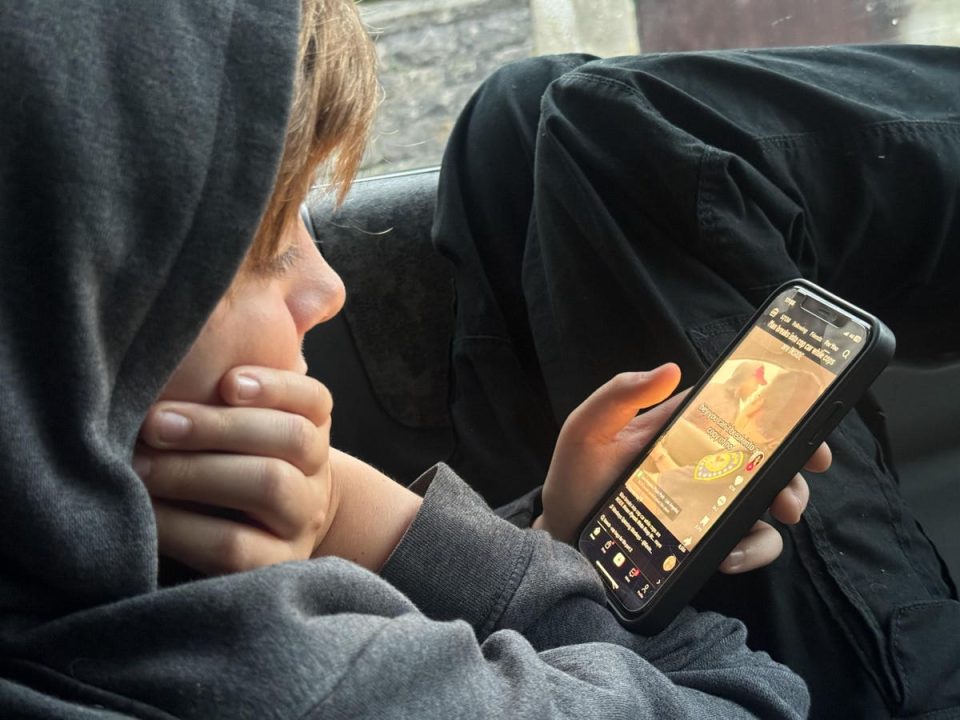

PORTSMOUTH, UNITED KINGDOM – OCTOBER 20: A 12-year-old boy looks at a iPhone screen on October 20, 2024 in Portsmouth, England. Photo by Matt Cardy/
Getty Images
The UK government has announced a ban on social media for under-16s, with Prime Minister Keir Starmer framing it as a way to give children their childhood back. While some child protection groups welcomed the move, the method of enforcement raises serious concerns.
Joe Ryrie, co-founder of Smartphone Free Childhood, called it a “hugely significant moment,” while Chris Sherwood, CEO of the NSPCC, described it as “a win for children and parents.” The government’s plan to use highly effective age verification has drawn criticism from civil liberties groups who warn it risks expanding surveillance and digital identity systems beyond children.
The central issue is whether a blanket ban enforced through age verification will address the real harms children face online, or create a new layer of digital control around internet access.
Even among child protection groups there is concern that a ban merely covers up the symptoms without curing the disease. Leanda Barrington-Leach, Executive Director of 5Rights Foundation, told Forbes that while they do not oppose a ban, it must only be treated as an initial step toward confronting corporate business models.
“A ban or curfew may change who comes through the front door, but it does not change what is waiting for children inside,” Barrington-Leach warned. “The Government should make clear that this is an emergency measure, not a long term solution and that all companies exploiting children are in their sights.”
She emphasized that the true measure of success is whether the policy forces tech firms to build fundamentally safe products and whether existing rules under the Online Safety Act are actually enforced to protect children, rather than simply pushing them out of the digital world.
The policy risks targeting the wrong problem. Instead of forcing platforms to fix their addictive design, the government is focusing on restricting access while building new surveillance tools.
Broadcaster Bev Turner was more direct in her criticism. She argued that the real problem lies in “the addictive nature of an algorithm.” The government has instead chosen to focus on restricting access rather than confronting the platforms’ design. Turner said the policy reduces a complex structural issue to one of basic access, when what’s needed is for leaders to call out the tech companies and investigate predatory practices such as targeted advertising aimed at vulnerable children.
Rather than solving the problem, the policy risks pushing children into less visible online spaces while expanding identity checks and surveillance for everyone else.
BATH, UNITED KINGDOM – FEBRUARY 25: In this photo illustration a a 12-year-old school boy looks at a iPhone screen A 12-year-old boy looks at an iPhone screen showing various social media apps including TikTok, Facebook and X on February 25, 2024 in Bath, England. Photo by Matt Cardy
Getty Images
Underground Migration
Derek Ross, a developer at Soapbox who works on decentralised social protocols, argued that the ban would fail to protect children in any meaningful way. Instead of reducing children’s exposure to harmful content, the policy creates a surveillance layer across the entire population, using child safety as justification for unprecedented levels of control.
Similar challenges have already emerged elsewhere. Australia’s under 16 ban demonstrated enforcement hurdles, with children quickly learning how to evade controls rather than becoming meaningfully safer. Even proponents of the legislation acknowledge these limitations. Chris Sherwood of the NSPCC cautioned that “Australia has shown that bans alone don’t keep all children safe, some young people will always slip through the net”.
This is backed up by recent behavioral data. Research conducted by Internet Matters reveals that a third of children have already successfully circumvented existing age checks on the very platforms targeted by the new ban. A top down ban risks formalising a system that tech literate minors routinely bypass.
Ross explained that determined teens have always found workarounds while the people who actually comply are the ones who were not the problem to begin with.
Critics warn that cutting off access to mainstream, moderated platforms is pushing children onto Virtual Private Networks or VPNs, fake accounts, encrypted group chats and offshore, unregulated applications. In these less visible environments, corporate content moderation does not exist, leaving families with far less visibility and control than they had before.
Jeffrey Demarco, Senior Adviser at Save the Children UK, also warned against creating a moral panic around children’s online lives, arguing that context matters when assessing digital harm. He said bans may have unintended consequences if children continue using platforms secretly and then feel unable to seek help when something goes wrong.
The government itself has acknowledged the limitations of any ban. In its June progress statement to Ofcom, Science Secretary Liz Kendall wrote: “No ban can ever be entirely watertight. Some children will inevitably seek to circumvent age restrictions.”
The mechanism intended to enforce this ban is what the government calls Highly Effective Age Assurance. Science, Innovation, and Technology Secretary Liz Kendall has tasked the regulator Ofcom, led by Dame Melanie Dawes, to assess appropriate age verification methods. She said the government is learning from Australia’s experience, arguing that “Tech companies have had countless opportunities to keep children safe, yet they have failed to act. That is why we are taking power away from the tech giants and putting it back in parents’ hands.”
Dame Melanie Dawes, Ofcom’s Chief Executive, has said the regulator will assess options for “highly effective age assurance” that must be “technically accurate, robust, reliable and fair.”
This approach effectively requires people to prove their identity to participate in large parts of online life. It represents a big shift toward greater state and corporate control over digital access.
Bev Turner warned that a total ban inevitably triggers “facial scanning for all of us,” pointing out the flaw in the state’s plan, “You cannot decide whether it’s a 13 year old watching TikTok unless you have to also prove that it’s a 30 year old watching TikTok.” She cautioned that rather than a meaningful victory for families, “this decision today is the creaking of a digital cage door dressed up as a welcoming velvet rope,” potentially altering the relationship between the individual, the internet and the government.
Concerns Over Centralized Identity Systems
Civil liberties groups have raised concerns that forcing citizens to upload ID documents to private platforms creates serious cybersecurity vulnerabilities. Emerging verification tools have already raised concerns about how age assurance could expand beyond children’s access controls.
These centralized repositories of identity data would become attractive targets for hackers and state actors. A single breach could expose the personal data of millions of people, turning a policy sold as child protection into a serious privacy and security liability.
Derek Ross added that building an ID checkpoint at the door of the old, broken platforms does not make children safer.
This approach has drawn criticism from civil liberties groups, who argue it conflicts with public concerns over digital ID. A parliamentary petition demanding the halt of digital ID implementation amassed nearly three million signatures, triggering a four hour debate in Westminster where MPs across the political spectrum condemned the plans as authoritarian.
The risks of linking identity verification to access have been well documented. Civil liberties groups warned that digital ID systems risk excluding the most vulnerable while creating new forms of state and corporate surveillance.
Despite cross party concerns and strong public opposition, others have pointed to ongoing efforts by various institutions, including the Tony Blair Institute, to advance digital identity systems through other policy channels.
Decentralized Alternatives And Parental Sovereignty
Supporters of open source protocols argue that instead of handing power to state regulators or Silicon Valley, protocols like Nostr strip away corporate data tracking and predatory algorithms entirely. On a decentralized architecture, families can subscribe to customized, moderated relays or use cryptographic keys to co-manage accounts without relying on third party digital identity. Nostr projects like Kubo and active applications like Ditto prove that transparent, non-predatory social spaces are already viable.
On centralized platforms, parents have limited control against shifting corporate algorithms and government mandates. On decentralized protocols, families possess the tools to become the platform operators for their own households.
The Government has indicated it will move forward with secondary legislation before Christmas, with the ban expected to take effect in early 2027. This timeline sets up an immediate operational conflict between top down regulatory enforcement and bottom up technological workaround patterns.
As policymakers move to establish age assurance, the test will be whether the ban actually protects children. If it instead builds a permanent identity layer around the internet, it risks leaving the underlying harms intact and potentially making them worse.