
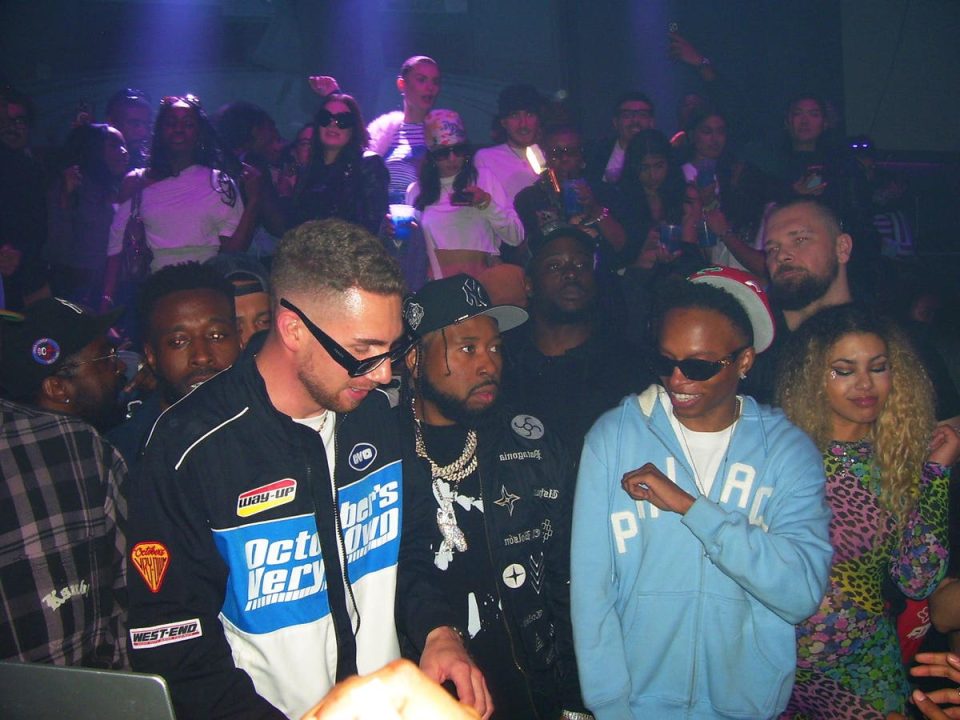

From the Drake album listening party at SOBs NYC
Tyshawn J.
Last week, I attended a Drake album listening party hosted by Certified Jared at SOBs in NYC. It was for Drake’s three new albums Iceman, Habibti, and Maid of Honour. Almost 600 tickets were sold and the venue was completely packed until 4 A.M. What was interesting about it though was that neither Drake, nor anyone from his October’s Very Own (OVO) team attended the event. It was an unofficial party hosted by a long-time fan who represents a new wave of cultural curators building businesses around fandom.
There was another layer to the night that made it feel strangely full circle. According to Larry Gold, owner of SOB’s, Drake’s first New York City show also took place at the exact same venue during his breakout So Far Gone era. Well over a decade later, SOB’s was once again packed for Drake related culture, only this time the event was being driven not by the artist himself, but by an internet-native fan community that had evolved into a business of its own.
The Rise Of Fan-Led Culture
Certified Jared is a creator building a real business around fandom and community. A self admitted Drake superfan, he has spent years building an audience around that identity and has now turned it into multiple successful Drake-themed parties across cities including Washington D.C., Miami, Tempe, Dallas, Austin, and New York City, collectively drawing thousands of attendees. The expansion is continuing as well, with additional events already planned for Philadelphia, Paris, and another return to Washington D.C. later this year.
For Jared himself, the evolution from internet fandom into a real world business happened gradually.
“People misunderstand how powerful fan communities have become in the real world. We’re entering an era where the value of fan communities is more valuable than the label’s traditional marketing spend. Selling out SOB’s, a legendary New York venue, speaks to how true this statement is in a time where traditional signed artists are currently struggling,” he told me.
Jared argued that audiences increasingly want participation and identity rather than simply consuming content passively.
“Fans want more than corporate content; they want fan-led events and to participate in experiences where they feel they belong. What’s misunderstood is that labels and media no longer fully control fan culture, the fans themselves do.
Certified Jared
Danny Mensah
In 2026, audiences are smarter, more engaged, and more critical than ever. They question false narratives and botted engagement. Fans want to rally behind what feels real in a world full of fake.”
What makes that trajectory notable is that it reflects a broader shift increasingly happening across entertainment and internet culture. Communities that once primarily existed through posts, memes, and fan pages online are now evolving into scalable ecosystems capable of driving live events, commerce, media, and increasingly their own forms of distribution.
Konrad Sit, who manages Jared, framed the night in business terms rather than cultural ones. “The most important part of this event wasn’t ticket sales. It was proof of concept. We’re entering an era where creator communities can outperform traditional marketing because the audience feels personally connected to the experience. That changes how you think about talent management, venue strategy, media, and even ownership models in entertainment.”
The shift is not just being noticed by internet creators either. Rory Farrell of the Rory and Mal podcast told me, “I think it’s just the natural progression of how fans have always connected … from street teams, to blogs, to forums, to Reddit, to Twitter communities.”
What has changed, according to Farrell, is that “those communities don’t turn off anymore.” Before, fan communities primarily came to life at concerts, pop-ups, or in-store appearances. “Now the online experience is so constant that it demands a real world version to mirror it,” he said.
Farrell added that “music went direct to consumer, fandom went direct to each other … the fan to fan connection has become just as important as the artist to fan one.” His point speaks to something larger happening across entertainment right now: fandom is no longer simply passive consumption. Increasingly, communities themselves are becoming businesses, with audiences looking for participation, identity, and shared experiences that exist outside of traditional artist or label structures.
The Hidden Economics Of Live Entertainment
At this point, you might reasonably be asking what any of this has to do with digital assets. And you’d be right to ask, because I haven’t yet mentioned that the infrastructure powering these events is KYD Labs, a blockchain-based platform on the Solana network built by former Ticketmaster veterans that is attempting to rethink how liquidity and ownership function underneath the ticketing economy.
That distinction matters because live entertainment has quietly become one of the most financially concentrated industries in modern culture. While most consumers experience ticketing as little more than a checkout screen and a service fee, the infrastructure underneath the live events business is heavily controlled by a small number of companies, most notably Ticketmaster and parent company Live Nation.
Live Nation’s dominance over the industry has become so extensive that critics and regulators have increasingly raised antitrust concerns around the company’s control of venues, promotion, and ticketing itself. Ticketmaster is estimated to control roughly 70% to 80% of major concert ticketing in the United States, giving the company extraordinary influence over how live entertainment is distributed and monetized.
Most people assume Ticketmaster dominates live entertainment because it built the best ticketing software. In reality, its power comes from something far less visible: liquidity. Before a single ticket is ever sold, venues often need to front millions of dollars in guarantees to artists just to keep their calendars full. Ticketmaster solved that problem by advancing capital to venues in exchange for exclusive ticketing rights, control over distribution, and ownership over valuable audience data. In other words, modern ticketing is not just a technology business. It is a financial one.
According to Ahmed Nimale, a co-founder of KYD Labs, that underlying financial structure is precisely the problem he believes the traditional ticketing industry has failed to solve. “It’s all reach and resale. Without fan data and attribution, artists and venues can’t properly market in today’s technology age. They need to have it to properly retarget and reach customers on social media, we prevent the blue dot problem (shows that are not sold out on Ticketmaster). On the resale front, artists and venues can set rules at the moment the show is created to enforce price caps, royalty paybacks and more when their tickets are resold whether it’s on Stubhub or Vividseats” he told me. The broader argument is that ticketing infrastructure has historically concentrated ownership, liquidity, and audience relationships into the hands of a small number of centralized intermediaries. Platforms like KYD are attempting to rebuild parts of that system in a way that gives more flexibility and economic ownership to venues, organizers, and community-driven curators themselves.
This is the kind of use case crypto proponents have long pointed to as the industry’s most defensible: seamless consumer experiences where the technology operates in the background rather than the foreground, quietly enabling new business models without demanding that users care about the underlying rails. What started as content posted across X and Instagram has gradually evolved into a full fledged machine, with Jared effectively building a scalable community business using infrastructure most attendees probably never even realize is powered by blockchain technology underneath the surface.
The Decentralization Of Cultural Infrastructure
Historically, the economics of entertainment have largely flowed from the top down. Record labels controlled distribution, promoters controlled venues, and media companies controlled attention itself. While the internet dramatically changed audience building by allowing creators to reach people directly through platforms like YouTube, Instagram, TikTok, and X, much of the underlying monetization infrastructure remained centralized. The rails underneath culture still largely belonged to a small number of gatekeepers. What platforms like KYD Labs potentially represent is the early decentralization of cultural infrastructure itself.
This moment arguably matters not because consumers suddenly care about blockchain technology, but because platforms like KYD Labs are attempting to give a new class of organizers and cultural curators ownership over the financial infrastructure underneath their communities. What makes someone like Certified Jared interesting is not simply that he is hosting Drake themed parties. It is that fandom itself has evolved into an independent business with real distribution, real audiences, and increasingly scalable economics operating outside of the traditional entertainment system.
Why This Feels Different From Previous Crypto Experiments
For years, blockchain companies have promised to fundamentally change the relationship between creators and their audiences, arguing the technology would finally let creators build direct economic relationships with their most engaged fans. What followed instead were social tokens, creator coins, and eventually memecoins, each pitched as a new way to align creators and fans economically, each largely producing the same speculative dynamic. On Pump.fun, the most visible memecoin platform of the cycle, Dune Analytics data showed that fewer than 0.5% of traders had realized profits above $10,000 as of early 2025.
Part of the reason this feels different from prior crypto creator experiments is because the technology itself is no longer being positioned as the product. Previous attempts at “creator economies” in Web3 often revolved around turning audiences into speculators through social tokens, memecoins, or creator coins whose primary value proposition was financial upside. In many cases, the fan experience itself became secondary to the asset being traded.
What stood out at SOB’s was the opposite dynamic entirely. Nobody there cared that blockchain infrastructure was quietly powering parts of the ticketing and settlement rails underneath the event. They cared about Drake, community, music, and the experience of being there together. If blockchain technology finds durable footing in entertainment, the SOB’s model suggests it will come through exactly this kind of invisible integration, not when audiences are forced to think about it constantly, but when it disappears almost entirely into the background.
What made the night feel notable was how organic it all was. Nobody inside SOB’s was discussing blockchain infrastructure, tokenization mechanics, or digital assets. They were there rapping lyrics, debating Drake records, taking photos, meeting people who had spent years following the same online communities, and participating in something that felt much closer to culture than technology. That disconnect may ultimately be the point.