
Maritime disruptions through the Strait of Hormuz are reshaping global oil trade flows in ways that could threaten extended declines in tanker requirements, even as alternative supply routes partially offset lower seaborne volumes by adding to ton-mile demand, according to industry experts.
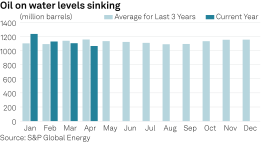
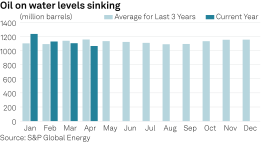
Oil-on-water levels, a barometer for tanker requirements, have sunk. In April, they were 1.07 billion barrels, down from 1.24 billion barrels in January and against a three-year average of 1.16 billion barrels, data from S&P Global Commodities at Sea showed.
Dirty and clean tanker volumes have fallen 13% in the 10 weeks since the war in the Middle East began, compared with the prior 10-week period and year-earlier levels, shipping association BIMCO said May 28. Year-to-date, volumes in both markets are 5% lower than in 2025, equating to declines of 340 million barrels for dirty tankers and 147 million barrels for clean tankers, according to BIMCO.
“Some of this disruption has been offset by alternative flows, including increased Red Sea exports as Saudi barrels move west to Yanbu, draws from inventories and the release of Russian barrels that have accumulated on the water,” Lois Zabrocky, CEO of tanker firm International Seaways, said May 7, while presenting the company’s first-quarter results.
“These sources have not fully replaced the volumes typically moving through the [strait]. In the near term, the market is benefiting as it works to adjust to this dislocation,” she said.
Freight rates rose following the start of the war on Feb. 28, with rates still higher than prewar levels. The Platts VLCC index for non-scrubber-fitted, non-eco vessels was $278,717/day on May 26, above an average of $75,881/day since the index launched in March 2024.
After an initial spike, it has remained in a holding pattern.
Energy security
As disruptions through the Strait of Hormuz persist for an extended period, they could have broader implications for global energy markets until a resolution is reached, Zabrocky said.
On the bullish side, the inefficiencies in trade lanes that the conflict has yielded could prove sticky, due to concerns about energy security, Lars H. Barstad, CEO of crude tanker firm Frontline, said May 22, presenting Q1 results.
“We will see a higher focus on energy supply security going forward,” Barstad said.
The conflict has triggered the largest supply disruption in the history of the global oil market, with shipping through the Strait of Hormuz, which normally carries around 20% of global oil consumption, reduced to a trickle, the International Energy Agency said March 20.
The world is approaching the “red zone” for oil supplies by July or August amid ongoing shipping disruptions through the Strait of Hormuz and rapid drawdowns of global inventories, Fatih Birol, executive director of the IEA, said May 21.
Demand outlook
The chief downward driver of the outlook for tanker markets remains a significant global oversupply of tonnage relative to cargo demand, analysts at S&P Global CERA said May 17.
In the Americas, while Aframaxes may have found a temporary floor, VLCCs could face continued rate declines into June due to persistent length, according to the analysts.
“The West of Suez market relies heavily on the continued exodus of ballasting ships to the Americas to eventually tighten European lists and halt further erosion,” the analysts said.
East of Suez, markets remain highly unpredictable, according to the analysts.
If transits through the Strait of Hormuz remain disturbed throughout 2026 and 2027, BIMCO’s alternative scenario forecasts that crude tanker demand could contract by 11% to 13% in 2026 and a further 8.5% to 10.5% in 2027.
“The longer the strait remains closed, the closer market expectations will move to this scenario,” BIMCO said.
Under BIMCO’s base-case scenario, which assumes the strait reopens before the end of June, crude tanker demand is expected to contract by 4% to 6% in 2026 before rebounding 6.5% to 8.5% in 2027.
“Even if the Strait of Hormuz reopens within the second quarter, the overall supply/demand balance may weaken in 2026 in both markets,” BIMCO said. “In 2027, the crude tanker market could see an improvement, but the product tanker market could weaken further.”
Fleet supply growth is projected at 0% to minus 1% for crude tankers in 2026 and 5% to 6% in 2027, while product tanker capacity is anticipated to expand 4.5% to 5.5% and 7% to 8% over the same periods, BIMCO said.