
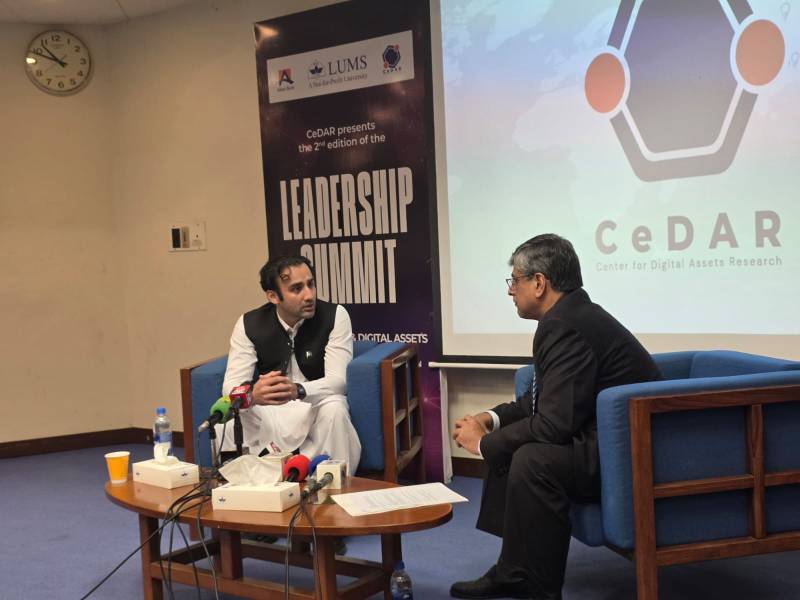
LAHORE: Pakistan is developing a regulatory framework for digital assets as usage of blockchain-based technologies expands rapidly across the country, Minister of State and Chairman PVARA Bilal Bin Saqib said on the opening day of a leadership summit on digital finance.
Speaking at the Leadership Summit on Blockchain and Digital Assets held at Lahore University of Management Sciences (LUMS) and hosted by the LUMS Centre for Digital Assets Research (CeDAR), he said the government was working to formalise a rapidly growing sector that already involves millions of users operating outside regulatory oversight.
He noted that approximately 40 million Pakistanis were engaged in digital asset-related activity, largely through informal platforms, creating both financial inclusion opportunities and regulatory challenges.
Bilal Bin Saqib said the objective of ongoing policy work was to transition users into a formal financial framework while ensuring consumer protection and enabling innovation.
He stressed that regulatory development must keep pace with technological adoption, stating that timely action was critical in managing risks associated with unregulated markets.
Highlighting macroeconomic implications, he pointed to Pakistan’s annual remittance inflows of around $38 billion and said blockchain-based systems could improve efficiency in cross-border settlements. He also noted the growing freelance economy, stating that regulatory clarity could enhance competitiveness in global digital markets.
He said Pakistan had moved to establish a regulatory approach for digital assets within a relatively short timeframe, describing it as a result of institutional coordination and policy direction. The framework, he added, would adopt a risk-mitigated model, including sandbox environments for controlled testing of emerging technologies.
Bilal Bin Saqib identified asset-backed tokenisation as an early focus area, stating that it could broaden access to investment opportunities by enabling fractional participation in sectors such as real estate and financial instruments. He cautioned that delays in regulation could increase exposure to unregulated systems, given the scale of existing adoption.
He added that Pakistan now had an opportunity to contribute to global digital finance policy discussions rather than solely adopting external frameworks. Calling for cross-sector collaboration, he urged banks, technology firms, academia, and regulators to work together to build capacity and develop skilled human resources for the sector.
The summit will continue with sessions on artificial intelligence, blockchain integration, and the future of regulated digital finance.