
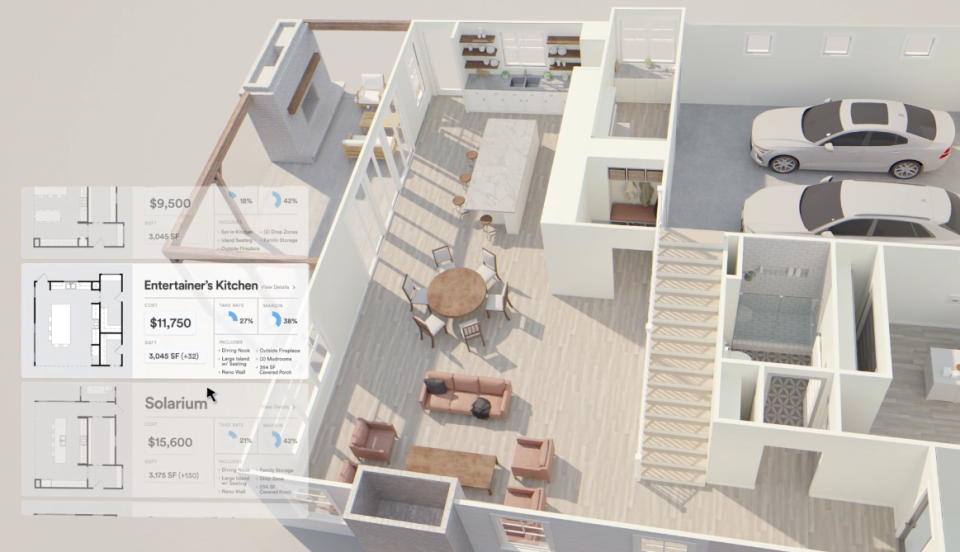
Homebuilding artificial intelligence startup Higharc said today it has raised $95 million in a new round of funding to transform the way construction projects are planned and run.
Today’s Series C round was led by Insight Partners, and saw participation from a host of other venture capital firms, including Wellington Management, Fifth Wall, Spark Capital, Lux Capital and SE Ventures, the investment arm of Schneider Electric SE.
Higharc says it’s trying to use AI algorithms to bring order to the chaotic process of homebuilding, which requires tons of organization and planning before the first foundation trench is even dug. Architects have to produce designs, engineers have to check them against local codes, and then estimators pore over those plans to count each piece of two-by-four, drywall and all of the window frames and everything else that goes into it. There are permits and utility connections to consider.
The entire process typically takes up to a year before actual construction work begins, and even then, much of the planning goes out of the window, with cost overruns being so common that most developers budget for them. It’s this organizational mess that Higharc is trying to rein in with its specialized AI models, which are designed to automate complex workflows across building design, 3D modeling, estimating costs, sales and construction documentation.
Co-founder and Chief Executive Marc Minor said the company wants to do more than just assist homebuilders. “It’s about reshaping how builders work, cutting time and cost per job while giving buyers a more personalized experience,” he said. “The builders and distributors leading the way use AI to automate their most complex workflows, unlocking teams to focus on product improvement and customer experience.”
Spatial AI
Minor says there’s a big opportunity in construction, because standard AI systems simply aren’t sophisticated enough. Tools such as Anthropic PBC’s Claude and OpenAI Group PBC’s ChatGPT are designed to process and generate text, but buildings are spatial environments, with walls, windows, fixtures and structural elements that all tie into one another across three dimensions. Large language models don’t have enough understanding of this to generate accurate floor plans.
Higharc’s solution is “spatial AI,” which is a category of AI models distinct from LLMs that have been trained to understand physical spaces and their intricate dynamics. The startup has trained its models exclusively on thousands of residential architectural drawings, similar to how autonomous vehicles are trained from video footage of real cars driving on roads.
Just as a self-driving car can distinguish between a road sign and a pedestrian, Higharc’s models can identify everything one might find in a home, such as a structural wall, a window bay, a load-bearing column and even the kitchen sink. By understanding all of these components, it can ingest architectural drawings to construct a machine-readable model of an entire home.
These models are dynamic, baking in local building codes and construction standards, so any change to a floor plan will automatically be reflected in the AI-generated cost estimate and the documentation. Traditionally, these things would all have to be updated separately.
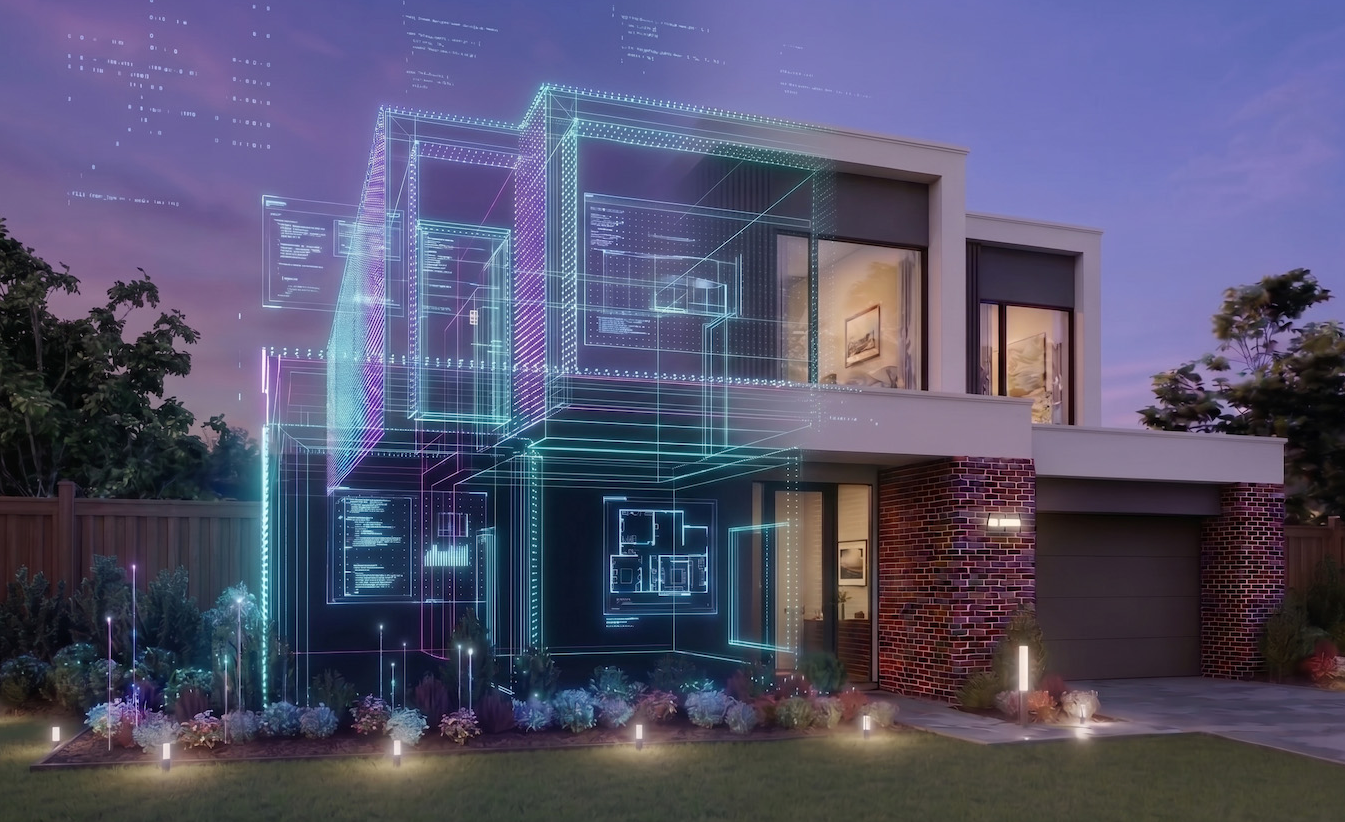
The startup uses a multimodel validation architecture to prevent hallucinations from occurring. So instead of relying on a single model to avoid mistakes, it uses layered models that continuously cross-check inputs and outputs and flag any discrepancies that show up.
Human experts remain in the loop to validate everything, ensuring all of the AI-generated plans can be relied upon. That’s important, because if something like a cost estimate comes up short, or if the wrong materials are ordered, it could stall work on the job site for days or even weeks.
“We evaluated a lot of AI tools, but most produce outputs that require so much correction they’re unusable,” said Kyle Bear, vice president of research and development at Higharc customer Signature Homes LLC. “Higharc is different. It’s grounded in how homes are actually built, so the outputs are usable from day one. [It] helps us move faster and operate with more precision and fewer downstream surprises.”
Supply chain pivot
To date, Higharc has focused on homebuilders only, but alongside the funding it announced a significant pivot, saying it’s extending its floor plan intelligence technology into the materials supply chain. It’s partnering with US LBM, which is the largest privately owned building materials distributor in the U.S., to automate pricing estimates for homebuilding projects.
US LBM Chief Digital and Technology Officer Jonathan Greene said the typical process for estimating costs is laborious and unreliable. When a builder provides a floor plan to a materials distributor, someone needs to sift through those blueprints and produce what’s known as a “takeoff,” namely a detailed count of every stud, nail, joist, beam, drywall sheet, door frame, door handle and everything else that goes into the finished home. It’s a slow and error-strewn process that leads to overruns, wasted materials being ordered but never used, and costly delays.
Higharc’s new AutoTranslate AI is meant to streamline the entire process. It can ingest a flat 2D floor plan and transform it into a 3D spatial model. Based on that, it will then generate a precise material takeoff that’s aligned with products in US LBM’s catalog, so homebuilders can see a more accurate price estimate.
“What sets Higharc apart is the ability to go from a static 2D plan to a precise and dynamic 3D data model in one step,” Greene said. “That unlocks not just fast, accurate quoting, but smarter material planning, the ability to sell the whole home and real-time collaboration with our customers.”
Higharc will use the funds from today’s round to expand its AI product development, develop more specialized models and expand into broader segments of the homebuilding industry. “Everything we’re building is in service of one outcome: to make homebuilding seamless so builders can build better homes more affordably,” Minor said. “This next phase is about scaling that impact by deepening our AI capabilities and bringing suppliers onto the same trusted system builders already rely on.”
Images: Higharc
Support our mission to keep content open and free by engaging with theCUBE community. Join theCUBE’s Alumni Trust Network, where technology leaders connect, share intelligence and create opportunities.
- 15M+ viewers of theCUBE videos, powering conversations across AI, cloud, cybersecurity and more
- 11.4k+ theCUBE alumni — Connect with more than 11,400 tech and business leaders shaping the future through a unique trusted-based network.
About SiliconANGLE Media
Founded by tech visionaries John Furrier and Dave Vellante, SiliconANGLE Media has built a dynamic ecosystem of industry-leading digital media brands that reach 15+ million elite tech professionals. Our new proprietary theCUBE AI Video Cloud is breaking ground in audience interaction, leveraging theCUBEai.com neural network to help technology companies make data-driven decisions and stay at the forefront of industry conversations.