

Ethena’s USDe holds its dollar peg with a hedged futures position rather than cash reserves, the structural reason the GENIUS Act yield ban does not apply to it.
US Congress
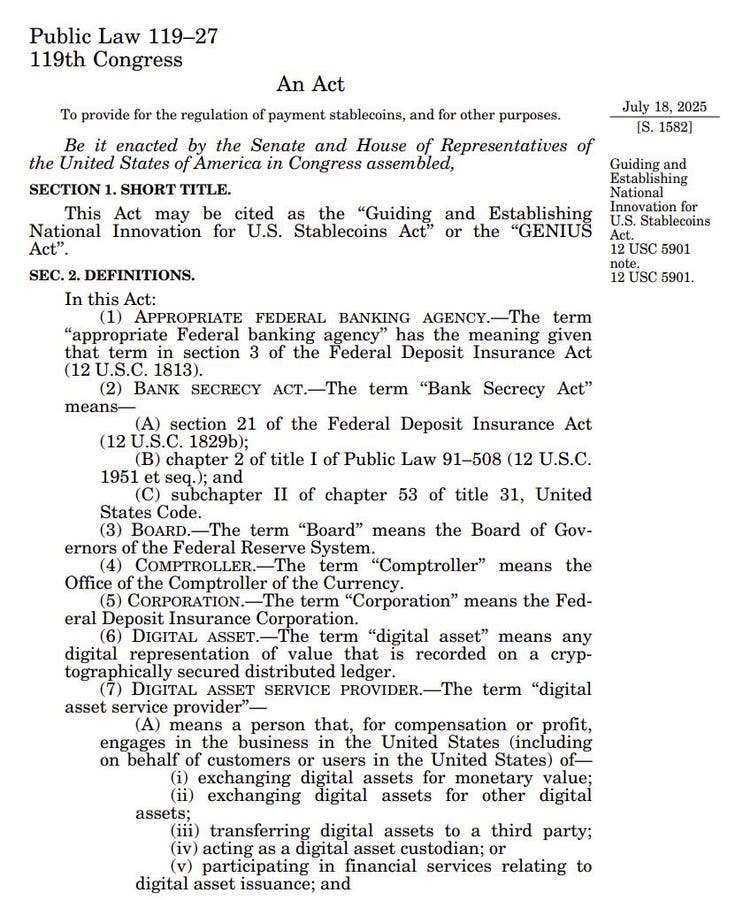
When Congress wrote the GENIUS Act, it drew one bright line for stablecoins: a permitted payment stablecoin issuer cannot pay holders “any form of interest or yield.” That clause, Section 4(a)(11), is what forced Circle and Coinbase to rebuild how USDC holders earn. It is also the clause that the fastest-growing yield-bearing dollar in crypto steps around completely.
Ethena’s USDe does not hold cash and Treasuries. It is a delta-neutral synthetic dollar: the protocol takes crypto collateral and opens an offsetting short in perpetual futures, so the dollar value stays roughly flat while the position earns. Stake USDe as sUSDe and you collect that return. Because the backing is a hedged derivatives trade rather than fiat reserves, USDe does not meet the statutory definition of a payment stablecoin, and the prohibition that reshaped USDC never touches it. The result is a regulatory gap with billions of dollars sitting in it, growing, while the policy conversation stays fixed on the coins that play by the new rules.
A synthetic dollar that grew into the top three
This is not a fringe instrument. USDe’s supply peaked above $14 billion in 2025, capturing around 5% of the entire stablecoin market, and by that September CoinDesk was already calling it the third-largest dollar-denominated crypto asset. After an October 2025 deleveraging the supply contracted to around $5.9 billion, where it sits in 2026. Even at the reduced size, it is the only stablecoin outside the fiat-backed category anywhere near the top of the table. Every other dollar of that scale is a reserve coin holding cash and government paper. USDe is a trading strategy that happens to print a token, and in January 2026 it added Kraken as a custody partner with weekly proof-of-reserves reporting to firm up the part of its credibility that a basis trade cannot supply on its own.
Where the yield actually comes from
The return is a cash-and-carry basis trade, the oldest structure in derivatives. When perpetual funding rates are positive, holders of long positions pay shorts, and USDe’s hedged short collects that flow on top of the staking yield earned by its collateral. Ethena describes the revenue as the funding and basis spread from the delta-hedging derivatives; CoinDesk puts it more plainly, that USDe generates yield by harvesting funding rates. In early 2026 the staked token paid in the neighborhood of 4% annualized. That is the legal core of the whole design. No issuer is paying interest on reserves, which is the thing GENIUS forbids. A strategy is generating a return, and a token is passing it through, which is a thing GENIUS never addressed. The distinction sounds technical. It is the entire difference between a regulated product and an unregulated one.
The definition the Act did not stretch
GENIUS regulates payment stablecoins, requires one-to-one fiat or Treasury reserves, and mandates monthly disclosures. USDe satisfies none of that and does not try to. Ethena’s answer to the US market is a second, separate product: USDtb, a fiat-backed coin issued with Anchorage Digital and built to be GENIUS-compliant, backed largely by BlackRock’s tokenized money-market fund. So the company runs two dollars at once: a compliant payment coin that pays no yield, and a synthetic dollar that does. The OCC has noticed the gap. Its March 2026 proposal would extend the yield ban to affiliates and third parties under a rebuttable presumption, the rule that threatens the Coinbase-style distribution deal funding USDC rewards. Even that draft, though, aims at issuers paying yield through a side door. It does not obviously capture an instrument that pays no issuer yield at all, because the return comes from a market, not a balance sheet. To close the gap properly, a regulator would have to define and police synthetic dollars as their own category, and nobody in Washington has written that rule.
The risk the funding trade carries
The model has a real failure mode, and it is worth stating plainly before USDe scales again. The strategy depends on funding staying positive over time. Ethena’s own data shows that across three years, 17.5% of days carried negative summed funding for ether positions, with the longest negative stretch running 13 days against a longest positive stretch of 176; a reserve fund absorbs the negative periods so stakers are not charged. The danger is a sustained negative-funding window landing at the same moment as a leveraged unwind across DeFi. That is roughly what tested it on October 10, 2025, when USDe briefly slipped to $0.97 in a market-wide flash crash before recovering within hours. A reserve stablecoin breaks when its custodian or its bank breaks. A synthetic dollar breaks when a crowded trade unwinds, a different and less visible kind of risk, and one that arrives without anyone doing anything wrong.
Europe said no, and US institutions said yes
Regulators are not converging on this. Germany’s BaFin forced Ethena to wind down its local entity and prohibited public sales of USDe, alleging it was selling unregistered securities and could not satisfy MiCA’s reserve rules. Ethena became the third stablecoin issuer pushed out of the EU. US institutional money has moved the opposite way. In June 2026, Janus Henderson, with roughly $480 billion under management, partnered with Ethena to use USDe for treasury cash management and to fold its tokenized AAA credit product into USDe’s reserves, with regulated exchange-traded products planned for the second half of the year. One major market is treating the synthetic dollar as an unregistered security; another is wiring it into the plumbing of a half-trillion-dollar asset manager. Both cannot be right for long.
The counter-case for a basis-trade dollar
The strongest version of the bull case is that USDe has earned its size. It has held its peg through multiple cycles, its collateral is overcollateralized and externally attested, and the yield it pays is real money from a real market rather than an issuer subsidy that has to end. Demand for a dollar that yields will not disappear because Congress wishes it would, and pushing that demand offshore or off-label does not make it safer. The problem is not that USDe is a fraud. It is that it is sold next to instruments it does not resemble, under a category name, “stablecoin,” that the law has now defined to mean something else. A holder who treats USDe and USDC as interchangeable is pricing a derivatives position as if it were a checking account. The GENIUS Act, by regulating only one of the two and leaving the other unlabeled, quietly underwrites that confusion rather than clearing it up.
The GENIUS Act settled what a payment stablecoin is and what it cannot do. It did not address the instruments that decline the label. USDe is the largest of them, and the open question for US regulators is whether the next rule draws a perimeter around synthetic dollars, or whether yield simply keeps migrating to whatever sits just outside the one they already drew.